Union presses Sacramento to reach conclusion on Railyards protest
The local hospitality workers’ union — locked in a battle over affordable housing requirements for the Railyards — on Thursday accused the city of dragging its feet in counting protests lodged by a group of the district’s residents.
Aamir Deen, president of Unite Here Local 49, said during a news conference Thursday that “a clear majority” of residents had filed protests — enough to put the city’s financing agreement for the project on hold for a year. By the union’s interpretation of state law, the city was required to determine that during a committee hearing last week.
“I don’t know what their game is,” Deen said. “They’ve had a week.”
But elected officials say that this process is brand new, established by the state Legislature just a handful of years earlier and untested until now. The city is in the process of confirming protesters’ residency in the Railyards, in apartment buildings that only opened in the past year.
“There’s just so much uncertainty,” said City Councilmember Phil Pluckebaum. “We’re trying to just figure it all out as we go… Being first in these kinds of situations is perilous.”
The City Council in June approved a deal to expand a special tax district in the Railyards — a largely empty, 220-acre infill area adjacent to downtown — essentially agreeing to use expected increases in property taxes to repay developers for the costs of infrastructure, like roads, sidewalks and water and sewer connections. Developers plan to build a 12,000-seat soccer stadium, retail and other entertainment in the area, which has remained mostly vacant since railroad operators pulled out in the 1990s.
But at a small subcommittee hearing last week, where a final, procedural vote was to be taken to cement the council’s earlier decision, the project hit a snag.
The union, Unite Here Local 49, had identified a piece of state statute that allows residents to protest special taxing districts. They canvassed residents of the two apartment complexes that have opened in the Railyards over the past year — The Wong Center and The A.J. — and the residents ultimately filed 135 written protests against the taxing district.
The union and the residents have argued that the city must renegotiate its deal with the developers to require more affordable housing. The union and its allies have suggested that the city, which is behind on its goals for affordable housing development, should require that about 20% of the housing in the district be affordable. The developers have said that 500 of the first 6,000 units would be affordable, or about 8%.
The union has also called for neutrality agreements for the planned soccer stadium and any hotels that might be built in the district. The language would require employers to voluntarily recognize a union if the majority of workers sign union cards, rather than requiring organizers to hold an election overseen by the National Labor Relations Board.
At the meeting, an attorney for the city said that based on a preliminary tally, more than 25% of Railyards residents had lodged protests — enough to require an election on the issue among the district’s residents and landowners. But it was unclear if the numbers had surpassed 50%, which would effectively stop proceedings for the special taxing district for a year.
Since the meeting, the city has been attempting to confirm residents’ names and addresses to verify the protests, and to determine how many people live in the Railyards in total.
City spokesperson Jennifer Singer said in an email that the committee overseeing the taxing district is following the law and working as quickly as possible. Verification, she said, takes time. The committee must confirm that each protest comes from a resident who is an adult and lived within the boundaries of the district as of the day of the meeting.
A resident’s ability to lodge a protest against the special taxing district is not based on voter registration, but on residency. So the city, Singer said, essentially has to create a list of residents based on information from the property owners, and is in contact with The Wong Center and The A.J. to do so.
Experts said this is likely the first time this bit of statute has been used. It was part of a bill passed in 2019.
Residents from the apartment complexes in the Railyards have said they feel an urgent need to push for more affordable housing. Some have experienced homelessness. Some have said that while they have now managed to secure affordable housing, others aren’t so fortunate.
Nancy Williams, a 67-year-old resident of The A.J., said she wishes her friends had access to the type of housing she now has.
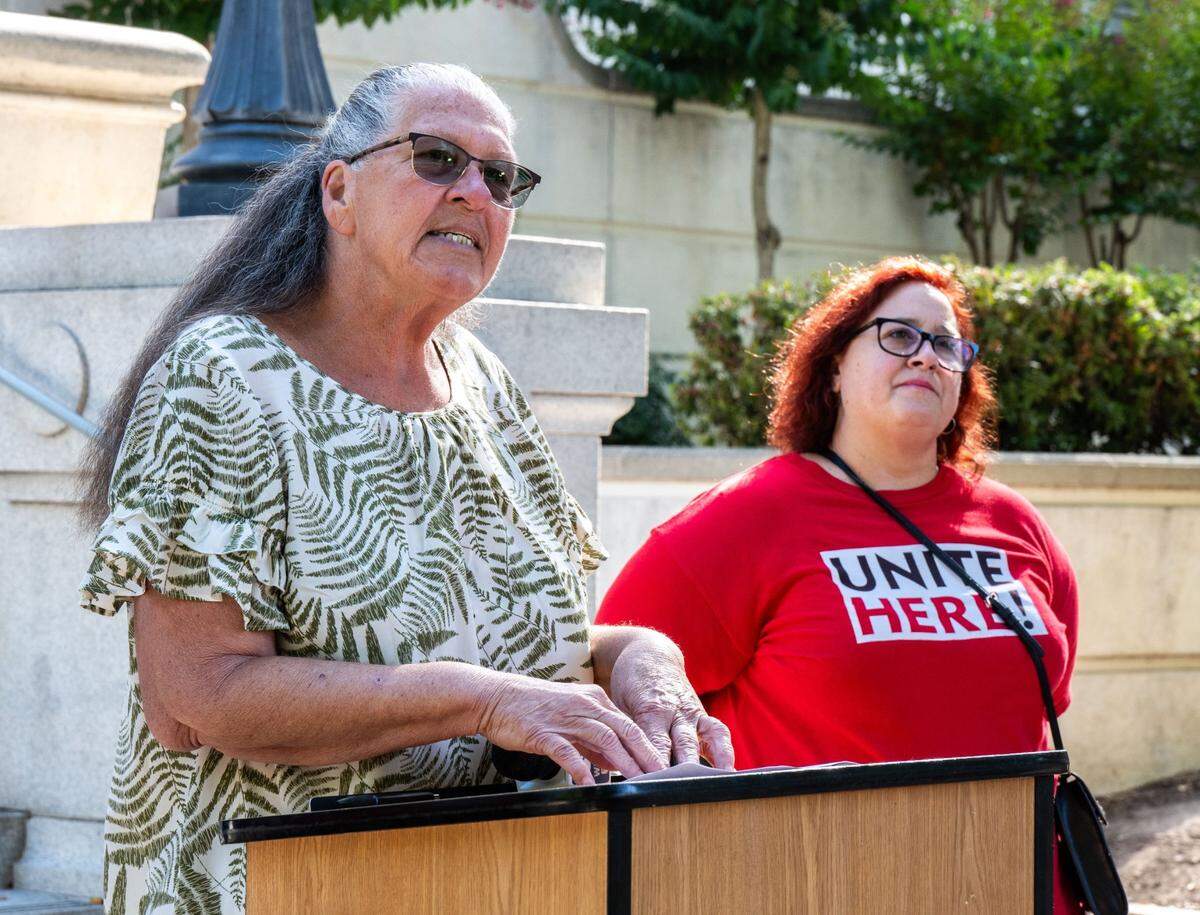
“There’s just not enough,” she said. “There’s too many of us on the streets, walking around, living with family members.”
Williams said that when her children were growing up, her family spent years on waitlists for affordable housing.
“I don’t know the quote about, ‘When you’ve made it, you reach back?’” she said. “That’s what I’m trying to do… It’s been a long fight, and it’ll be longer.”
Pluckebaum noted in a radio interview last week that Unite Here Local 49 has been attempting to organize workers at the Sky River Casino in Elk Grove. The casino is operated by the Wilton Rancheria tribe, which owns Sacramento Republic FC, the team planning to build a soccer stadium in the Railyards.
Deen, the union president, said the guild’s efforts with the casino are unrelated to the Railyards protest.
“It’s a distraction. We’re organizing many different places,” Deen said. “This is about the Railyards. This is about housing.”
Still, proponents of the special taxing district argue that the Railyards will sit vacant without public support.
“The reason that the Railyards have been vacant for so long is that you need some kind of incentive to develop the roads, the city infrastructure,” said Todd Dunivant, president and general manager of Sacramento Republic FC. “For development to happen, for the stadium to happen, we need roads, we need sewers and all those things, and this is a key tool to do that.”
Dunivant said that the team is committed to building the stadium, and wants to locate it in the Railyards — both for the site’s proximity to downtown and the city’s public transit network, and to boost the region.
“Ultimately, maybe even against our own economic interests, we want to have this stadium in the Railyards,” Dunivant said.
As to whether Sacramento is in peril of losing the soccer stadium to another site in the region, Dunivant said, “there’s always risk.”
“We’re going to keep figuring out how to make this work,” he continued. “We’re going to keep pushing ahead.”
Downtown Railyard Ventures, which owns much of the real estate in the district, declined to comment.
If the protests amount to a majority, said Pluckebaum, the councilmember, the city will have to figure out how to “backfill” the next year.
“If we have to have an election, I think I can convince 400 people,” he said, referencing the residents of the two apartment complexes in the Railyards.
Regardless, Pluckebaum said, adding costs and delays to projects is counterproductive.
“One thing’s for damn sure,” he said. “This will not result in more affordable housing.”