
Yuba City affordable housing project breaks ground after nearly breaking apart
AI-generated summary reviewed by our newsroom.
- Groundbreaking begins on $75M Merriment Village, 218 low-income units planned
- City seeks up to $48M from state Homekey+ to fast-track phase two construction
- Habitat secures Five Star Bank credit line after $7.5M funding gap threatens project
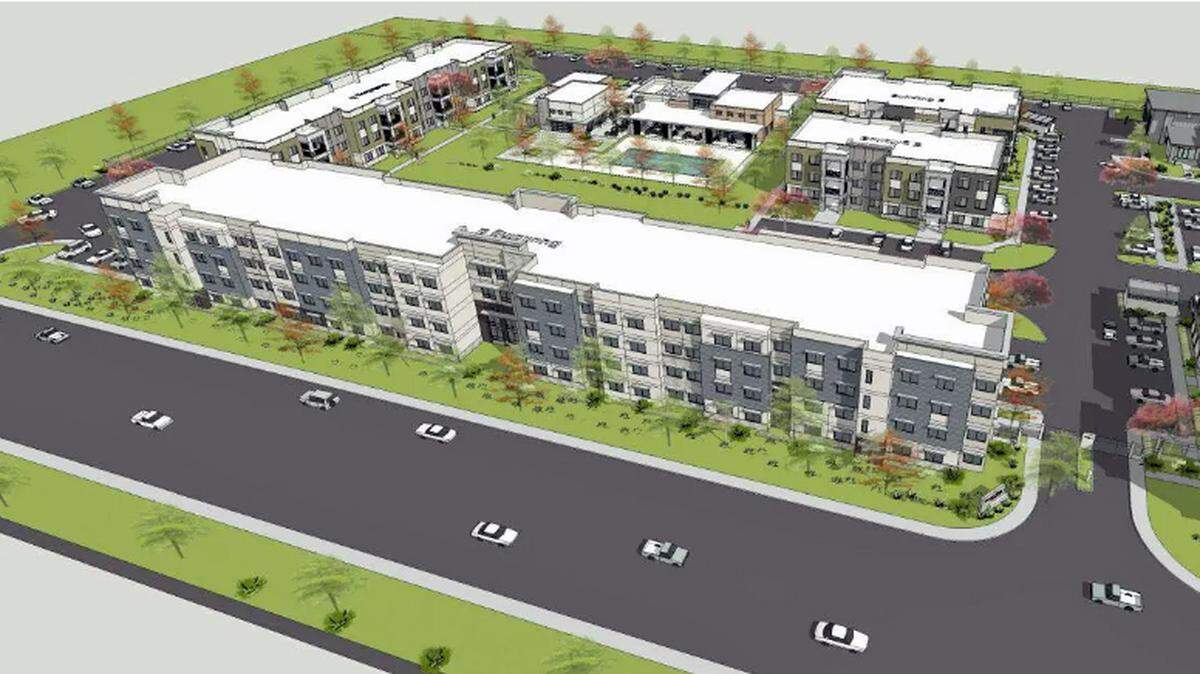
A muddy grass lot across from a chiropractor’s office and falafel shop in Yuba City may eventually house more than 200 people and families as construction begins on a long-planned affordable housing complex.
The roughly $75 million project, totaling 218 low-income units and spearheaded by Habitat for Humanity Yuba-Sutter and Yuba City, regained momentum after nearly capsizing amid a $7.5 million budget shortfall earlier this year.
Despite uncertainty months ago, ground broke this week at the Walton Avenue lot for Merriment Village Apartments, whose first phase of construction includes a four-story, 79-unit building.
To support the larger second phase of the project, which includes multiple buildings on the same lot housing 139 units and support services, Yuba City council members voted last week to submit another grant application to the California Department of Housing and Community Development. The city is eligible for up to $48 million through that application, but city officials have said they do not expect to receive that full amount if awarded.
“If we can bring tax dollars back to our community, our tax dollars to our community, through important, vital projects like this, that’s just a home run,” Yuba City Councilmember Marc Boomgaarden said at the groundbreaking.
The additional state funding could fast-track the second phase of construction and potentially enable contractors to build both phases of the project concurrently on the nearly 7.5-acre property.
The state agency contacted the local Habitat for Humanity to apply for additional funding through the state’s Homekey+ program, according to city officials, who expect to know whether they will receive more state funding within a few months.
The sight of exposed dirt and hard hats marked a far-cry from the dire straits felt earlier this year. Then the city’s shallow pockets, although bolstered by more than $24 million of state housing funds already in hand, ran into a call from Habitat for Humanity for more than $7 million of credit on which the project depended.
“We couldn’t go to our constituents and say, ‘We’ve got a budget deficit but then we’re gonna give away $7 million,’” said Yuba City Mayor Dave Shaw. “We just needed a common sense solution, and we’re there.”
A $7 million solution
Plans for Merriment Village Apartments date back to early 2022 and became official in the summer of 2024. By that point, city officials were already sweating the strict construction timeline tied to their state financing.
The time crunch intensified and was met with a nearly-prohibitive financial hurdle when Joseph Hale, CEO of Habitat for Humanity Yuba-Sutter, approached the city in March for a roughly $7.5 million line of credit to cover a deficit of more than $7 million between secured funding and construction bids.
“For us and our budget, we didn’t have $7 million — we don’t have $1 million,” Shaw said. “We had to do this without it being on the backs of the taxpayers, the residents.”
City officials declined the request and put the onus on the local nonprofit to cover the gap. To avoid scrapping the project and returning more than $24 million to the state, council members at the time discussed either scaling back the project or seeking more funding from the state housing agency.
“(Housing and Community Development) wanted to see the project go as well,” Shaw said. “They didn’t want us to return the money back to them.”
The state granted extensions on its construction milestones, and Habitat for Humanity eventually found its solution by way of a line of credit from Five Star Bank in Yuba City.
“It’s a great deal for everybody,” said James Beckwith, President and CEO of Five Star Bank.
For veterans, too
The local nonprofit was able to hold its other properties as collateral to secure the line of credit, about half of which is for contingencies Habitat for Humanity doesn’t anticipate but is required to cover, Hale said.
“I always felt that we had enough to complete the project, but you have to be able to provide those assurances,” Hale said. “I think we were able through this credit line to provide the backup the city felt comfortable with to be able to go forward with the project.”
The 79 two-bedroom units being constructed first are for qualifying families, Hale said. Officials have said that at least 70 units of the project’s second phase are intended for veterans waiting for low-income housing.
Hale said that the local Habitat for Humanity has about 1,000 people and families experiencing some form of homelessness on its waiting list.