
Money Research Collective’s editorial team solely created this content. Opinions are their own, but compensation and in-depth research determine where and how companies may appear. Many featured companies advertise with us. How we make money.
This Social Security Bill Could Boost Your Retirement Checks — if It Can Pass Congress
By Adam Hardy MONEY RESEARCH COLLECTIVE
The Social Security 2100 Act seeks change how the program’s cost-of-living adjustments (COLAs) work by incorporating an inflation measure called the CPI-E.

A new bill seeks to reform Social Security by raising payroll taxes on high-income earners and changing how the program’s cost-of-living adjustments (COLAs) work.
Sen. Richard Blumenthal, D-Conn., recently introduced the Social Security 2100 Act to increase Social Security benefits for some and put the flagging program on sounder financial footing. Meanwhile, Rep. John Larson, D-Conn., introduced the bill in the U.S. House of Representatives.
Must Read
- 10 Smart Ways Seniors Are Earning Extra Money
- Why You're Getting So Many Spam Calls and How to Make Them Stop in 2026
- Your Money Is Losing Value Right Now. Start Earning More on Your Cash Today
- Silver Is Up 70% Since This Time Last Year — and These Gold IRA Companies are Handing Out Up to $25,000 of It
“Social Security 2100 will protect Americans’ hard-earned benefits from cuts and enhance the program to keep pace with rising costs, by finally making the wealthy pay their fair share,” Larson said in a news release.
For over a decade, Larson has attempted to reform Social Security, introducing a similar proposal six times in the House. Chief among the changes he has proposed is a new way to calculate Social Security’s annual COLA, which seeks to protect benefits from inflation.
Social Security advocates have long argued that the current COLA process does not adequately reflect the costs that are facing retirees and disabled Americans. According to the advocacy group The Senior Citizens League (TSCL), Social Security benefits have lost nearly 14% of their buying power since 2016.
“The bill is the gold standard for Social Security reform and accomplishes the majority of changes older Americans want to see for the program,” TSCL Executive Director Shannon Benton said in a statement.
The proposal comes as Social Security is nearing insolvency. If Congress does not act to shore up the program’s finances by 2034, benefits would automatically fall by 17% across the board.
How the Social Security 2100 Act would change COLA
Social Security benefits are recalculated each year in October based on recent inflation trends. To do this, the Social Security Administration uses a separate inflation gauge from the headline number that most people are accustomed to.
Where People Are Buying Gold Right Now
- American Hartford Gold – Get a free investor kit, plus see if you qualify for $25,000 in free silver
- American Silver & Gold – Free account set up, free insured shipping and free storage for up to 5 years
- Explore gold exposure with a gold ETF — Public's investing app can do this for you
The metric Social Security relies on is currently the CPI-W, an index aimed at tracking costs for urban clerical workers. A critique of this method is that the majority of Social Security’s 75 million beneficiaries are retirees or disabled workers, and so they need an inflation index that tracks costs for them — not clerical workers.
Enter CPI-E: an inflation gauge designed for Americans 62 and older.
The Social Security 2100 Act directs the Department of Labor to publish the CPI-E alongside its core inflation metrics so that it can be implemented into the new COLA. Already, the department calculates the CPI-E each month, though it is currently in a research phase.
The key difference between the CPI-E and CPI-W is that the former weighs expenses for housing, medical care and recreation higher than the latter, something advocates say better reflects what older Americans spend their money on each month.
The Social Security 2100 Act proposes officially introducing the CPI-E but not completely getting rid of the old method. Instead, the government would use both CPI-W and CPI-E for COLA calculations and go with whichever inflation number is higher.
While this theoretically could result in higher COLA each year, the reality is that the two measures don’t differ all that much, according to a Money analysis of inflation data. Comparing the first six months of 2026, Money found that the annual inflation rates varied by half a percentage point or less each month.
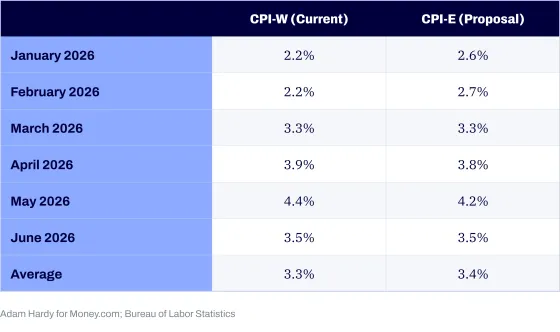
While the proposal is a step in the right direction, according to The Senior Citizens League, introducing CPI-E doesn’t go far enough. The group says a minimum COLA of 3% each year is preferable because it ensures that Social Security benefits won’t continue to lose their buying power
In years where inflation is higher than that, the COLA ideally would defer to CPI-E or CPI-W, whichever is higher.
“Over time, switching the COLA calculation to a better inflation index would have a profound impact on seniors’ benefits and financial health,” the group said in a report.
For now, changes to the COLA appear to have taken a back seat. Social Security reform is currently laser-focused on improving the program’s finances before it reaches insolvency. Given that this bill includes several broader provisions that increase benefits and was introduced by Democrats in a Republican-controlled Congress, the proposal probably won’t pass.
According to the legislation-tracking site GovTrack, the chances of the Social Security 2100 Act becoming law are currently 0%.
Must Read
- 10 Smart Ways Seniors Are Earning Extra Money
- Why You're Getting So Many Spam Calls and How to Make Them Stop in 2026
- Your Money Is Losing Value Right Now. Start Earning More on Your Cash Today
- Silver Is Up 70% Since This Time Last Year — and These Gold IRA Companies are Handing Out Up to $25,000 of It
Adam Hardy is Money's lead data journalist. He writes news and feature stories aimed at helping everyday people manage their finances. He joined Money full-time in 2021 but has covered personal finance and economic topics since 2018. Previously, he worked for Forbes Advisor, The Penny Hoarder and Creative Loafing. In addition to those outlets, Adam’s work has been featured in a variety of local, national and international publications, including the Asia Times, Business Insider, Las Vegas Review-Journal, Yahoo! Finance, Nasdaq and several others. Adam graduated with a bachelor’s degree from the University of South Florida, where he studied magazine journalism and sociology. As a first-generation college graduate from a low-income, single-parent household, Adam understands firsthand the financial barriers that plague low-income Americans. His reporting aims to illuminate these issues. Since joining Money, Adam has already written over 500 articles, including a cover story on financial surveillance, a profile of Director Rohit Chopra of the Consumer Financial Protection Bureau and an investigation into flexible spending accounts, which found that workers forfeit billions of dollars annually through the workplace plans. He has also led data analysis on several of Money’s marquee rankings, including Best Hospitals, Best Credit Cards, Best Places to Live and others. In 2025, Adam was named a Goldschmidt Data Journalism Fellow by the Society for Advancing Business Editing and Writing (SABEW). As part of the fellowship, he received hands-on training from SABEW, the U.S. Census, U.S. Federal Reserve Bank, Bureau of Labor Statistics and other federal government agencies in Washington, D.C. Adam also holds a multimedia storytelling certificate from Poynter’s News University and a data journalism certificate from the Investigative Reporters and Editors at the University of Missouri. In 2017, he received an English teaching certification from the University of Cambridge, which he utilized during his time in Seoul, South Korea. There, he taught students of all ages, from 5 to 65, and worked with North Korean refugees who were resettling in the area. Now, Adam lives in St. Petersburg, Florida, with his pup Bambi. He is a card-carrying shuffleboard club member.