
Money Research Collective’s editorial team solely created this content. Opinions are their own, but compensation and in-depth research determine where and how companies may appear. Many featured companies advertise with us. How we make money.
How Much of The Average Vet Bill Does Pet Insurance Cover?
By Kat Tretina MONEY RESEARCH COLLECTIVE
Pet insurance can take the sting out of unexpected vet bills, covering up to 90% of eligible expenses after you meet the deductible.



When your pet is hurting, your priority is their well-being — not the vet bill that follows. But emergency veterinary care gets expensive fast, with costs that can easily climb into the thousands.
Pet insurance can help soften the financial blow.
Whether your pet has a broken leg, swallows something they shouldn’t or is diagnosed with a serious illness, insurance can significantly reduce what you pay out of pocket.
Here’s what to know.

What is the average vet bill in the U.S.?
The typical vet bill averaged about $400 in 2025, according to claims data from Healthy Paws Pet Insurance.
Emergency care, however, is far more expensive. Around-the-clock staffing and the specialized resources needed to treat urgent, life-threatening conditions make ER veterinary hospitals much costlier than a routine visit.
Pet insurance can help offset these costs by reimbursing you for all or a portion of emergency-related expenses, including diagnostic tests, hospitalizations, surgery, anesthesia and prescription medications.
In a recent survey by Money and Healthy Paws, more than half (54%) of insured pet owners said their insurance reimbursed at least half of a significant vet bill.
Common pet insurance claims for cats
Cats are usually less expensive to insure than dogs, and their treatments tend to be less expensive, too. However, vet visits can still be pricey.
According to the North American Pet Health Insurance Association (NAPHIA), some of the most common claims for cats include:
- Gastrointestinal issues
- Dental diseases
- Diabetes
- Skin conditions
- Arthritis
Common pet insurance claims for dogs
Emergency vet visits for dogs are often prompted by unexpected injuries, though hereditary and congenital conditions can also lead to costly treatment.
According to NAPHIA, the most common insurance claims for dogs are for the following health issues:
- Gastrointestinal issues and foreign object ingestion
- Ear infections
- Allergies
- Skin conditions
- Growths or masses
How much of the average vet bill does pet insurance cover?
How much your insurance policy will cover depends on several factors:
- Your reimbursement percentage: This percentage determines how much of your eligible veterinary expenses your insurer will reimburse. In general, you can choose a percentage between 50% and 90%.
- Your deductible: This is the amount you’ll pay out of pocket before your insurer starts reimbursing you. The most popular options hover between $250 and $500, but some plans go as low as $50 or as high as $1,000. Like other types of insurance, the higher the deductible, the lower the monthly premium.
- Annual or lifetime limits: Some insurers have annual or lifetime treatment limits. If your pet’s treatment exceeds that amount, you’re responsible for any additional costs.
- Treatment plan: Pet insurance only covers approved procedures performed by a licensed veterinarian. Experimental procedures and medications are typically excluded.
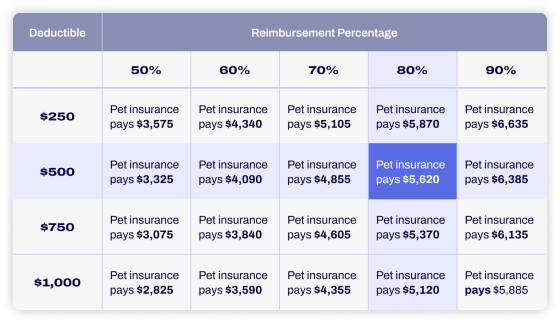
Consider this example: Your five-year-old German Shepherd needs a total hip replacement to treat hip dysplasia, and your vet estimates the procedure will cost $7,650. The table below shows how different reimbursement rates and deductible amounts affect your payout.
With an accident and illness policy with 80% reimbursement and a $500 deductible, you’d get back over $5,600.
That said, pet insurance isn’t a cure-all. While a policy can help with unexpected medical costs, it doesn’t cover pre-existing conditions or health issues diagnosed during the policy waiting period, so any care related to those problems won’t be reimbursed.
What reimbursement percentage and deductible should I choose?
Your selected reimbursement percentage and deductible play a big role in determining how much of your vet bills pet insurance will cover. Most insurers don’t allow you to change these terms unless you cancel and re-enroll, which can trigger new waiting periods and pre-existing condition exclusions.
Survey data from Money and Healthy Paws shows that about a third (32%) of insured pet owners select an 80% reimbursement rate, while more than half (52%) choose a deductible of $500 or less.
As you shop for a plan, ask yourself:
- How much can I afford each month? Review your monthly cash flow and determine how much you can comfortably afford to spend on insurance premiums.
- How much do I have in savings? Deductibles can range between $250 and $1,000. A higher deductible will give you a lower monthly premium, but you’ll have to cover more of the upfront treatment costs yourself. If you have savings set aside, that trade-off may be worth it.
- How likely is it that my pet will need treatment? Some dog and cat breeds, like French Bulldogs or Maine Coons, are prone to chronic health issues. If your pet’s breed or medical history puts them at higher risk, opting for a higher reimbursement rate plan can save you money in the long run.
Your pet paw-sitively needs Healthy Paws


More from Money:
What to Do If Your Pet Insurance Claim Is Denied
Most Pet Owners Spend Over $4,000 a Year. Here’s Where the Money Goes
Are Pet Wellness Plans Worth the Money? Here’s What the Data Shows
Kat Tretina is a personal finance writer and certified student loan counselor based in Orlando, Florida. Dedicated to helping people build a solid financial foundation, she has written about debt repayment, investing, and insurance—including pet, life and car insurance —for major publications. Her work has been published by The Huffington Post, Business Insider, Credit Karma, and more.