
American River in Sacramento still tainted with feces, despite new parkway bathrooms
Check out more our stories in the Tipping Point series. Click here.
• • •
Over the scorching hot Memorial Day weekend, hundreds of people headed to Tiscornia Beach near the confluence of the American and Sacramento rivers, one of the region’s most popular swimming areas.
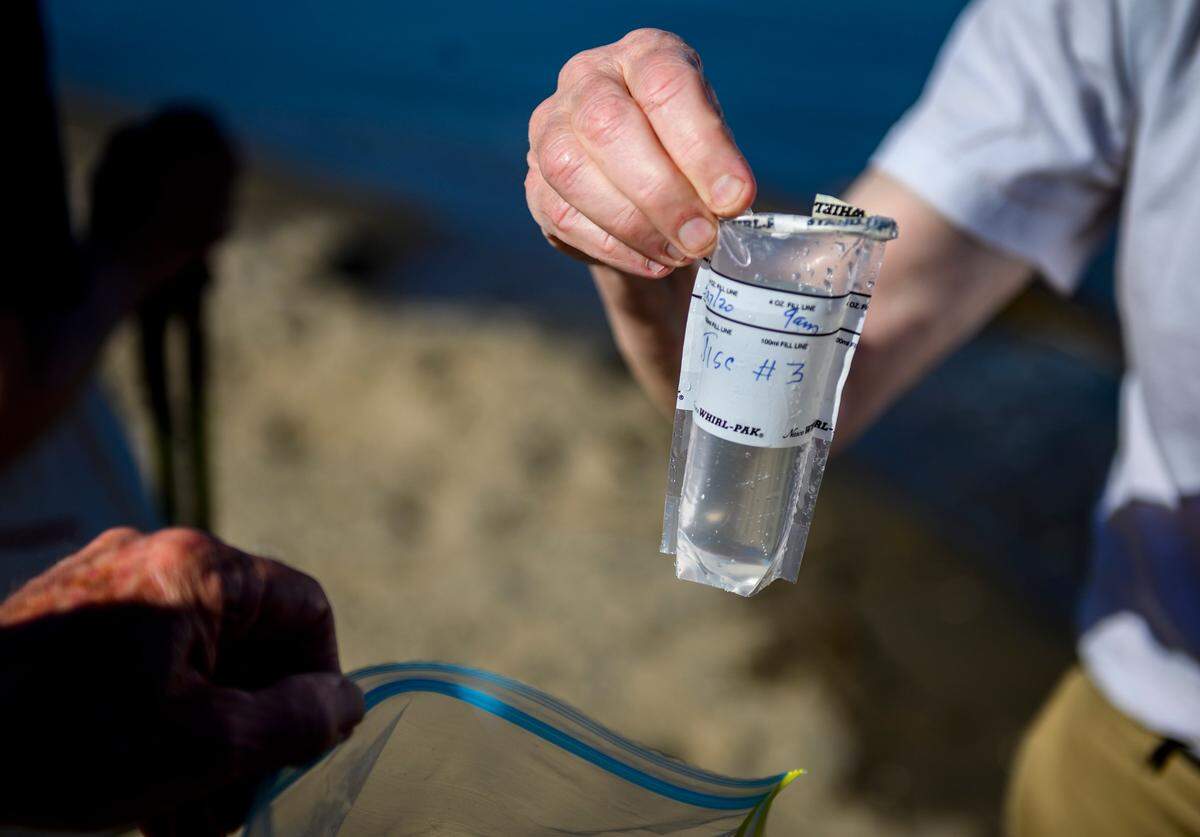
A few days earlier, state scientists had collected water samples with rates of E. coli bacteria that reached the highest limits of the testing equipment. The samples on May 12 and May 21 at Tiscornia Beach were at least seven times higher than state and federal standards for E. coli in a waterway.
It was a troubling sign that the alarming fecal contamination in the water along the Lower American River that’s plagued the stretch for years has not gone away — despite the COVID-19 crisis forcing local officials to do something they’d been reluctant to try in the past.
Homeless campers regularly defecate in and around the river at the large camps upstream from Tiscornia, but officials for years have fought the idea of setting out portable toilets for them, arguing that the homeless quickly vandalized them when they tried it before.
That changed this spring when the COVID-19 pandemic hit California.
To help prevent the spread of the new coronavirus among the vulnerable population, the county has so far placed 49 portable toilets and 56 handwashing stations near camps and places where homeless frequent.
A handful of the toilets are in and around the American River Parkway, where officials estimate anywhere from 200 to 300 homeless people regularly camp upstream from Tiscornia Beach.
Crystal Sanchez, president of the Sacramento Homeless Union, said there’s still not nearly enough bathrooms to serve all the parkway campers. Making matters worse, some of the nearby fast food restaurants where they used to go to relieve themselves are no longer opening their restrooms for them during the crisis, Sanchez said.
County officials also released 540 inmates from the main jail downtown in March, and advocates say it’s likely some of them may have gone to the river to camp.
Could all that translate into human feces causing the alarming E. coli spikes at Tiscornia earlier this month?
Officials have long been reluctant to point to the homeless as a source of the fecal bacteria. Instead, they’ve embarked on a three- to four-year study that will test the DNA of the bacteria to determine its exact source. The cost to taxpayers: $600,000 to $800,000.
Leaky sewage lines and other urban sources of feces could be contributing to the E. coli spikes, officials say. The DNA tests also could prove whether the E. coli stems from dogs and geese, whose feces also is found along the parkway.
For instance, dozens of Canada geese gather daily at Tiscornia Beach. A single goose can produce up to three pounds of feces per day, by some estimates.

COVID-19 pandemic delays testing
Because of the coronavirus pandemic, scientists with the Central Valley Regional Water Quality Control Board took almost two months off from sampling for E. coli along the Lower American River like they’d been doing since 2018.
They resumed limited sampling a couple of weeks ago, including the two Tiscornia samples that maxxed out their testing equipment.
Before taking a break from testing in March, the E. coli samples at Tiscornia exceeded state and federal standards every week since June 2019, state testing data show.
Those estimates determine when at least three out of every 100 swimmers would be expected to suffer ailments such as diarrhea from coming in contact with feces-fouled water. However, officials caution large spikes wouldn’t necessarily translate an increase in swimmers falling ill those days.
The samples also come with one other caveat. Officials are only looking for E. coli as an indicator of fecal contamination in the water. Not all E. coli cause potentially lethal symptoms such as bloody diarrhea, which would trigger a notification to county health officials. Most E. coli strains found in human and animal intestines are harmless.
Could the high levels of fecal contamination translate into a risk of swimmers catching the new coronavirus?
Dr. Jake Scott, an infectious disease expert at Stanford University, doesn’t think so. Though recent studies have found traces of the new coronavirus in human feces, coronaviruses, such as the one that causes COVID-19, breakdown quickly when they contact water, he said.
“I certainly wouldn’t worry about getting COVID-19 if I were downstream from a homeless encampment,” Scott said. “But I would definitely worry about E. coli and Hepatitis A.”
Those concerns are not idle.
In late 2017, 20 people died in San Diego County from an outbreak of Hepatitis A, which was linked at least in part to poor sanitation among the homeless.
‘We’re completely frustrated as to what we can do’
Parkway advocates with the Save the American River Association have been doing their own independent sampling as well, and finding alarming levels all along the Lower American River below Folsom Dam.
“Whenever we find dangerous levels, they should shut down the beaches,” said Stephen Green, SARA’s president.
County officials have been unwilling to do that, noting that they post results of the state’s E. coli tests on the county’s website and have installed permanent signs along the parkway’s river access points to warn swimmers to avoid drinking the water and to wash their hands and shower after getting wet.
But Alan Wade, a past SARA president and one of the volunteers who conducts the independent sampling, said the signs are notoriously small and difficult to spot, and don’t go nearly far enough to protect the swimmers at Tiscornia. Wade suspects it’s because the beach goers tend to be from poorer Sacramento neighborhoods, so they have less clout with local officials.
“(They think) they’re all poor people. Who gives a s---? Pardon me for saying that, but I don’t know how else to put it,” Wade said. “We’re completely frustrated as to what we can do, but we intend to keep up our measurements and keep them honest.”
County spokeswoman Brenda Bongiorno said in an email that the county’s health officer has the authority to close a recreation area if there’s a “a known communicable disease outbreak or a high level of a known sewage release.”
“Currently, there have been no communicable disease outbreaks related to homeless encampments directly linked to river locations,” she said.
BEHIND THE STORY
MOREWhy we did this story
As the summer weather begins to hit Sacramento, thousands of families head to the American River to cool off. That was the case over Memorial Day weekend.
Yet, recent measurements of E. coli bacteria in the river have reached the highest limits the testing equipment could detect.
Will Sacramento ever clean up the beautiful American River to a point where it’s safe for all to enjoy?
What is Tipping Point
This story is part of Tipping Point, a journalism project focused on telling the stories of the Sacramento region’s evolution. We have formed a team of reporters and editors who are writing weekly stories focused on the challenges and opportunities in the region.
We’ve brought you stories about how Woodland is changing as new residents move there from Davis, the viability of downtown’s restaurant scene and where the Sacramento region’s real estate market is headed.
Stay in the loop and subscribe to our Tipping Point newsletter here.
Support local journalism. Support The Sacramento Bee
In-depth articles such as this are reported by journalists who live right here in the Sacramento area. And Sacramento Bee’s investigative journalism makes a difference in our communities and in our state. Your support makes it possible.
Subscribe today, and #ReadLocal with us.
County officials also say they may remove the toilets they’ve set out for the county’s homeless encampments in the months ahead.
“The toilets are there for COVID-19,” said county spokeswoman Janna Haynes in an email. “Due to the dynamic nature of this pandemic, we cannot name a specific date when they will be removed.”
A coalition of 14 local organizations are asking officials to leave the toilets and handwashing stations at the camps permanently.
For Sanchez, the homeless advocate, the ongoing lack of bathroom access along the river points to a larger problem for the more than 3,800 people who live in 80 encampments in the county.
She’s urging leaders to place more homeless people into motels and trailers the county acquired as part of its coronavirus response plan.
As of Tuesday night, 480 homeless people were staying in the trailers and motel rooms, while 86 units were empty, Haynes said. Nonprofit Goodwill Industries, tasked with motel intake, has the ability to get 20 to 25 homeless people into the motels per day, Haynes said.
Sanchez said officials need to find a way to get homeless into the rooms faster. A January 2019 county estimated there are 5,570 homeless people in the county, mostly sleeping outdoors, she pointed out. Of those sleeping outdoors, about 20 percent are over age 55.
“They need to absolutely place people (in motels and trailers),” Sanchez said. “The longer we wait, people are gonna be dying out there with the heat and with no bathrooms. It’s gonna cause a bigger issue than this pandemic.”
This story was originally published May 28, 2020 at 5:00 AM with the headline "American River in Sacramento still tainted with feces, despite new parkway bathrooms."