
‘A crucial year for PG&E.’ California tightens grip on utility but wildfire risk persists
The Dixie Fire was rampaging through rural Northern California, chewing through nearly a million acres, when state regulators bestowed a blessing of sorts on the company responsible for the fire: PG&E Corp.
Last September, weeks after PG&E acknowledged that its equipment probably caused the fire, an obscure but powerful new state agency named the Office of Energy Infrastructure Safety signed off on PG&E’s annual wildfire mitigation plan — a legally-required safety map the utility must prepare and then follow to reduce the likelihood of new fires.
Even though it had room for improvement, the Office of Energy Infrastructure Safety declared, “PG&E has demonstrated sufficient year-over-year progress to warrant an approval of the plan.”
This summer marks two years since PG&E, driven into the financial wilderness by damages from some of the worst wildfires recorded in California, exited bankruptcy with its business model essentially intact. After sidestepping Gov. Gavin Newsom’s calls for a public takeover, it placated state officials by overhauling its leadership and pouring billions of dollars into wildfire safety.
“We are a safer company,” Patti Poppe, a former utility executive from Michigan who became chief executive a year ago, likes to say.
But not completely safe, apparently.
The company that pleaded guilty to manslaughter in the Camp Fire is again facing criminal charges in two more fires and possibly a third: Prosecutors are investigating its role in the Dixie Fire, the second-largest in California. Meanwhile, the exasperated judge who oversaw PG&E’s probation sentence — the result of a felony conviction following a fatal pipeline explosion in San Bruno — just branded the company “a continuing menace” that should be split in two.
Longtime critics such as former state Sen. Jerry Hill wonder if PG&E will ever reform — or face a true reckoning.
“We’ve become lackadaisical about PG&E, complacent about their failures: ‘Oh, it’s just PG&E again, we know they’re bad,’” said Hill, a Bay Area Democrat.
State officials insist that isn’t true. They say they’re doing everything in their power to steer the utility toward a safer path — and they’re seeing progress.
“No governor in California history has done more to hold PG&E accountable and force the company to make fundamental change,” said Newsom spokeswoman Erin Mellon in a statement to The Sacramento Bee. “Since taking office, Governor Newsom has used every tool at the state’s disposal — including passing strict new safety requirements, tying PG&E executives’ compensation to the utility’s safety record, creating new protections for PG&E customers, creating a state office solely focused on utility safety, and forcing PG&E’s investors to pay billions for safety improvements.”
Yet Newsom and other officials say more work needs to be done, a task that’s being made more difficult by the growing dangers posed by drought and climate change.

“Risk ... has built up over time in the grid, and they’re still trying to catch up,” said Caroline Thomas Jacobs, director of the new Office of Energy Infrastructure Safety. “None of the utilities are ahead of the risks that are out there.”
At the same time, with California’s drought intensifying wildfire dangers, state officials believe PG&E must show results.
“It’s a crucial year, honestly; it’s a crucial year for PG&E,” said Rachel Peterson, executive director of the California Public Utilities Commission. “The risk of wildfire is going to be high all year long.
“We will act quickly if things don’t go well in 2022.”
PG&E resists efforts to break up grid
With 16 million customers, 124,000 miles of power lines and a service territory as big as New England, PG&E is California’s largest utility.
It likes it that way.
PG&E has routinely resisted efforts to shrink its footprint. When Yolo County tried to break away from PG&E in 2006 and join SMUD, PG&E spent $10 million successfully thwarting the idea at the ballot box.
Now it’s busy fighting an attempt by its hometown, the city of San Francisco, to buy PG&E’s power lines and other equipment in the city. When PG&E said the $2.5 billion offer was too low, the city asked the Public Utilities Commission to set a fair market value for the assets. The commission hasn’t acted yet on the city’s request.
PG&E is using the courts to fend off a similar bid by the South San Joaquin Irrigation District, which offered $116 million for the utility’s equipment. The irrigation district won a crucial court ruling in December — allowing it to use the eminent domain laws to buy the assets — but PG&E has appealed to the state Supreme Court.
“We’re in the business of serving our customers,” said Carla Peterman, PG&E’s head of corporate affairs and sustainability. “Our assets are not for sale.”
Yet PG&E’s sheer size and complexity are part of what make it difficult to control. said Arthur O’Donnell, who was a supervisor in the Public Utilities Commission’s safety and enforcement division until 2020. “It’s an impossible utility. If you had to, you would not create that utility today. It’s too big; it’s too unwieldy.”
It certainly seemed that way to state leaders in the fall of 2019.
Newsom and others fumed as the company, driven into bankruptcy months earlier by the Camp Fire, imposed multiple “public safety power shutoffs” — deliberate blackouts during fierce windstorms, designed to eliminate the danger of fire. Yet it chose not to shut off a transmission line running through Sonoma County, and a live tower sparked the Kincade Fire.
As nearly 200,000 people evacuated, hundreds of thousands of others in Northern California endured days of blackouts.
Newsom mused aloud about a government takeover; he’d already signed a bill creating a state-run corporation that could have taken control of PG&E. Separately, San Jose Mayor Sam Liccardo led 200 local government officials around Northern California calling for a new ownership model, a customer-owned cooperative.
Public ownership wouldn’t have necessarily fixed everything. Among other things, a government-run utility would have put itself on the hook for billions of dollars in liabilities.
“People have this notion that public ….power fixes everything,” O’Donnell said. “Sometimes yes, sometimes no.”
But advocates said a different business model couldn’t hurt. A customer-owned utility would have been able to borrow money a lot more cheaply. That’s no small thing considering the billions of dollars PG&E is spending to improve safety.
As a regulated utility, PG&E couldn’t pull itself out of bankruptcy without the state’s permission. Even after PG&E made a deal to compensate the nearly 70,000 victims of its wildfires, Newsom rejected its first plan to exit bankruptcy, saying it didn’t go far enough to create a “radically restructured and transformed utility.”
So PG&E agreed to a more thorough overhaul of its leadership, including a new board of directors and chief executive. It agreed:
- To divide itself into regional operating divisions that would have greater control over safety.
- To allow the state to install a safety monitor inside the company.
- To an “enhanced enforcement” mechanism that would require more frequent and intensive reporting to regulators if the company failed to meet certain standards for safety.
And that was that. PG&E had a deal with the governor. There was no more talk about a public takeover.
“There was a window that closed,” Liccardo said. “I’m not sure what structural reform we really saw. We still have the same company with the same misaligned incentives. I don’t think anything really changed.”
But Dan Richard, a former PG&E executive who advised Liccardo, believes the utility has made progress. He credits Poppe, the new CEO, with bringing in a strong team and encouraging employees to speak up about safety problems.
Richard also said PG&E has been in such deep trouble that Californians shouldn’t count on instant results.
“Some of that’s just going to take time,” Richard said. “If you’re airplane’s in a deep dive, you pull back on the stick. But it’s going to take a long time before it pulls out of that dive.”
Suggestions for a radical reorganization continue to pop up. U.S. District Judge William Alsup, who ran PG&E’s just-completed criminal probation following the San Bruno explosion, was so fed up that in January he called for the company to be split in two, with one utility focusing exclusively on fire-prone areas.
“Less sprawling utilities would be easier to train and to instill practices that truly put safety first,” he wrote in a report summarizing his disgust with PG&E.
But the idea is sure to go nowhere. Industry consultant Stephen Tankersley, a former PG&E executive, said the company serving the wildfire zones would face astronomical costs of reducing risks and have a comparatively small base of customers — a nearly unsustainable combination.
“Electricity would be prohibitively expensive,” Tankersley said..
California struggles to rein in PG&E
The notice from Marybel Batjer, president of the Public Utilities Commission at the time, carried more than a trace of impatience.
PG&E had failed to inspect some of its critical equipment, including transmission lines and hydro power substations, Batjer said in a letter last August to Poppe, the CEO. It had fallen behind on tree management, and failed to identify dry rot on some utility poles.
“The CPUC and I hold customer safety as a top priority and expect leadership from PG&E to execute on its safety responsibilities,” Batjer wrote. “This is a message PG&E has heard from us more times than should be necessary.”
Yet the state’s record on reining in PG&E is problematic as well.
After the fatal 2010 natural gas explosion in San Bruno, federal pipeline investigators ripped the Public Utilities Commission for its “failure to recognize PG&E’s corporate failures.”
Later, a trove of emails revealed improper back-channel communications between PG&E executives and Michael Peevey, the commission’s president at the time, over the San Bruno investigation and other matters. After Peevey completed his term, the commission fined PG&E nearly $100 million over the improper communications — and then hit the company with a record $1.6 billion penalty over the San Bruno blast.
Other fines have followed as the mega-fires piled up, including more than $1.9 billion for the 2017 wine-country fires and the Camp Fire.
Still, some say the state has been unwilling to hold PG&E truly to account. Consumer advocate Mark Toney, of The Utility Reform Network in San Francisco, said state officials “have just been too soft on PG&E.” Newsom said in 2019 that the Utilities Commission at times has been “too cozy with the utilities.”
Others say it isn’t just a matter of coziness; it’s the problems inherent with an agency of 1,000 staffers trying to police an $18 billion-a-year corporation while also regulating railroads, telecommunications companies, water suppliers and even Lyft and Uber.
The commission’s deliberations can take months if not years. In May 2017, for instance, the agency’s staffers recommended a 60-point plan for upgrading PG&E’s safety practices after the San Bruno disaster. Not until late November 2018, three weeks after the Camp Fire, did the five-member commission finally order PG&E to adopt the plan.
“There’s been tremendous frustration up and down about holding PG&E accountable,” said O’Donnell, the former commission official. “It’s been grasping at a way to find an effective response” to PG&E’s problems.
After wildfires, California makes new plan for PG&E
The mega-fires of the past four years have ushered in a new effort to clamp down.
Among other things, the Public Utilities Commission created a six-step “enhanced oversight” mechanism designed to bring greater scrutiny on PG&E if the company fouls up. Last spring, after finding that PG&E wasn’t directing enough of its tree-trimming work to the most hazardous areas, it put the company in step one.
Peterson, the commission’s executive director, said it appears PG&E has corrected that problem. But with her letter last August, Batjer served notice that PG&E was in danger of moving into step two, this time because of missed inspections of power poles, substations and other equipment. Step two would bring even greater scrutiny, including “spot audits, spot inspections,’” Peterson said.
The company is fighting it, with Poppe telling the commission that PG&E is already taking corrective action. The agency still hasn’t decided on the issue.
The “enhanced oversight” process could theoretically lead to the radical moves Newsom chose to avoid two years ago. If PG&E ever reaches step six, the state could pull its operating license and arrange a sale.
There’s more. The Legislature created a new wildfire safety division within the utilities commission, and then spun it off into its own agency, the Office of Energy Infrastructure Safety, with 80 employees and a $26 million budget.
The state also gave PG&E and other big utilities a lifeline. By enacting AB 1054, the Legislature gave them access to a multibillion-dollar insurance policy aimed at buffering them from the financial fallout caused by the kinds of mega-disasters that plunged PG&E into bankruptcy. The policy is funded by ratepayers and shareholders equally, and PG&E plans to become the first utility to use it. PG&E said it plans to tap the fund for $150 million to help pay for damage from the Dixie Fire.
The insurance pool comes with strings attached. Each year the utilities must develop extensive wildfire mitigation plans, complete with detailed analyses of how they’ll inspect trees, how quickly they’ll replace antiquated poles and so on. PG&E’s plan runs to more than 1,000 pages. They also must obtain an annual “safety certificate,” a document based on the mitigation plan and other factors, such as linking executive pay to safety improvements.
State officials say these new measuring sticks represent an attempt to instill a safety-first ethic in PG&E.
“Our goal is to drive the utilities to build a sustained culture of safety,” said Jacobs, the head of the new Energy Safety agency.
So the Dixie Fire didn’t disqualify PG&E from earning approval for its mitigation plan or, months later, its safety certificate.
“It is not a punitive tool,” Jacobs said. “It’s not looking backwards and penalizing them for past actions .... It is really about motivating and encouraging the utilities to invest in safety improvements.”
PG&E’s critics say the state must do much more.
“We think it’s mind-boggling that PG&E has been granted a safety certificate,” said Toney, the consumer advocate. “Nobody I’ve ever talked to has ever said PG&E is a safe company. You can’t keep starting fires and flunking inspections.”
Burying power lines after deadliest wildfire
PG&E can’t bury the past. But maybe it can bury the danger.
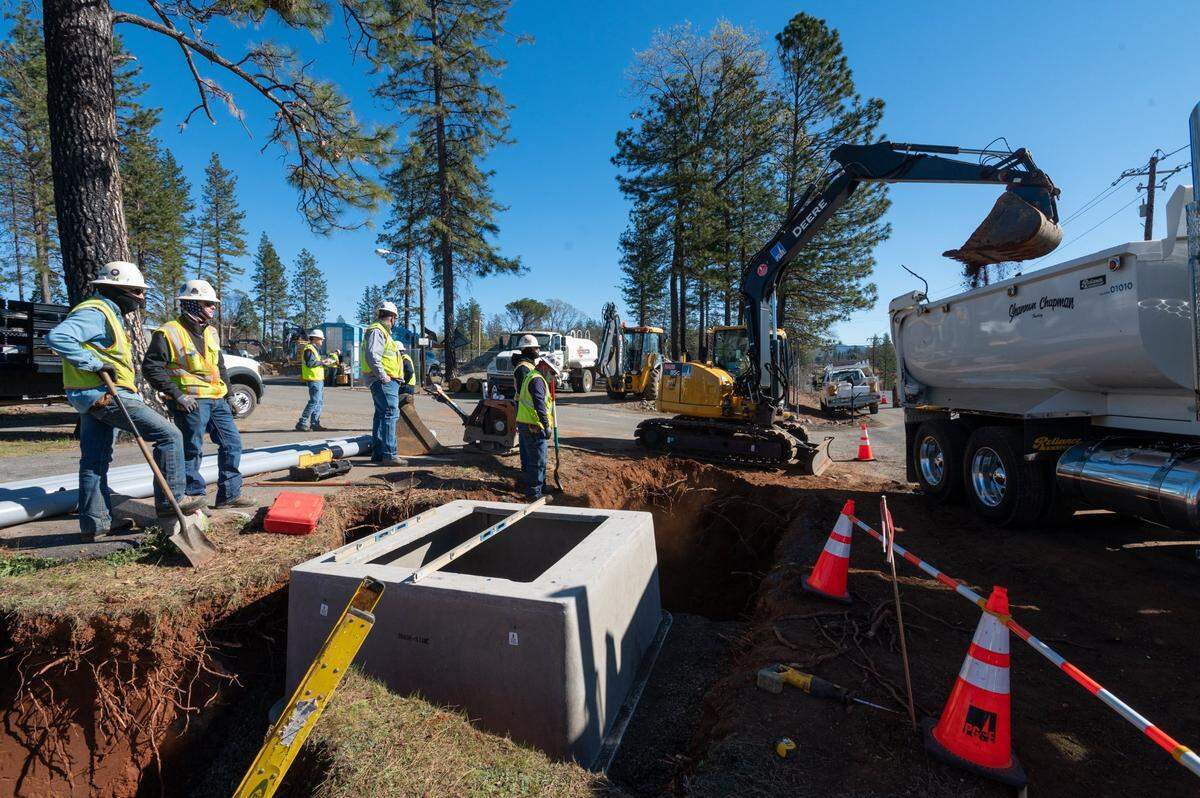
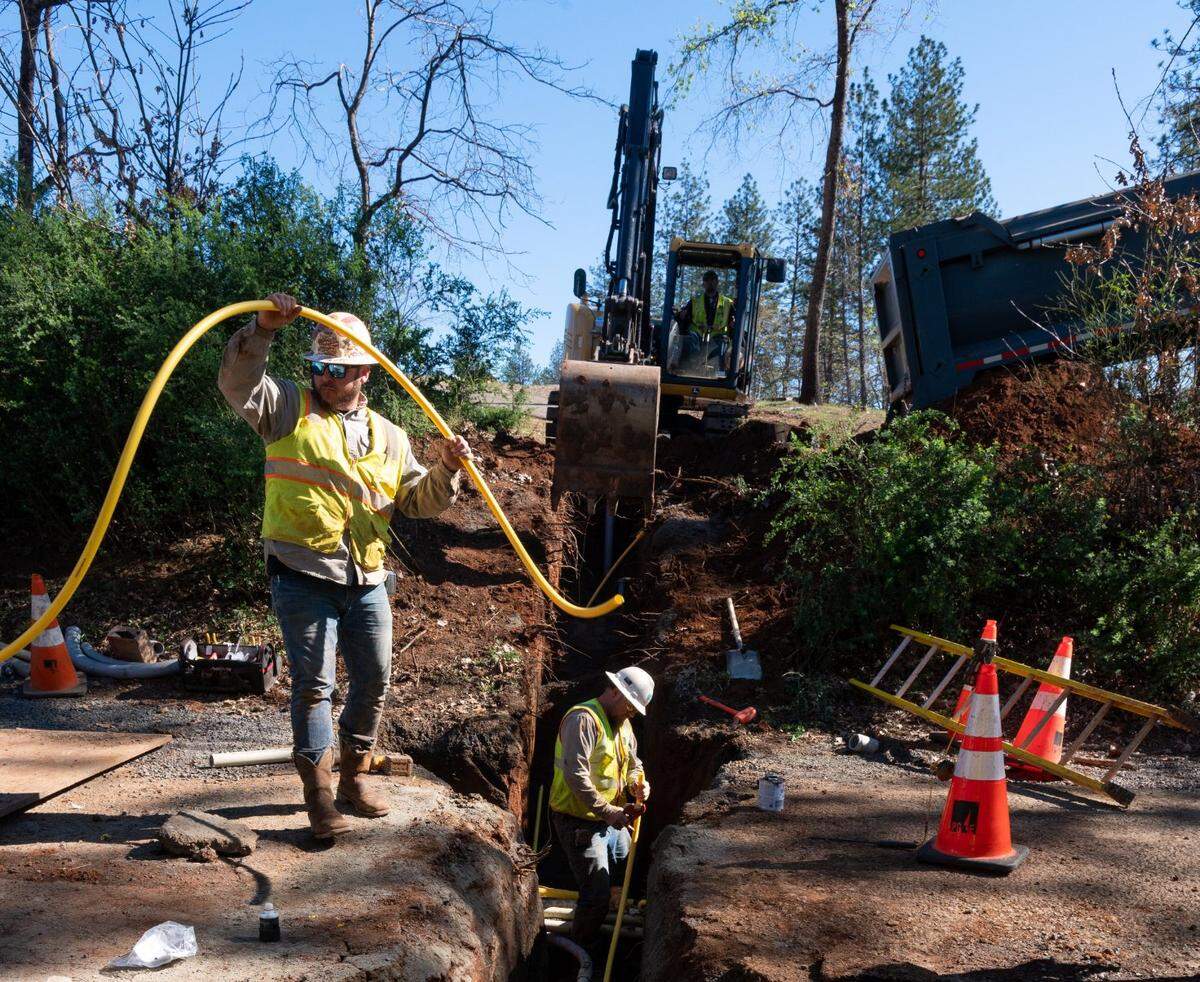
As the sun beat down on Travis Road in Paradise recently, a six-man crew from PG&E planted an array of pipes and power lines five feet below the street.
It was a small piece of a big project, begun more than two years ago, to replace 200 miles of overhead wires with underground lines to dramatically reduce wildfire hazards. By 2025, overhead wires will disappear for good in Paradise as well as in a portion of nearby Magalia, said utility spokesman Paul Moreno. In some spots PG&E’s crews are also replacing gas pipes and other infrastructure.
“Once it’s all done, everything will be underground,” PG&E foreman Rudy Duenas said as a John Deere backhoe began filling the Travis Road trench with fine, gray dirt. “And hopefully we won’t have any more disasters here. That’s what this is for.”
On Nov. 8, 2018, as howling winds blew through the Feather River canyon, a faulty clamp failed on a decades-old, high-voltage PG&E transmission tower several miles northeast of Paradise. A jumper cable brushed against the tower, showering sparks on the dry vegetation below. Within hours, the Camp Fire destroyed more than 12,000 homes and killed 85 people in California’s deadliest California wildfire. A Public Utilities Commission investigation accused the utility of failing to properly inspect the equipment. PG&E pleaded guilty to felony manslaughter charges.
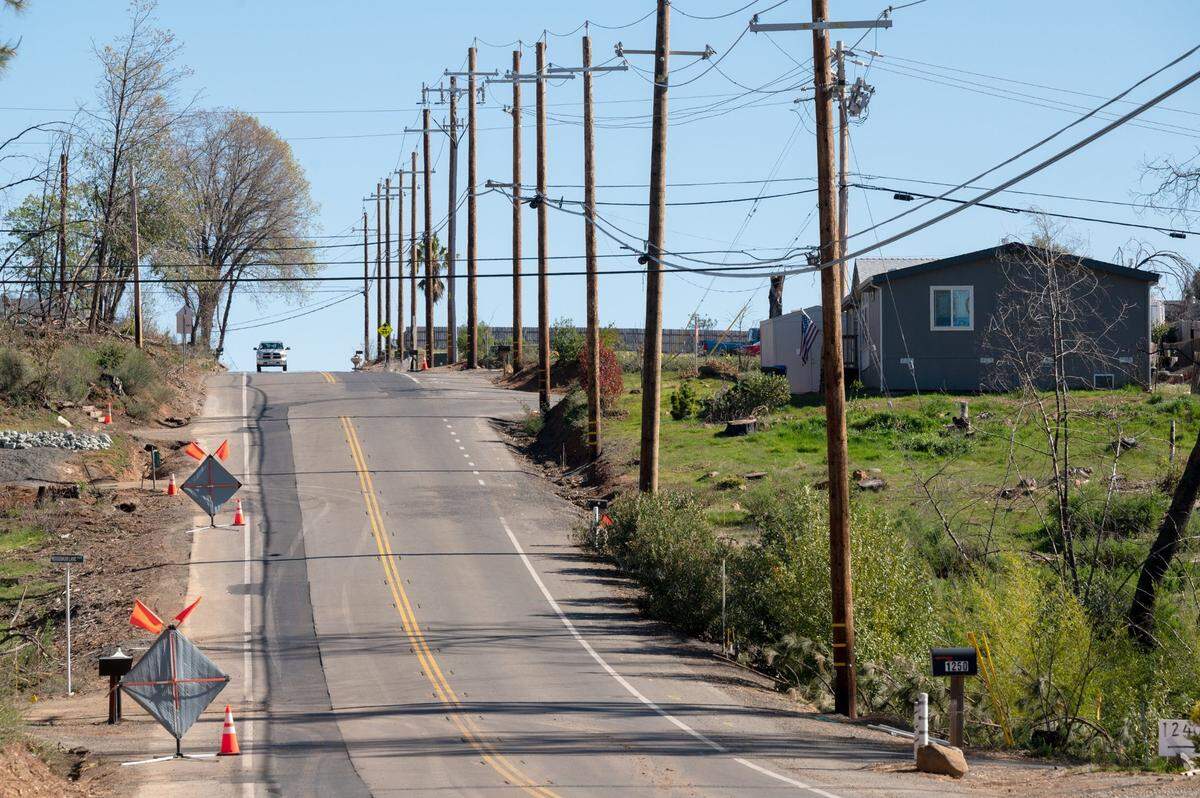
The town is still struggling to recover. About 1,200 homes have been rebuilt, or 10% of the total. Travis Road is typical, a narrow residential spot with a few homes that survived the fire — and plenty of empty lots that have been scrubbed clear of debris.
The underground project is a significant investment, costing about $200 million so far, according to Sumeet Singh, the company’s chief risk officer.
Only recently has PG&E become enthusiastic about planting wires underground.
In 2019 an outside auditor told the utilities commission that PG&E, over a nine-year period, failed to spend $123 million that it had collected from ratepayers to bury overhead lines (The company cited project delays and other factors). Even after starting the Paradise project, the company told the commission last June that underground work is effective but “time-consuming and costly.”
Then, a few weeks later, a tree made contact with PG&E equipment near the Cresta Dam in Plumas County, triggering the Dixie Fire. Poppe, the CEO, headed to Chico two weeks later and made a dramatic announcement: PG&E would replace 10,000 miles of overhead wires in the most hazardous wildfire areas. The decade-long project could cost $25 billion.
State officials weren’t thrilled. Members of the utilities commission grumbled that they should have been notified before the media.
Toney said the plan “has the feeling of a publicity stunt” and predicted the project will blow its deadlines and its budget.
“Ten years is going to stretch into 20 years,” he said. “Whatever they say it’s going to cost, it’s going to cost double or triple.”
The company’s own statistics show that underground work will cost $3.75 million per mile this year. That would put the 10,000-mile project at $37.5 billion — well over the company’s projections.
PG&E, though, insists that economies of scale and improved technologies will reduce the expense.
It also says there are parts of its territory where the trees are so thick that planting wires underground is simply the most effective way of reducing risk.
“Not only does it provide the greatest risk reduction, the most resilience from the extreme weather,” Singh said, “it actually does it at a more affordable cost structure for our customers.”
Can PG&E’s billions guarantee wildfire safety?
Since 2020 the company has spent about $5 billion a year on wildfire safety, a figure expected to grow to nearly $6 billion this year. It has insulated volatile electrical conductors and installed stronger, more resilient utility poles and insulated conductors. It has embedded hundreds of remote weather stations and high-definition cameras as early-warning devices throughout fire country.
It has spent $1.5 billion a year alone on “vegetation management” — aggressive tree trimming and removal near power lines, a budget that staggers company veterans.
“That’s nearly 10 times what it was a decade ago,” said Tankersley, the consultant who ran PG&E’s vegetation program until 2015.
Yet Tankersley, who runs a firm called Clear Path Utility Solutions, said the huge increase in spending might not do the trick.
“Just realistically, you’re only able to address a small fraction of the tree population that could strike those lines.”
The methods PG&E employs to reduce fire risk often generate controversy. After acknowledging it took hours for its crews to reach the equipment that started the Dixie Fire, PG&E embarked on a new strategy. It ramped up the sensitivity on hundreds of circuit breakers throughout wildfire country during fire season.
With the new settings, the breakers triggered automatic shutoffs if the equipment came into contact with a tree, an animal or anything else that could cause danger. PG&E said this program would have prevented the Dixie Fire if it had been in place.
There’s a downside. Unlike the public safety power outages — the blackouts that riled up Newsom in October 2019 — these blackouts come without warning. PG&E recorded 600 instant blackouts in just a few weeks last summer, affecting hundreds of thousands of households. The Public Utilities Commission scolded the company for failing to warn customers of the possibility these outages could occur.
Utility officials say they have fine-tuned the program to limit the footprint and length of the blackouts. But they won’t limit the initiative itself: PG&E insists that dialing up the circuit breakers prevented scores of wildfires last year, and they plan to expand the program this season to include more circuit breakers.
Between climate change and drought, the company acknowledges that the potential hazards are growing even as it races to contain them.
A decade ago, 15% of PG&E’s territory was considered to be in the most dangerous fire zones, as measured by the Public Utilities Commission. In 2018, when the commission mapped the state again, more than half of PG&E’s service area was in the highest-risk zones.
“We’re prepared for the fire season and the fire year, frankly,” Singh said. “That’s the stage California is in — the fire season is a fire year.”
This story was originally published March 9, 2022 at 5:00 AM with the headline "‘A crucial year for PG&E.’ California tightens grip on utility but wildfire risk persists."