Soccer, concerts and housing: Inside Sac Republic’s $100 million downtown stadium plan
The owners of Sacramento Republic FC are in the advanced planning stages of building a soccer stadium in the downtown Railyards that would anchor a new housing and entertainment district and serve as a long-awaited spark for one of the nation’s largest urban infill developments.
In an exclusive interview with The Sacramento Bee, Republic FC owner Kevin Nagle said the stadium would seat between 12,000 and 15,000 for soccer matches and cost between $100 million and $150 million. The facility would be constructed in the same portion of the Railyards where the team had planned to open a larger stadium for a Major League Soccer expansion franchise before that plan fell through.
Team and city officials stressed they have not abandoned their pursuit of an MLS franchise. Nagle said the new stadium could be expandable by several thousand seats to accommodate an expansion team into MLS, the top division in American professional soccer. For now, however, the facility would host the club’s second-division United Soccer League franchise.
The Railyards have stood mostly vacant for decades along Interstate 5, as city officials have long sought a transformative project to anchor the 244-acre site that could one day double the size of downtown.
The city had a plan in 2012 to build a new arena for the Kings in the development, only to see the plan fall apart when the team’s previous owners, the Maloof family, backed out. Instead, Golden 1 Center was constructed several blocks away with the team’s new owners, transforming a failing downtown mall into the vibrant Downtown Commons district.
A new soccer stadium hosting sports and live music could finally represent the Railyards’ missing piece. The facility could hold around 20,000 spectators for live music and host other events, including college football and professional rugby and lacrosse, Nagle said.
“I think really, big picture right now, because of everything that has happened with respect to the pandemic, with respect to some of the issues that the city and community have faced, that we could re-engineer and jump start the city with a new major project that would really start with the stadium,” Nagle said in an interview in his El Dorado Hills office last week. “Really, I would say, a community stadium — a stadium that really served the community.”
Nagle and a group of investors are also planning to build housing near the stadium to address what he called “the highest priority in my mind:” the region’s housing shortage. Nagle said his team would “look at building different types of housing, everything from apartments to condominiums to small standalone housing.”
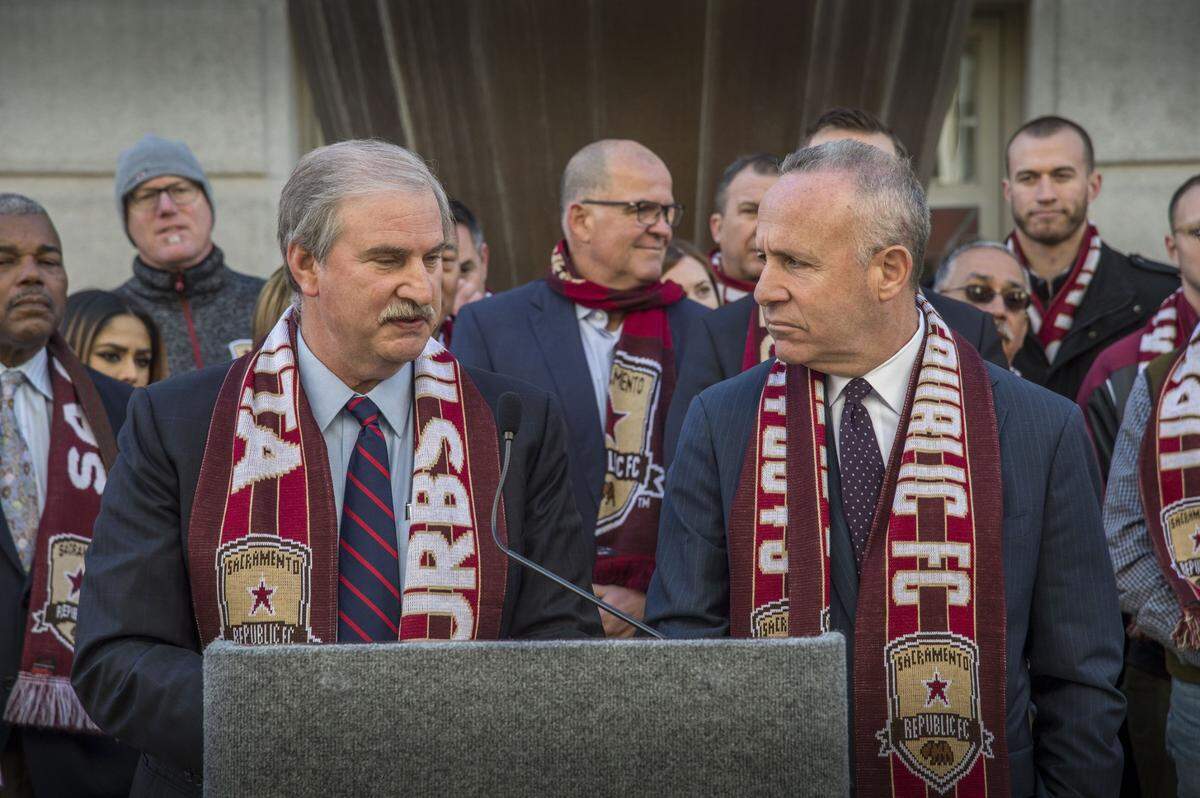
The revised stadium plan received the endorsement of Sacramento Mayor Darrell Steinberg, who two years ago helped engineer a $33 million incentive package for the proposed MLS stadium. That deal was unanimously approved by the City Council and would create a special financing district around the stadium where tax revenue generated by the project would fund streets, sewers and other infrastructure. The incentive deal also included development fee waivers.
The mayor told The Bee he supports offering the same deal to the team for its scaled-down stadium plan and would likely seek the City Council’s approval.
“I think investing in infrastructure is smart for the city,” the mayor said. “Wherever there are big holes and big opportunities, it’s more than appropriate for the city to make a contribution to infrastructure.”
Steinberg added he was comfortable with public funds being used on infrastructure “but otherwise (the stadium) has to be privately funded.”
Why build a new soccer stadium?
Republic FC has played in what is now called Heart Health Park at the Cal Expo state fairgrounds since 2014. The stadium was designed to serve as a temporary home for the team and was constructed for $3 million in just a few months.
The franchise has regularly been at or near the top of the United Soccer League for home attendance. The team reported its home opener March 12 drew a sellout crowd of 11,569.
But team officials and the mayor say the stadium should be replaced. Several franchises in the USL have recently opened or are constructing new soccer-specific stadiums in downtown cores, including teams in Louisville, Kentucky, Colorado Springs and Des Moines, Iowa.
USL President Jake Edwards told The Bee that a new stadium for Republic FC will help the club remain viable and competitive with other franchises that are building venues. Unlike other pro leagues, where athletes often chase top dollar for contracts, USL teams with good fan support stand apart from those with lower attendance.
Players consider atmosphere when they’re looking for a place to play. Stadiums serve as a sort of recruiting tool for players. New stadiums “will differentiate those particular clubs, not just from their ability to generate revenue and re-invest that into the club, but that will therefore affect competitiveness of those clubs moving forward,” Edwards said.
“A lot has changed since 2014 (when the stadium at Cal Expo opened) and the evolution of the league and the other clubs in the league,” Edwards said. “Clubs are moving forward now, building tremendous stadiums, 12,000, 15,000 (seats) and above. It is important for Sacramento Republic to be part of that push and I know they are working very hard and have got a very exciting project that they’re working on. That will set the club up for continued success and keep up with the growth and trajectory of the league and other clubs.”
For city officials, a stadium in the Railyards is about revitalizing a site that has languished for decades.
“It’s about soccer but also about developing that great extension of downtown (in the Railyards),” Steinberg said. “The location is important, not just the stadium.”
City officials have long counted on a stadium to provide a spark for the broader development of the 244-acre Railyards. Even with the MLS stadium plans shelved, a new 17-story courthouse is under construction and three apartment buildings are either being built or will be built soon.
Republic FC and its investors are prepared to enter into an agreement with Downtown Railyard Venture and the city of Sacramento to build the stadium, housing and retail at the site, but need additional acreage to be part of the deal for it to make financial sense.
“To be clear, we want to do this at the Railyards,” Nagle said. “We have other locations presenting very intriguing offers, but we owe it to the city to try to get it done there. Obviously if we can’t get the deal we need, we’ll have to look elsewhere, but we’ll cross that bridge when and if we get there.”
Denton Kelley, the managing principal for Downtown Railyard Venture, the developer of the Railyards, declined comment.
Patrick Rishe, head of the sports business program at Washington University in St. Louis, said it’s not surprising USL franchises such as Republic FC would look to invest in new stadiums in downtown cores.
“I think most sports leagues want to build downtown if they can, but in particular soccer, whether it’s MLS or USL, because soccer trends younger,” he said. Soccer is “about community more so than other sports,” he added, with a focus on supporter clubs, fan chants and “just the way they celebrate.”
Rishe said it’s important second-division franchises find the right size for their stadiums; the new stadiums opening in the league range in seating capacity from about 6,500 to Louisville’s Lynn Family Stadium, which can hold 15,304 with standing-room-only spots. Surrounding the stadiums with other attractions is also vital, he said.
“To make those things viable, you’ve got to have restaurants and retail within walking distance to make the entire experience more seamless,” he said. “If you build these USL stadiums near pockets of downtown that are areas to congregate and eat, places people can do things, it also increases this sense of community.”
Republic fans Julie and Michael Kashuba enjoy the experience of Heart Health Park, the team’s current stadium, though it is not downtown and built on the state fairgrounds, with no restaurants or bars in sight.
“It’s well-kept, it’s the right size, you have parking, you’re close to the freeway,” Michael Kashuba said at a home game last weekend. “There’s not a lot wrong with it. USL level, there’s not a lot wrong with it.”
But a downtown stadium would be nice, the Kashubas said, especially if it’s close to public transit and gathering spots — an atmosphere found at international stadiums such as Chelsea’s Stamford Bridge.
“I think they did a great job here given what we have to work with,” Julie Kashuba said, “and we’re all on board with the Railyard one.”
Major League Soccer dreams
Conceptual drawings of a stadium viewed by The Bee show rows of seats could be added to the facility, increasing its capacity to more than 20,000 for soccer matches. That was roughly the planned capacity for the Major League Soccer stadium Republic FC previously proposed.
“That’s the intent, even right now (to build a stadium that could be expanded),” Nagle said. “We’ve looked at that and it’s all doable.”
Steinberg said city and team officials have “several prospects or people actively looking for” prospective billionaire owners wealthy enough to land an MLS expansion franchise.
“Smart and nimble cities make sure they have more than one option and having a parallel track to consider building a USL stadium is not only good, it’s great,” the mayor said. “Dual tracks are better than no tracks.”
Republic fans have heard news like this before. After years of campaigning for a spot in the nation’s first division soccer league, MLS awarded Sacramento an expansion spot in October 2019. But billionaire lead investor Ron Burkle backed out of the deal in February 2021. Burkle’s decision was due in part to the escalating cost of the planned stadium — which by then was more than $300 million — and an expansion fee of $200 million.
MLS Commissioner Don Garber later called the failed deal “a COVID casualty” made complicated by “costs rising dramatically and other factors.” Garber also called Sacramento “a good soccer market,” but added “right now there are other markets we are looking at.”
Garber said last month Las Vegas was nearing an expansion bid and that he expected to finalize a deal soon.
This story was originally published April 1, 2022 at 5:00 AM with the headline "Soccer, concerts and housing: Inside Sac Republic’s $100 million downtown stadium plan."