You’ve passed Level II. Now it’s time for the final stretch. The CFA® Level III exam takes everything you’ve learned and asks the most important question yet: Can you apply it like a pro?
Level 3 is the most practical and judgment-based exam in the CFA Program. It’s where you go from studying to synthesizing—taking different inputs and making smart, defendable decisions. In 2025, it’s also more customizable than ever, with three new pathways that let you tailor your exam to your future.
If you’re feeling the pressure, that’s normal. But with the right study strategy and format awareness, you’re in a strong position to cross the finish line. After all, Level III had the most consistent pass rates of all three levels in 2024, with 49% in February and 48% in August.
In this guide, I’ll cover the format, question types, topic weights, and how to prepare with clarity and confidence.
Key Takeaways
- Mixed Question Format: The exam includes both vignette-based multiple choice and constructed response (essay) sets.
- Application Is Everything: You’ll interpret complex scenarios and provide well-justified recommendations.
- Pathways Are Here: Choose from Private Wealth, Private Markets, or Portfolio Management when you register.
- Two Sets Are Unscored: One essay set and one item set are trial questions, but you won’t know which ones.
- Clarity Counts: For constructed responses, bullet points and direct answers are not only allowed but encouraged.
🧠 What the CFA® Level 3 Exam Tests
At this stage, the CFA Institute isn’t just testing what you know—they’re testing how you think.
Expect scenarios where you’ll need to:
- Evaluate competing investment options
- Make trade-offs based on investor profiles and constraints
- Justify your decisions clearly, both numerically and conceptually
- Apply theory to real-world portfolios
This is your chance to demonstrate not only your technical skill, but also your professional judgment.
📝 CFA® Level III Exam Format
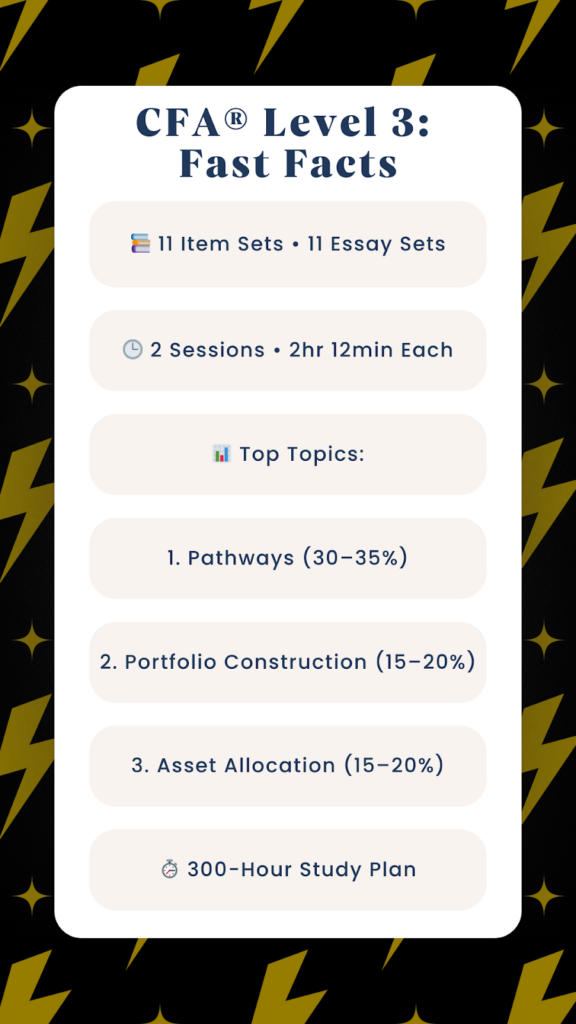
The exam consists of 22 question sets, split evenly between two sessions:
- 11 item sets (vignettes with multiple-choice questions)
- 11 essay sets (vignettes with constructed response questions)
Each session is 2 hours and 12 minutes, and includes either:
- 6 item sets and 5 essay sets, or
- 5 item sets and 6 essay sets
You won’t know the breakdown until you’re in the exam, so prep for both formats equally.
Each vignette begins with the topic and total point value (12 points), followed by a set of questions. You’ll need to reference the vignette for every answer—nothing stands alone.
Two of the 22 sets (1 item set and 1 essay set) are unscored, but since you won’t know which ones, treat every section like it counts.
🧩 Quick Format Breakdown
- Exam Duration: 4 hours, 24 minutes total
- Sessions: 2 (with optional break)
- Item Sets: 11 total (4 questions each)
- Essay Sets: 11 total (open response)
- Question Style: All vignette-based, combining analysis and judgment
📊 Topic Areas & Weights
In 2025, CFA® Level III introduces specialized pathways, so your exam will be a mix of shared topics and path-specific content. When you register, you’ll choose one of three tracks:
- Portfolio Management (traditional path)
- Private Wealth
- Private Markets
Once selected, your pathway can’t be changed—so pick the one that best fits your goals.
Here’s how the exam breaks down:
| Topic | Weight |
|---|---|
| Ethical & Professional Standards | 10–15% |
| Asset Allocation | 15–20% |
| Portfolio Construction | 15–20% |
| Performance Measurement | 5–10% |
| Derivatives & Risk Management | 10–15% |
| Pathway-Specific Content | 30–35% |
Each pathway includes readings unique to its track and will be tested using both item sets and essays.
👉 Tip: Don’t assume your pathway content is easier—it’s a third of the exam and requires just as much prep as the core material.
🧠 How Level III Is Different From Level II
If Level II taught you how to analyze, Level III asks you to connect the dots. You’ll need to move from numbers to narratives—justifying choices, building portfolios, and addressing client-specific constraints.
The format changes too:
- Item sets remain, but now there are constructed response questions
- You won’t always be choosing between A, B, C, or D—you’ll be typing out your logic
- Some questions ask for multiple parts—only the number requested will be graded, and in the order in which you write them
Expect more nuance, more context, and a greater emphasis on clear communication.
📅 Study Strategy for CFA® Level III
The material isn’t necessarily harder—but the way it’s tested is. You’ll need a strategy that blends content review with practice under test-like conditions.
Here’s how to get the most from your prep:
✅ Practice Written Responses
Bullet points are fine, but your logic has to be clear. Learn to answer directly and efficiently, especially when time is tight.
✅ Don’t Underestimate Pathway Content
That 30–35% isn’t filler. Study it like it’s a core topic—because it is.
✅ Integrate Topics in Your Practice
Use mock exams to simulate the complexity of real questions, where topics like ethics, asset allocation, and risk management often appear together.
✅ Track Points, Not Just Time
Unlike other levels, some questions are worth more than others. Learn to pace yourself based on question value—not just the clock.
🧘♂️ On Exam Day
Level III isn’t about speed—it’s about clarity under pressure. You’ll need to stay composed, think critically, and explain yourself effectively.
Here’s how to approach exam day:
- Show up early, well-rested, and organized
- Bring your passport, admission ticket, and approved calculator
- Expect questions that require thoughtful, multi-step answers
- Use the optional break to reset, especially if your first session includes more essays
- Don’t panic if you don’t know one item—move on and circle back if time allows
The final CFA® level is a test of endurance as much as it is knowledge. Stay focused, and keep your pacing steady.
✅ Final Thoughts
CFA® Level III is where it all comes together. It’s less about memorization and more about decision-making—testing how well you can think, communicate, and manage portfolios under pressure.
With the introduction of pathways, the exam is more tailored to your career goals than ever before. But no matter your path, success still comes down to the same things: preparation, consistency, and focus.
You’ve made it through two major milestones—now it’s time to take on the giant and finish strong.
FAQs
This CFA® exam is challenging in a different way. Level III focuses on applying concepts and writing clear, well-reasoned answers, which many candidates find more demanding than memorization.
Yes. It’s the final step to earning the charter and builds real-world skills in portfolio management, client objectives, and investment decision-making.
Most say yes, mainly because of the essay format and the need to synthesize topics. That said, some still find Level II harder due to the volume and complexity of the material.
It’s possible, but tough. You’ll need to study consistently—around 25–35 hours per week—and focus heavily on essay practice and integrated review.
Most candidates pass in their late 20s to early 30s, but there’s a wide range. The program fits a variety of career stages.