Which is better, CFP® vs. CPA? Choosing between becoming a Certified Financial Planner™ (CFP®) or a Certified Public Accountant (CPA) can feel like deciding between two big life paths. Both are respected and come with some serious perks (like a 10% higher salary), but they also head in pretty different directions.
So, how do you know which one is for you?
If you’re wondering whether you should be guiding people toward their financial goals or diving deep into financial accounting for businesses, you’re not alone. I’ve been there, too—trying to figure out which path would give me the most career satisfaction and the best balance of helping others while building my own skills.
And here’s the thing:
It’s not just about picking a job title. It’s about finding out what excites you more—personal finance or keeping organizations financially in check. Let’s break down the CFP® vs. CPA debate so you can make the right call for your future.
Key Takeaways
- CFP® Certification: Ideal for those who enjoy working directly with individuals to achieve their personal financial goals (i.e., retirement planning and investment management.)
- CPA License: Best suited for those interested in the technical side of finance, including tax preparation, audits, and ensuring businesses comply with financial regulations.
- Career Opportunities: CFP® professionals can work as wealth managers, financial planners, or retirement specialists, while CPAs often find roles in public accounting, tax planning, or corporate finance.
- Exam Difficulty: The CPA exam is known for its complexity, with an overall pass rate of around 54%, while the CFP® exam has a pass rate of about 60–70%, making it slightly less difficult in comparison.
- Combining Both: Earning both the CPA and CFP® designations can open even more doors, offering greater versatility and marketability in the financial services industry.
Becoming a CFP® or CPA: What You Need to Know
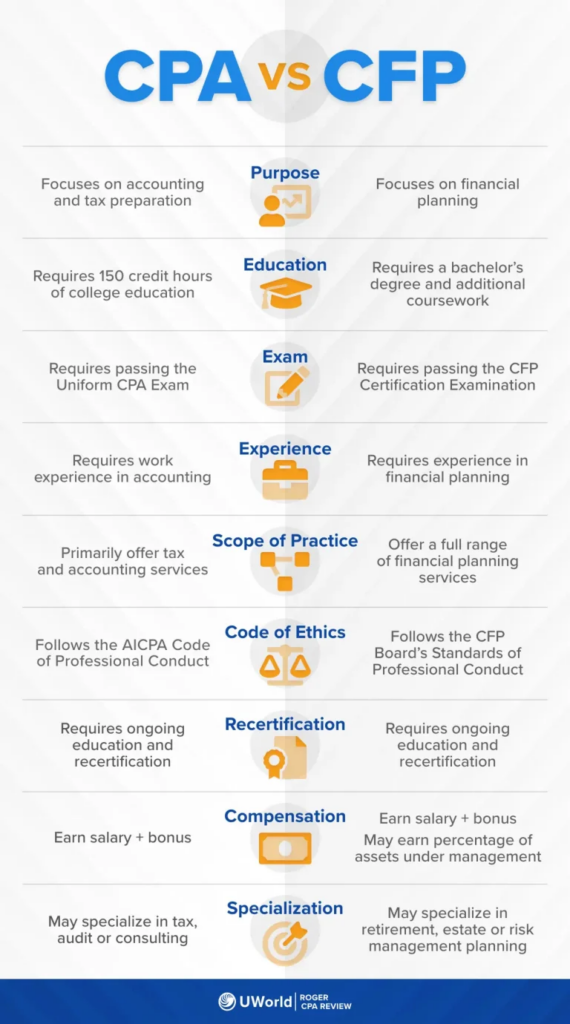
CFP® Certification Requirements
The CFP® designation is one of the top credentials for financial advisors focused on personal financial planning. CFPs specialize in guiding individuals through decisions like retirement planning, investment strategies, and risk management.
To earn the CFP® certification, you’ll need:
- A bachelor’s degree
- Completion of a financial planning program approved by the Certified Financial Planner Board
- Passing the CFP® exam
- At least 6,000 hours of professional experience in personal finance
- A commitment to acting in your client’s best interest (fiduciary duty)
CFP® professionals help clients reach their financial goals, making them trusted figures in personal finance and financial advisory services.
CPA Certification Requirements
Certified Public Accountants are highly skilled in areas like tax preparation, financial accounting, and auditing. If you’re aiming to work in public accounting, financial reporting, or assurance services, becoming a CPA might be the best path.
Here’s what’s required to become a CPA:
- At least 150 semester hours of education, typically leading to a master’s degree
- Passing the CPA Exam
- 1-2 years of supervised accounting work (varies by state)
- In some states, you may also need to pass an ethics exam
CPAs often work in corporate finance, public accounting firms, or government, where they ensure compliance with financial regulations and offer tax advice.
Career Opportunities
Certified Financial Planner™

As a CFP®, your primary focus is on helping clients achieve their financial goals. You’ll work closely with individuals to manage their investments, plan for retirement, and navigate the complexities of financial decision-making.
Here are some of the top positions you can pursue as a CFP®:
- Wealth Manager: Managing investments and long-term financial growth for individuals and families.
- Financial Advisor at a Wealth Management Firm: Working with clients on asset allocation, tax strategies, and estate planning.
- Retirement Planning Specialist: Helping clients build strategies for financial security in retirement.
- Investment Adviser: Guiding clients in managing their portfolios and making smart investment decisions.
For CPAs
Certified Public Accountants take on more technical roles that focus on financial reporting, audits, and ensuring businesses comply with tax laws and regulations. Whether you’re working for a public accounting firm, a corporation, or a government agency, CPAs play an essential role in maintaining financial integrity.
Here are some top positions for CPAs:
- Tax Accountant: Specializing in tax planning, preparation, and minimizing tax liabilities for businesses and individuals.
- Auditor: Conducting financial audits to ensure accuracy and compliance with regulations.
- Corporate Controller: Overseeing a company’s financial reporting, budgeting, and accounting operations.
- Forensic Accountant: Investigating financial discrepancies and fraud.
Exam Details: What to Expect
CFP® Exam
- Format: 170 multiple-choice questions
- Duration: 6 hours, split into two 3-hour sessions
- Pass Rate: Historically 60–70%
The CFP® exam covers everything from retirement planning to estate management, testing your ability to apply financial planning knowledge to real-life situations.
CPA Exam
- Core Sections: Auditing and Attestation, Financial Accounting and Reporting, Taxation and Regulation
- Discipline Sections (choose one): Business Analysis and Reporting, Tax Compliance and Planning, Information Systems and Controls
- Pass Rate: Approximately 54% overall across all CPA sections, highlighting its reputation as one of the more challenging professional exams.
The CPA exam is known for its complexity, covering everything from financial accounting to tax strategies. It’s split into multiple sections with a mix of multiple-choice questions and task-based simulations.
Time and Money Commitment: CFP® vs CPA
What It Takes to Get CFP® Certified
Becoming a CFP® involves a lot of studying and planning. You’ll need to complete a bachelor’s degree and then dive deep into financial planning topics to prepare for the CFP® exam. Most people put in about 1,000 hours of study time to feel confident they can pass.
Here’s a breakdown of the exam fees:
- Early registration: $825 (if you register more than six weeks ahead)
- Standard registration: $925
- Late registration: $1,025
But that’s just the exam. You also have to consider the cost of your education programs and any study materials or CFP® prep courses you decide to use. These extra costs can add up, so it’s good to plan ahead.
The CPA Route
If you’re aiming to become a CPA, get ready for a big-time investment too. Most states require at least 150 semester hours, which usually means you’ll need a master’s degree. After that, you’ve got the CPA exam to prepare for. Many candidates spend around 300 hours per section of the exam. That’s a lot of study time!
As for costs:
- Exam fees are about $345 per section, with four sections.
- You’ll also pay a $75 application fee (this varies by state).
On top of that, there are additional costs for prep. You’ll have to invest in one of the best CPA review courses and study materials, similar to the kind of prep you’ll need for the CFP® exam. So, like the CFP® path, the CPA license comes with its own significant financial commitment.
In short, both certifications require serious time and money, but they open doors to rewarding careers in financial planning and accounting.
Insights From Professionals
Deciding between becoming a CPA, a CFP®, or even pursuing both can be tough. Hearing from those who’ve been through it can help you understand the real-world impact of these career paths. In fact, a recent Reddit thread featured several professionals sharing their experiences and advice, highlighting the pros and cons of each path. Here’s what some of those professionals had to say about their journeys.
One user shared: “I find that the CFP® career path is more rewarding than the CPA path, but the CPA/CFP® combo smokes both. If you love the idea of financial planning, you may regret not getting the CPA first. The CPA adds more weight to your technical recommendations, especially for tax and estate planning. So ironically, go the CFP® route but pay your CPA dues first—it’s the best career path in my opinion.”
Another user emphasized getting the CPA first while your studies are fresh: “The CFP® is a breeze relative to the CPA. Might as well get the most difficult one out of the way first. With a shortage of CPAs, you’ll be more employable right away. Then, after a few years in tax, you can get your CFP® and head into a Registered Investment Advisor (RIA) role.”
For some, the CPA/CFP® combination opens even more doors. One user shared: “I passed the CPA exam and got over three years of experience in public accounting. Now, I’m working on finishing up my CFP®. Having both credentials is a great skill set.”
These stories show that while the CPA path can be more technical, it adds credibility, especially in areas like tax planning and compliance. On the other hand, the CFP® designation allows you to work more closely with clients on financial planning. For some, the best choice might be combining both to maximize career flexibility and client trust.
CFP® vs CPA: Which Career Path is Right for You?
Deciding between becoming a CFP® or a CPA can shape your career in different ways. Here’s a simple guide to help you figure out which path aligns best with your goals:
- If you want to help individuals with their personal finances – things like retirement planning, tax strategies, and achieving long-term financial goals – then go for the CFP® certification. This is perfect for people who enjoy working with clients on comprehensive financial planning and guiding them through their personal financial decisions.
- If you’re interested in financial reporting, tax preparation, and auditing for businesses and organizations, then the CPA license is a better fit. The CPA path is ideal if you’re drawn to the technical side of accounting and want to ensure companies follow the rules and meet financial regulations.
- If you want to do both – helping individuals with personal financial planning and handling business financial accounting – then pursuing both the CFP® and CPA designations could give you a huge advantage. With both, you’ll be able to offer a broad range of services, making you more versatile in the financial services industry.
In short, it’s all about what excites you most: personal finance and working with clients (CFP®) or focusing on financial reporting and compliance (CPA). Or, why not go for both and maximize your potential in the field?
Conclusion
When it comes to choosing between a Certified Financial Planner™ and a Certified Public Accountant, both offer exciting and fulfilling careers in the financial services industry. Each path has its own unique challenges and rewards, and your decision will depend on what excites you most.
Whatever you choose, both paths require dedication, ethical responsibility, and a commitment to making a difference—whether for individual clients or large organizations. Take time to think about your career goals and the kind of work you want to do. From there, you can make the best decision for your financial future!
FAQs
A CFP® focuses on helping individuals with personal financial planning, including retirement, investments, and tax strategies. Conversely, CPAs specialize in financial accounting, tax preparation, and auditing, usually for businesses.
The Certified Financial Planner Board oversees the entire certification process, ensuring that candidates meet the necessary educational, ethical, and professional experience requirements to become CFP® professionals. They also enforce ongoing education and adherence to fiduciary standards for all CFP® holders.
Yes, some financial planners, especially those with the CFP® designation, provide tax strategies as part of comprehensive financial planning. However, for more complex tax matters, they may recommend working with a CPA for specialized asset allocation tax advice.
Yes, you can work as a financial advisor without a CFP®, but the certification from the Certified Financial Planner Board can increase your credibility and expand the services you offer in areas like financial planning and investment strategies.
Both financial planners with a CFP® and CPAs can earn competitive salaries, but earnings often depend on experience, location, and the type of clients served. Typically, financial advisors working with high-net-worth individuals or in niche areas like estate or retirement planning may command higher fees.