If you’re thinking about a career in accounting, you’re probably weighing the pros and cons of becoming a Certified Public Accountant (CPA). With more companies embracing flexible and remote work, the role of a CPA is evolving. This change has increased the demand for CPAs who can navigate new work environments while upholding strong financial expertise.
But what does that mean for you?
If you’re on the fence about pursuing a CPA license or sticking with a regular accounting role, now’s the perfect time to understand what sets them apart.
Let’s dive into the key differences and see how these trends could impact your future.
Key Takeaways
- CPA vs. Accountant: CPAs have the legal authority to perform specialized tasks and represent clients before the IRS, which isn’t true for regular accountants.
- Certification Matters: Earning a CPA license requires passing a tough exam and meeting specific education requirements, but it opens doors to higher-level roles and greater career opportunities.
- Higher Salaries: CPAs typically earn more than their non-certified counterparts, with entry-level CPAs starting around $80,000 and experienced CPAs in executive roles making over $200,000 annually.
- Additional Certifications: Accountants without a CPA can still boost their careers by obtaining certifications like CMA or CIA, leading to higher salaries and specialized roles in areas like management accounting.
- Career Advancement: Whether you choose the CPA path or remain an accountant, both roles offer rewarding careers, but the CPA designation generally provides more room for advancement and specialization.
What Sets Them Apart?
When it comes to managing money, understanding the difference between a CPA and an accountant is key. Both play important roles, but they have different responsibilities and qualifications. Let’s break it down.
Certified Public Accountant
A CPA is like the superhero of the accounting world. To become one, you’ve got to pass the CPA exam and meet specific state requirements. CPAs have the legal authority to do things that regular accountants can’t, like preparing audited financial statements or representing you in front of the IRS.
CPAs are the go-to pros for complex tasks like financial planning, auditing, and even preparing your tax returns. They have to follow a strict professional code of ethics and keep up with continuing education to stay certified. In short, if you need someone to handle tricky financial situations or deal with government agencies, a CPA is your best bet.
Accountant
Now, let’s talk about accountants. They’re the backbone of any business, handling day-to-day financial transactions, recording cash flow, and keeping financial records in order. Accountants usually have a bachelor’s degree in accounting or finance and are great at analyzing financial data and preparing financial reports.
However, not all accountants are CPAs. While they can prepare your tax returns and help with financial planning, they can’t perform audits or represent you before the IRS unless they have that CPA license. Some accountants go on to get other certifications like the Certified Management Accountant (CMA) or Certified Internal Auditor (CIA), which opens up more career paths in areas like management accounting or internal audits.
Choosing Your Accounting Path
Choosing between becoming a CPA or staying an accountant isn’t just about titles—it’s about where you want your career to go. Let’s look at what each path entails and how it might fit into your professional goals.
What It Takes to Be an Accountant
If you want to work as an accountant, you’ll generally need a bachelor’s degree in accounting or a related field. Many accountants stop there, but some choose to go further and get additional certifications like CMA or CIA. These certifications can make you stand out and open doors to specialized roles in management accounting or internal audits.
Accountants focus on tasks like recording financial transactions and managing financial data. They’re the ones keeping track of cash flow and making sure everything balances out. While accountants can prepare tax returns, they can’t perform audits or represent clients before the IRS unless they’ve also earned a CPA license.
The CPA Pathway
Becoming a CPA requires a bit more work. If you’re considering this route, you’ll need to complete 150 semester hours of education, which often means earning a master’s degree. Then comes the CPA exam, which tests your knowledge in areas like auditing, financial accounting, and regulation as well as specific discipline sections. It’s a tough test, and you should consider taking a CPA exam prep course, but passing it is key to unlocking the CPA designation.
Once you’re a CPA, your career options expand significantly. You’ll be able to offer financial planning services and even represent clients before the Internal Revenue Service. The CPA license is a big deal and is recognized across the U.S. and internationally, making it a valuable asset in public accounting firms, government agencies, and private companies.
Job Opportunities and Salaries
So, what’s the real difference between a CPA and an accountant when it comes to job opportunities and salary? Let’s break it down.
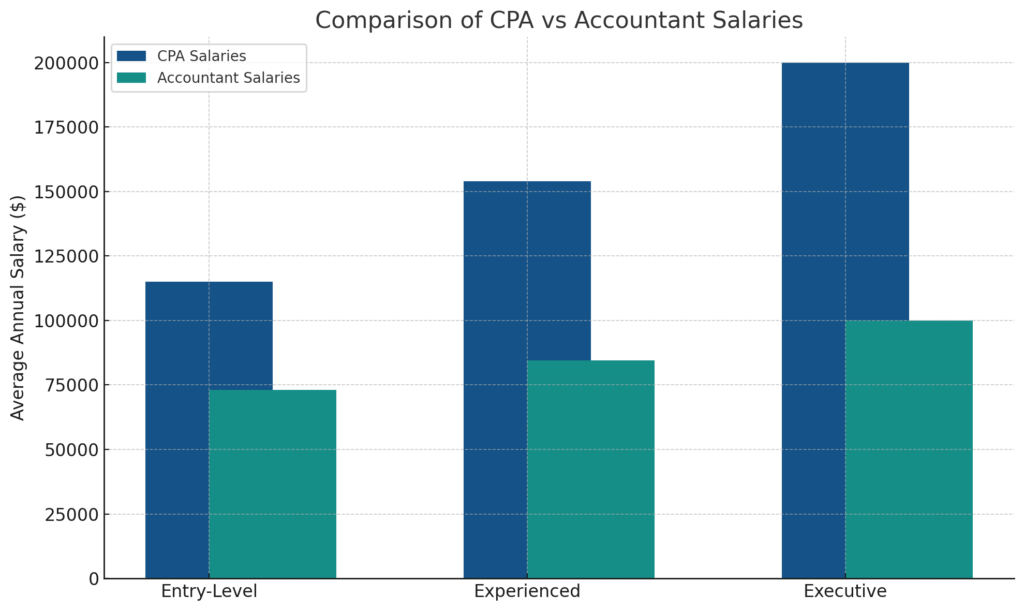
According to data from Glassdoor, CPA salaries can range as follows:
- Entry-level CPAs typically earn between $80,000 and $150,000 annually.
- Experienced CPAs in managerial or specialized roles can earn anywhere from $107,000 to $201,000 or more.
- CPAs in executive positions, such as Chief Financial Officers (CFOs) or partners in accounting firms, can see salaries exceeding $200,000 annually, not including bonuses and other compensation.
On the other hand, salaries for accountants without the CPA designation tend to start lower, according to Glassdoor:
- Entry-level accountants may earn between $56,000 and $90,000 per year, depending on their role and location.
- With experience and additional certifications like CMA or CIA, accountants can see their salaries rise to between $63,000 and $106,000.
- Senior accountants in specialized roles may reach salaries of $100,000 or more.
In the end, both CPAs and accountants play crucial roles in the accounting profession, and understanding the differences between the two can help you decide on a path.
So, Which One Is Right for You?
As you start your journey in the accounting world, understanding the different paths available to you is crucial. Whether you’re drawn to the prestige of becoming a CPA or the solid foundation of an accounting degree, each option offers unique opportunities. Let’s explore what each path can offer and how it aligns with your career goals.
Weighing Your Options
Deciding whether to go for a CPA license or stick with your accounting degree depends on what you want from your career. Here are a few scenarios to consider:
- If you want to audit financial statements or represent clients before the IRS, then becoming a CPA is the way to go. Only CPAs are legally allowed to do these tasks, so you’ll need that certification to advance in these areas.
- If you’re aiming for top positions like Chief Financial Officer or a partner in a public accounting firm, then a CPA license is almost a must. It gives you the credentials and respect needed to move up the ladder.
- If your goal is to work in corporate settings with a focus on financial planning or internal auditing, then a regular accounting degree, possibly with a CMA or CIA certification, could be just what you need. This path can offer a wide range of opportunities without the extra hurdles of the CPA exam.
- If taxes are your thing and you love digging into the details of tax codes, then getting a CPA license will give you the expertise to handle complex tax situations. CPAs are known for their deep knowledge of tax preparation and planning.
- If you’re drawn to private accounting or business management roles where GAAP and financial reporting are key, then a bachelor’s degree in accounting could be enough. You can build your career in environments that don’t require CPA-specific tasks.
- If working in public accounting firms that audit companies regulated by the SEC sounds exciting, then a CPA license is essential. It’s a requirement for anyone involved in these types of audits.
- If the time and financial investment required to become a CPA feels overwhelming, remember that a regular accounting degree can still lead to a rewarding career. It requires less of a time investment, and you can start working in accounting much sooner.
Conclusion
So, where do you see yourself after diving into the world of CPAs and accountants? If you’re anything like I was when I started out, you might still be weighing your options. And that’s okay! The accounting field is full of opportunities, whether you’re drawn to a CPA’s specialized skills and higher earning potential or prefer the steady and essential work of an accountant.
Whatever you decide, the important thing is that you’re making an informed choice that aligns with where you want to go in your career. Whether you choose the path of a CPA or decide to thrive as an accountant, both roads can lead to a successful and fulfilling career in the world of finance. Now, it’s up to you to choose the direction that feels right.
FAQs
The main difference between a CPA (Certified Public Accountant) and an accountant is that a CPA has passed the CPA exam, met state certification requirements, and is licensed to perform tasks like auditing and representing clients before the IRS. Accountants, while skilled in managing financial transactions, do not have the legal authority to perform these tasks without a CPA license.
While you don’t need a CPA license to prepare tax returns, having a CPA designation can provide a deeper understanding of tax codes and regulations, making it easier to handle complex tax situations. Only a CPA can represent clients before the IRS in case of an audit.
To become a CPA, you typically need to complete 150 semester hours of education (often requiring a master’s degree), pass the CPA exam, and gain 1-2 years of experience under a licensed CPA. In contrast, becoming an accountant generally requires a bachelor’s degree in accounting, which can be completed in about four years.
CPAs generally have more career opportunities and higher earning potential compared to non-CPA accountants. A CPA license allows you to perform specialized tasks and represent clients before the IRS, which can lead to higher-level positions in public accounting firms, government agencies, and private corporations.
Yes, an accountant can work in a public accounting firm without a CPA license, but their scope of work will be limited. Obtaining a CPA license is often necessary for advancement within public accounting firms, especially if you want to perform these specialized tasks