Passing the Fundamentals of Engineering (FE) exam is a critical step toward becoming a licensed professional engineer. Whether you’re studying civil engineering, mechanical, electrical, or another discipline, understanding the FE exam pass rate gives valuable insight into the exam’s difficulty, preparation strategies, and what to expect on exam day.
This article covers the most recent FE exam pass rates, why they vary, and how to prepare effectively for your first attempt.
Key Takeaways
- Pass Rates Vary by Discipline: Fields like Environmental Engineering have higher pass rates, while Other Disciplines tend to be lower.
- First-Timers Perform Better: Recent grads and first-time test takers from U.S. schools generally have the best pass rates.
- There’s No Set Passing Score: The FE exam uses scaled scoring, but most experts estimate passing requires around 50–60% correct answers.
- Prep Materials Matter: Using the FE Reference Handbook, practice problems, and full-length exams is crucial for test-day success.
- Time Management Is Key: With 110 questions and tight timing, pacing, and familiarity with question types make a significant difference.
What Is the FE Exam?
The FE exam is a computer-based exam administered by the National Council of Examiners for Engineering and Surveying (NCEES). It’s typically the first exam taken on the path to earning your PE license. It’s designed to assess your understanding of fundamental engineering concepts and is most commonly taken by students or recent graduates from ABET-accredited programs.
The exam is discipline-specific, with the following versions available:
- FE Civil
- FE Mechanical
- FE Electrical and Computer
- FE Environmental
- FE Industrial and Systems
- FE Other Disciplines
2025 FE Exam Pass Rates
Pass rates for the FE exam are updated periodically by the NCEES and vary based on discipline and whether the test taker is a recent graduate.
| FE Discipline | Average Pass Rate (2014-2024) |
|---|---|
| Chemical Engineering | 72% |
| Civil Engineering | 60% |
| Mechanical Engineering | 68% |
| Electrical and Computer | 62% |
| Environmental Engineering | 67% |
| Industrial Engineering | 68% |
| Other Disciplines | 59% |
These numbers reflect first-time test takers with degrees from U.S. institutions. The pass rate tends to drop for repeat takers or those with degrees earned internationally.
Why Do FE Pass Rates Vary?
Several factors contribute to different pass rates across disciplines:
- Curriculum Alignment: Some programs align more closely with FE exam topics than others.
- Content Breadth: The FE Other Disciplines exam, often taken by interdisciplinary engineers, covers a broader range of topics.
- Preparation Quality: Effective FE exam prep, including practice exams, question banks, and thorough use of the FE Reference Handbook, significantly impacts performance.
- Time Since Graduation: Those who take the exam shortly after college tend to perform better, as engineering fundamentals are still fresh.
What Score Do You Need to Pass the FE?
The FE exam passing score is not a fixed percentage. NCEES uses a scaled scoring system, and the exact passing threshold isn’t publicly disclosed. However, estimates suggest you need to answer roughly 50–60% of the questions correctly to pass, depending on the difficulty of your actual exam.
How to Improve Your Odds of Passing
Passing the FE exam on your first try is entirely possible—but it requires a study plan tailored to your discipline and learning style. Here are strategies that work:
- Use the Official FE Reference Handbook: This is your only reference during the exam. Learn how to navigate it efficiently.
- Work Through Practice Problems: Focus on solving timed problems using your calculator and handbook—this mimics test-day conditions.
- Take Full-Length Practice Exams: Simulate the full computer-based exam experience to build stamina and manage time constraints.
- Identify Challenging Topics Early: Pinpoint weak areas like thermodynamics or statics and build in extra time to review them.
- Join Study Groups or Seek Support: Explaining problems to others and hearing different approaches can deepen understanding.
- Choose Quality Prep Resources: Tools like the FE Review Manual, online video courses, and question banks help reinforce learning.
What Makes the FE Exam Challenging?
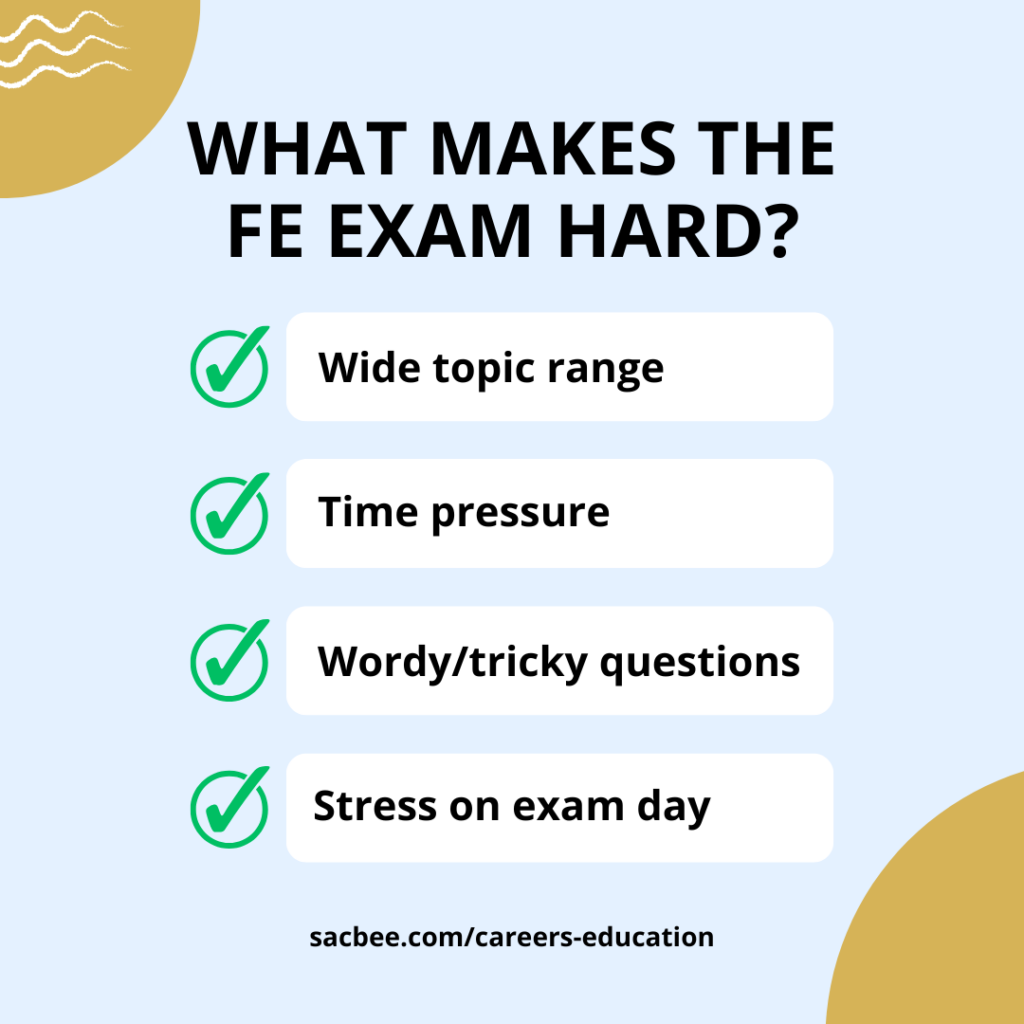
Several aspects of the FE exam can catch students off guard:
- Wide Range of Topics: Even within a single discipline, the scope can be overwhelming without thorough preparation.
- Time Pressure: With 110 questions in 6 hours, managing your pace is essential.
- Wordy or Tricky Questions: Some problems may appear simple but require careful reading and conceptual understanding.
- Stress on Exam Day: Even well-prepared test takers may underperform if they haven’t practiced under realistic conditions.
Final Thoughts
While the FE exam pass rate varies by discipline and background, success ultimately comes down to preparation. Use your time wisely, lean on proven tools, and simulate the testing environment as much as possible. Whether you’re targeting FE Civil, FE Mechanical, or another exam version, the combination of early planning and consistent effort can lead to a passing score—and a solid first step toward your PE exam and engineering licensure.
FAQs
As of 2025, the pass rate for U.S. civil engineering graduates is around 60%, combining the averages of first-time takers and retakers, according to NCEES data.
FE exams can be difficult, especially without preparation. However, with focused study and the right resources, many students pass on their first try.
The exam is scaled and equated for difficulty. While exact scores aren’t published, most estimates suggest that passing requires answering around 50–60% of questions correctly.
Start early, use the FE Reference Handbook regularly, complete timed practice exams, and review challenging topics thoroughly.
It helps. Pass rates are higher for recent grads, as coursework is still fresh and time hasn’t eroded core engineering knowledge.



![Best CPA Study Materials and Review Courses [2026]](https://www.sacbee.com/careers-education/wp-content/uploads/sites/6/2024/07/Best-CPA-Review-Courses-1024x569.png)