
If you’re planning on taking the Graduate Record Examination, you’ll get your score report back within 8-10 days to tell you how well you did. However, a number on a score report doesn’t mean much on its own unless you understand how scoring works, how schools interpret results, and how your performance compares to other applicants.
As an exam prep expert, I’m here to lay it all out for you in plain English. No fluff, just facts.
Key Takeaways
- No Universal Benchmark: There is no single number that defines a good GRE score.
- Percentile Rankings: Percentiles often matter more than raw scores.
- Section-by-Section Evaluation: Each section is evaluated separately and in context.
- Average Score Context: Average scores provide perspective, not requirements.
- Program-Specific Targets: Your target score should align with specific graduate programs.
The Short Answer Most People Don’t Want
Get ready to roll your eyes, but:
A good score is one that helps you get admitted to a school on your list.
That answer feels unsatisfying because it avoids a clean cutoff, but it’s accurate. A score that’s strong for one applicant or program might be unnecessary—or insufficient—for another. The GRE is simply a comparison tool used in admissions, not a predictor of your future success.
Once you accept that, the rest of the numbers become easier to interpret.
How GRE Scoring Actually Works
The GRE is a standardized test administered by the Educational Testing Service, and it reports multiple results rather than a single pass/fail outcome. Schools see a profile of your performance across different skills, which helps them evaluate readiness for graduate-level work.
What appears on your score report:
- Verbal reasoning performance
- Quantitative performance
- Analytical writing results
Admissions committees review these test scores together, but each section plays a different role, which can vary by program.
The GRE Score Range, in Plain English
The GRE score range is fixed and predictable, which makes comparisons easier across test dates and years.
Scores for verbal and math fall between 130 and 170 and increase in one-point increments. When those sections are added together, they form your combined scores, which cap out at the highest GRE score possible. These possible GRE scores are reported as a scaled score, so results stay consistent regardless of when you take the exam.
What the Average GRE Score Tells You (and What It Doesn’t)
The average GRE score represents the middle of the testing population.
It helps answer questions like:
- Where do most GRE test takers fall?
- Is my result typical or unusual?
- Am I far from the center of the distribution?
Mean GRE scores are useful for context, but they are not minimum requirements. Scoring at or near the average simply means you performed similarly to many other test takers.
Why Percentiles Matter More Than the Score Itself
Percentiles explain competitiveness better than raw numbers ever can.
A percentile rank shows how you performed relative to other test takers who sat for the exam during the same period. Percentile scores also help schools compare standardized test scores across different years, even when applicant pools change. This is why admissions teams often trust percentiles more than totals alone.
A score that looks modest can still be compelling if the percentile is strong.
What a Good GRE Score Depends On
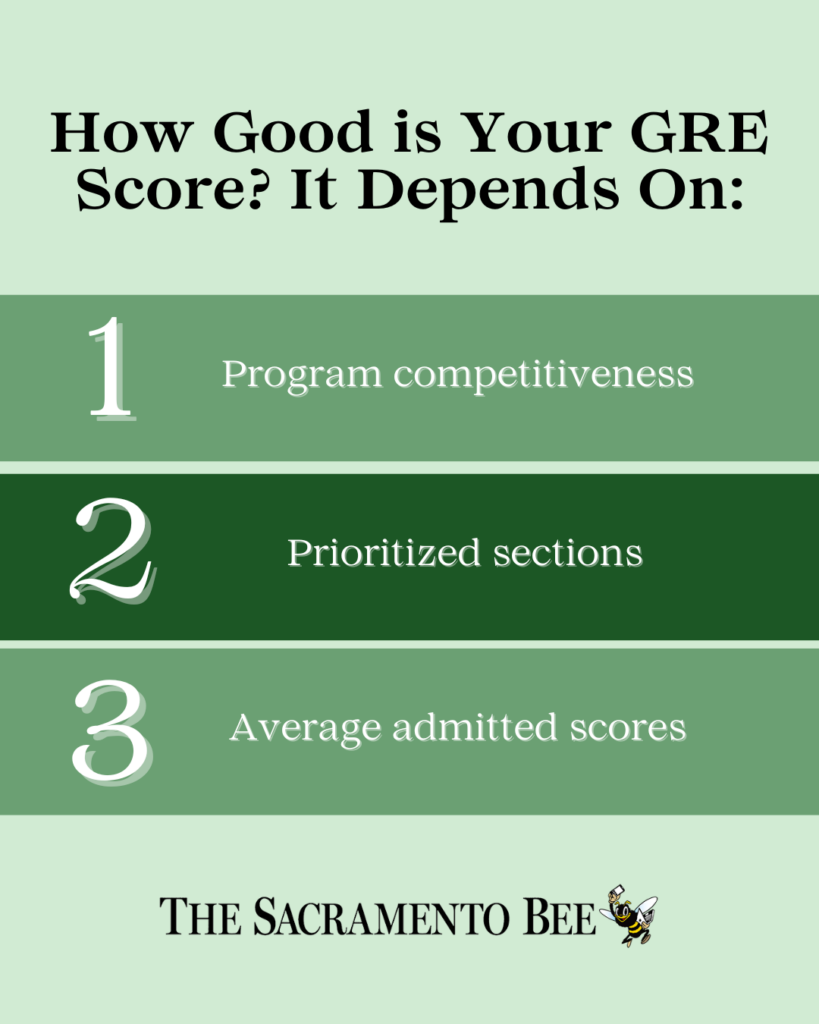
A good GRE score depends on context, not perfection.
Specifically, it depends on:
- The competitiveness of the graduate programs you’re applying to
- The discipline and skills that those programs prioritize
- Typical admitted-student profiles for that field
Because expectations vary so widely, there is no single cutoff that defines a good score for everyone.
How Schools View Each GRE Section
Verbal Reasoning
Verbal reasoning measures reading comprehension, vocabulary, and logical analysis. Programs that emphasize communication, theory, or research often value a strong verbal score, particularly when applicants demonstrate high verbal scores compared with peers.
Quantitative Reasoning
The quantitative reasoning sections focus on math fundamentals, data interpretation, and problem-solving. These scores tend to carry more weight in technical, analytical, and research-heavy disciplines.
Analytical Writing
The analytical writing section evaluates clarity, reasoning, and argument analysis. It is scored separately using half-point increments and can help distinguish applicants with strong writing and critical-thinking skills.
How GRE Scores Are Used in Admissions Decisions
GRE results are rarely considered in isolation.
Admissions committees typically look at:
- Section-level performance
- The overall GRE score in context
- How do you compare to other test takers in the same cycle
- Academic background, experience, and goals
Strong standardized test scores can support an application, but they’re only one factor among many.
How Long Most People Prepare for the GRE
GRE test takers typically spend several weeks to a few months preparing. The amount of time varies based on baseline skills, familiarity with the material, and desired outcomes.
What matters most isn’t how long you study for the GRE, but how focused and intentional that study time is.
Setting a Realistic Target Score
Instead of aiming blindly for the top of the scale, it’s more effective to be strategic.
A realistic target score should be based on:
- Published averages for your intended programs
- Your current performance level
- Which sections matter most for your field
This approach helps you allocate time and energy where it will have the biggest impact.
Study Tips to Improve Your GRE Score
Effective prep is structured and deliberate.
- Start with a diagnostic exam to identify weaknesses
- Prioritize areas with the greatest scoring upside
- Track percentile movement, not just raw points
- Consider a prep course if you need accountability and guidance
Many test takers see their biggest improvements once their studying becomes more focused and data-driven.
Final Verdict
A good GRE score is one that strengthens your application for the programs you actually want to attend. When you understand score ranges, averages, and percentiles, the GRE becomes less intimidating—and far more useful as a planning tool for grad school.
FAQ
A good overall GRE score is one that places you competitively within your intended applicant pool.
Often, yes—especially when paired with strong academics or professional experience.
Percentile ranks usually provide clearer context than raw scores alone.
Yes. Many applicants retake the exam to improve specific sections.
No. Some graduate programs have made the GRE optional, though many still accept scores.