If you’ve spent any time researching the GMAT™ exam, you’ve probably heard everything from “It wasn’t that bad” to “It was the hardest day of my life.” That gap exists because the Graduate Management Admission Test isn’t a one-size-fits-all experience. It measures multiple types of thinking—analytical, quantitative, and verbal—in a way that feels different for every person.
So, is the GMAT hard? And how hard is it, really?
Let’s break it down, section by section, with real data, insights from test takers, and my own input after taking the GMAC’s GMAT™ Mini Quiz.
Key Takeaways
- The GMAT’s difficulty varies widely by person and section — many test takers find Verbal Reasoning easier, Quantitative Reasoning manageable, and Data Insights the toughest.
- Section mean scores (Verbal 79.34, Quant 78.06, Data Insights 75.03) show that Data Insights is the hardest section on average, while verbal skills tend to come more naturally to most test takers.
- How hard the exam feels depends on your target score and the competitiveness of your chosen business school; aiming for Harvard is a very different journey than aiming for programs with more flexible expectations.
- The GMAT is a challenging exam, but most difficulty comes from pacing, format, and pressure, not from advanced content. The math is largely high-school level, and most questions are logic-driven.
- A strong GMAT score helps, but schools want well-rounded applicants, not just strong testers; professional experience, leadership, and impact matter a lot, too.
How Hard Is Each GMAT Section?
Different people find different parts of the GMAT tough. I personally found Verbal Reasoning relatively straightforward (and I’m not alone), Quantitative Reasoning surprisingly manageable, and Data Insights surprisingly difficult. Someone else could feel the exact opposite.
The good news? The Graduate Management Admission Council publishes average scores for each section, giving us a better idea of how challenging each section tends to be.
Verbal Reasoning: Often the Easiest for Many Students
Average Verbal Reasoning Score: 79.34 (on a scale of 60–90)
The verbal section evaluates your critical reasoning, reading comprehension, and overall verbal skills. Many GMAT test takers report that it feels intuitive—especially if they read often, work in communication-heavy fields, or naturally enjoy analytical writing and language-driven tasks.
Why Verbal Feels Easier for Many People:
- Reading comprehension feels familiar
- Critical thinking skills transfer easily from everyday work
- Passages are complex but not impossible
- No wild vocabulary or obscure grammar rules
Verbal may still be hard for some, of course, but the higher mean score suggests that, on average, it’s the least challenging section. It’s worth considering advice from real exam takers, like this one, who suggests not underestimating the non-math portions (note that this was written pre-Focus Edition):
“Just commit to prep and don’t underestimate any section – even supposedly easy sections like Reading Comp (if you took the TOEFL, you’ll defo underestimate this) are actually friggin difficult and can wreck your score if you’re unprepared. Use the right study material, set the right goals, and don’t stretch out your prep too much. You’ll get there.”
Redditor
Quantitative Reasoning: Tough, But Not Terrifying
Average Quantitative Reasoning Score: 78.06
Quant tests mathematical skills and data sufficiency concepts in a standardized exam format. Even students who don’t identify as “math people” often do better here than expected.
Why Quant Isn’t as Bad as Its Reputation:
- No advanced calculus or proofs
- Question styles repeat often once you get used to the format
- It’s more about “logic with numbers” than formulas and equations
- With a solid GMAT study plan, pacing becomes manageable
Most test takers score close to the mean. That suggests it’s challenging, but not impossible—and practice makes a huge difference. As a former CPA, I’m decent with math, but my skills have admittedly dulled a bit since I turned my focus to reviewing courses. However, I still performed really well in this section in the practice quiz; the questions felt more like puzzles than math problems, which helped a lot.
Data Insights: The Section Most People Struggle With
Average Data Insights Score: 75.03
The Data Insights section blends table analysis, data interpretation, and multi-step logic. If you’ve never worked heavily with data analysis or data literacy skills, this can feel like stepping into a different world.
Why Data Insights Often Feels Hard:
- Requires quick pattern recognition
- Involves layered questions
- Time pressure hits harder here
- It pulls from both quant and verbal skill sets
Many students can answer these question types when they’re relaxed—but under time pressure? That’s a whole different story.
Why the GMAT Feels Hard (Or Easy)
Beyond the sections themselves, a number of factors can shape your experience, making the exam a dream for some and a nightmare for others.
1. Your Target Score Matters
Trying to score in the 98th percentile is a very different journey from aiming for something more modest.
If you’re aiming at a highly selective business school—Harvard, Stanford, Wharton—you’re competing with applicants who often have years of experience with analytical work and test preparation. Reaching a top GMAT total score can take months of effort.
But if your goal is a strong but more accessible school? The difficulty curve changes dramatically.
Target Score Example
Purdue’s MBA program is respected, but their minimum GMAT score for applicants is only 500 (a 505 is in the 27th percentile for the GMAT Focus Edition), and they emphasize non-test factors more than many schools. They note that a 600+ helps, but they don’t make the GMAT the centerpiece of admissions.
This is why it’s important to research your options before setting your sights on a score that may demand months upon months of unnecessary pressure.
2. Your Natural Strengths Shape Your Experience
- Strong readers breeze through verbal.
- Math-confident students feel comfortable in quant.
- Analysts or engineers may find Data Insights shockingly easy.
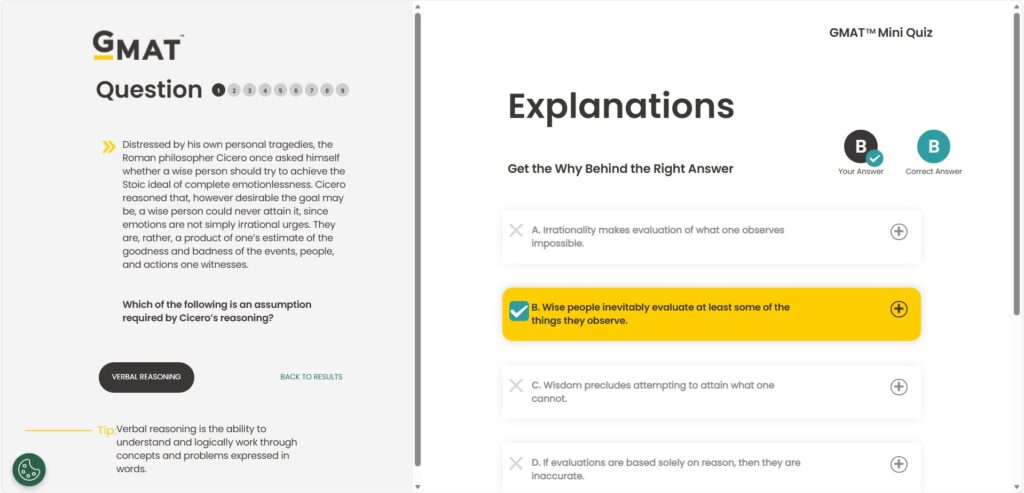
Your background shapes which part of the GMAT feels hardest. For example, I read and write for hours every day as a professional course reviewer. When I took GMAC’s official practice quiz, I quickly answered all of the Verbal Reasoning questions correctly. Frankly, it’d be embarrassing if I didn’t. Data Insights, though? I’m a little embarrassed, but let’s just say I would need a lot of work.
3. Test Anxiety Plays a Huge Role
Even if the content feels manageable, many people find the GMAT tough because:
- It’s timed
- It’s adaptive (answer correctly, and the next question is harder)
- It’s high-stakes
- It’s long enough to wear down your focus
This is why mock tests and timed drills matter—confidence reduces difficulty. You’re managing time, knowledge, and the thought of your own hopes and dreams on the line as you work through each question. You’ll need to master your test mentality to succeed.
4. The GMAT Format Takes Getting Used To
The GMAT isn’t difficult because the content is impossibly advanced. It’s difficult because:
- You need to maintain accuracy and pacing
- Wrong answers change the difficulty of future questions
- Time management is absolutely unforgiving
Even brilliant students may struggle at first, simply because the style is new. Plus, let’s face it, it’s been a long time since those high school state exams, and college tests have a different feel; your standardized testing skills might be a little rusty.
How to Make the GMAT Feel Less Hard
1. Take a diagnostic test early.
You’ll immediately see which sections feel intuitive and which need more work. Most test takers score lower on their first diagnostic test than they expect. That’s normal.
2. Use mock tests that mirror the real test.
Simulated exams build stamina and teach you how the GMAT format behaves.
3. Try a structured prep course if you’re overwhelmed.
Guided instruction helps you learn the patterns and strategies faster.
4. Build your pacing skills deliberately.
Data sufficiency, data analysis, and multistep logic problems all get easier with repetition.
5. Focus on your target score—not perfection.
It’s better to get the score you actually need than chase a number that isn’t justified by your school list.
Difficulty Depends on Your Goals and Your Story
If you want Harvard, you’re going to have a challenging exam ahead of you. But if your goals are different, the GMAT may not be nearly as intimidating as its reputation suggests.
And remember: even a great GMAT score won’t make up for a weak application. Business school programs want well-rounded students, not just good test takers. Admissions committees look for people who demonstrate:
- Ambition
- Leadership
- Passion
- Impact
- Sociability and contribution to community
- Career direction and purpose
A high score alone won’t open every door. But a solid score plus a well-developed, authentic profile will do some serious heavy lifting.
Final Thoughts
So, to summarize: Is the GMAT hard?
Yes, the GMAT is difficult, but it doesn’t have to be impossible. With the right strategy, realistic goals, and a clear understanding of your strengths, the GMAT becomes a challenge you can manage rather than Hercules’s twelfth labor.
Prepare with purpose, pace yourself, and choose the score that aligns with your future—not arbitrary bragging rights.
FAQs
The GMAT isn’t pass/fail; everyone receives a score rather than a “pass.” That said, earning a high score can be difficult because the exam is adaptive, fast-paced, and designed to measure how well you think under pressure.
Most students spend about 8–12 weeks preparing, or roughly 80–120 hours of focused study. You may need longer if you’re aiming for top-tier programs or shorter if you have a strong foundation in critical reasoning, quantitative reasoning, or data insights.
Generally, no. Neither Quantitative Reasoning nor Data Analysis test higher-level math. What makes the GMAT feel harder is the time pressure, the data sufficiency format, and the expectation that you apply logic rather than rely on long calculations.
A 700 GMAT under the 10th Edition format translates to a score of 645 in the current GMAT Focus Edition, which is a score that ranks in the 87th percentile. So yes, it’s very difficult to achieve.
Surprisingly, not in the way people expect. Quantitative Reasoning and Data Insights feel more like number-driven logic puzzles than traditional math classes; math stays at a high-school level.