How long is the GMAT exam? And more importantly: why does it matter, and how can you prepare?
The Graduate Management Admission Test isn’t just about testing knowledge; it also measures your pacing, stamina, and ability to stay focused under pressure.
Knowing the exam’s timing can be the difference between scrambling to finish and having time to double-check your work. Below, we’ll break down the GMAT Focus Edition’s timing, how long each section lasts, and practical ways to build better pacing before test day, so the clock doesn’t become your biggest obstacle.
Key Takeaways
- The GMAT Focus Edition lasts 2 hours and 15 minutes, with an optional 10-minute break and 64 total questions spread across Quant, Verbal, and Data Insights.
- Each section is 45 minutes long, so learning how to pace yourself within that uniform timeframe is essential for success.
- Most students spend 8–12 weeks preparing, building stamina, content familiarity, and time-management habits before their test date.
- Effective pacing comes from practice exams, timed section drills, and calculating your per-question time budget for each part of the exam.
- The Focus Edition’s features—such as Question Review & Edit and flexible section order—allow you to tailor the experience, but only if you manage your time intentionally.
GMAT Exam Length (Focus Edition)
The GMAT Focus Edition lasts 2 hours and 15 minutes, plus one optional 10-minute break. The exam includes 64 total questions, split evenly across three core skill areas:
Section Timing
- Quantitative Reasoning — 21 questions, 45 minutes
- Verbal Reasoning — 23 questions, 45 minutes
- Data Insights — 20 questions, 45 minutes
Each section is the same length, which helps you settle into a predictable rhythm no matter the order you choose.
Built-In Features That Affect Timing
The Graduate Management Admission Council designed the Focus Edition to feel more intuitive for test takers, especially in terms of pacing. You’ll see this reflected in several new features.
Question Review & Edit
You can now:
- Bookmark questions (also called “flagging”)
- Return to the review screen at the end of each section
- Change up to three answers (per section)
This gives you flexibility, but it also means you need to plan your time so you reach the review screen with at least a minute or two to spare.
Choose Your Section Order
You can choose whether to start with Quantitative Reasoning, the Verbal section, or Data Insights, letting you build on your strengths and warm up the way you prefer. Alternatively, you can start with your weakest area, so you have the most energy to tackle the hard stuff right off the bat.
Optional Break
You can place your break:
- After Section 1, or
- After Section 2
Strategic use of this break can help you reset mentally, especially if you plan to push hard during the longest stretch of the test.
How Long Does It Take to Study for the GMAT?
Prep time varies by background and target score, but most GMAT students spend:
- 8–12 weeks of preparation, or
- 80–120 total study hours
That gives you enough time to strengthen critical thinking, build data literacy skills, review content, take practice exams, and learn the pacing required for the real test.
You’ll want more time if:
- You’re balancing a demanding job with your studies (not to mention your social/family life and hobbies!)
- You need a high target score for selective business schools
- Quant or reading comprehension isn’t your natural strong suit
And you may need slightly less time if you have a strong math foundation or past experience with computer adaptive exams. And let’s get real: if you’re naturally pretty good at tests, that’s a huge boost, which means you can spend even more time dedicated to building your weaker test-taking muscles.

Time Management Strategies for GMAT Prep
Because the GMAT Focus Edition uses a Computer Adaptive Test (CAT), pacing is one of the most important skills you’ll build. After all, with this format, doing well leads to more difficult questions; that translates to more time needed to answer each correctly. The secret? Well, there are a few. Below are some of my favorite practical, test-taker-friendly methods to prepare for the pressure of test day.
1. Do the Math on Your Time Per Question
Knowing your exact time budget removes a ton of anxiety. Here’s a quick breakdown:
- Quantitative Reasoning: ~2 minutes and 6 seconds per question
- Verbal Reasoning: ~2 minutes per question
- Data Insights: ~2 minutes and 15 seconds per question
Obviously, these aren’t rigid limits—you’ll spend more time on some problems, less on others—but they give you a clear pacing baseline to practice with. Time yourself when you’re practicing, and over time, the pacing will feel a lot more natural.
2. Use Full-Length Practice Exams
Simulated tests help you build:
- Endurance
- Calibration for your pacing
- Familiarity with how long 45 minutes feels in a high-pressure setting
Since you can take the GMAT test online rather than in a test center, take at least one mock exam in the same setup you’ll use on your actual test date. This creates more realistic conditions for managing your focus, posture, and timing. The easiest way to get your hands on some high-quality mock exams is to purchase a GMAT exam prep course.
3. Practice Section Timing Separately
Do targeted drills for each section:
- Set a timer for 45 minutes
- Do a full batch of questions for just Quant, just Verbal, or just Data Insights
- Track how well you stay within the time frame
This builds content familiarity and pacing discipline at the same time.
4. Train Using the Question Review & Edit Mindset
Because you can revise up to three answers at the end of each section, your pacing should reflect that feature.
Practice this approach:
- Move past questions you’re stuck on
- Bookmark them
- Circle back at the end
- Edit only if you truly see the solution more clearly
It’s a powerful strategy—if you consistently reach the review screen with time left.
5. Build a Time-Tracking Habit During Study Sessions
Time yourself not to rush, but to observe your patterns. Notice:
- Which question types cause slowdowns
- Where your data analysis skills lag
- Whether you tend to overthink critical reasoning problems
- How quickly you approach table analysis and multi-step logic questions
You won’t remember all of this after a practice test, so have your notes app or a paper/pen combo by your side to record your observations. By seeing your strengths, weaknesses, and even your quirks in advance, you can adjust your approach long before test day.
Personal Example
In taking GMAC’s practice quiz and giving myself 10 minutes, I got all of the verbal reasoning section questions correct without spending much time. Hence, I suppose, becoming a writer. I probably spent the least time on Quantitative Reasoning and got most of the questions correct. However, I sped through the Data Insights questions, assuming I would get them right, and totally flopped. Now, I know that I would need to dedicate the most study time to this section AND ensure I’m reading the questions more thoroughly during the actual test!
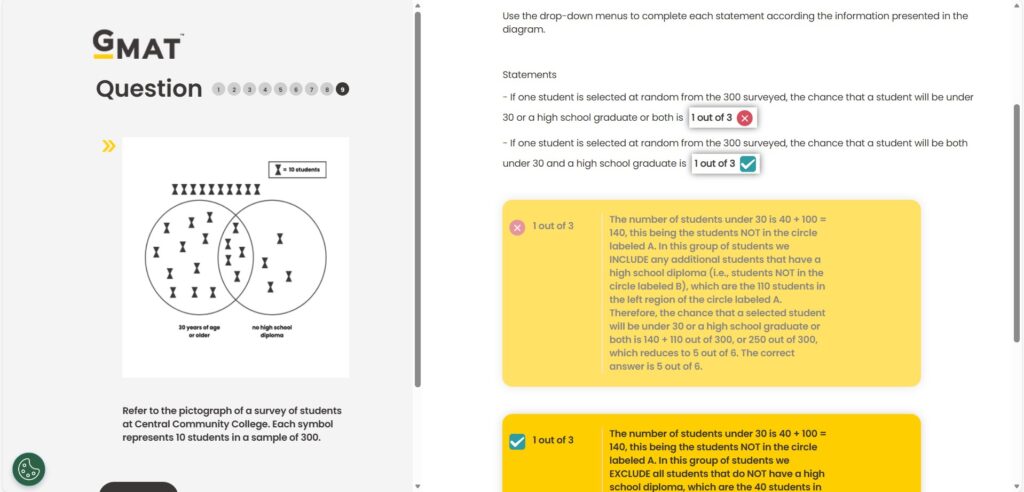
How do I know? Well, when I read the answer explanations, it wasn’t a feeling of, “wow, this is foreign.” It was a feeling of, “Hey, I know that! I could’ve gotten that right if I had paced myself better and fully understood the question.” Answer explanations bring it all home!
What Happens After the GMAT Exam?
Once your GMAT test is complete, you’ll receive your score reports within 3–5 days. Those reports break down your GMAT total score, section performance, and skill categories, helping you understand your readiness for business school programs or other graduate management programs.
Your scores are also valid for five years, which gives you flexibility as you explore graduate management education options.
Final Thoughts
The GMAT exam isn’t just about mastering content—it’s about mastering your time. Understanding the structure, preparing deliberately, and building strong pacing habits helps you stay calm and focused when it matters. With the right strategy and enough practice, you’ll walk into test day feeling steady, prepared, and fully capable of earning a score that moves you toward your next step in business education.
FAQs
The exam is 2 hours and 15 minutes, plus an optional 10-minute break. It includes three 45-minute sections covering Quantitative Reasoning, Verbal Reasoning, and Data Insights.
Most test takers spend 8–12 weeks preparing, though your timeline may vary depending on your goals, background, and target score.
On average, expect roughly 2–2.25 minutes per question, depending on the section. The exact timing varies slightly between Quant, Verbal, and Data Insights.
You can take the GMAT test online or at a test center. Pick the format that aligns best with your schedule, comfort level, and test-day environment preferences.
Use full-length practice exams, run timed 45-minute section drills, and calculate your time-per-question budget so you can pace yourself confidently during the real test.

![UWorld Discount Codes: Save $1,800 [Verified 2026]](https://www.sacbee.com/careers-education/wp-content/uploads/sites/6/2026/07/uworld-discount-code-1024x768.jpg)