Picking an SIE exam date can feel like a complete guess.
Rescheduling has a price attached, which is the other reason what the SIE costs to sit is worth knowing before you book.
Schedule it too soon, and every study session turns into a race. Push it too far away, and you may start forgetting the first chapters before reaching the last one.
A 2025 study found that students who planned and focused better reached their goals in less time. How you study can matter as much as how long you study.
There is no single answer to how long to study for the SIE exam. Your work schedule, financial background, prep course, and available hours can all change the timeline.
Today, I’ll help you estimate how long you may need, build a schedule around your week, and know when your original plan needs to change.
Key Takeaways
- Count Hours, Not Just Weeks: Your available study time changes the full timeline.
- Leave Room for Review: Finishing the lessons is not the end of prep.
- Your Course Can Set the Pace: Longer lessons may require more calendar time.
- Beginners Need More Space: New terms can make early chapters move slowly.
- Plans Can Change: Falling behind does not mean starting over.
What Is a Realistic SIE Study Timeline?
Most people should leave around four to eight weeks for SIE prep. The Securities Industry Essentials exam asks 75 scored questions in 105 minutes, so the material is broad rather than deep. Someone with securities experience may move faster, while a complete beginner may need the full eight weeks or longer.
The number of weeks alone does not tell you much, though. Studying five hours each week creates a very different timeline from studying 10.
| Weekly Study Time | Possible Timeline |
|---|---|
| 4–5 hours | 8–10 weeks |
| 6–8 hours | 5–8 weeks |
| 9–12 hours | 3–6 weeks |
| 13+ hours | 2–4 weeks |
These are starting estimates, not promises. Securities Training Corporation places common preparation around 20 to 50 hours, while other guidance recommends closer to 40 to 60 hours for many candidates.
Start With the Time You Actually Have
Do not build your plan around the version of you who wakes up early every day, never gets tired, and suddenly loves studying after work.
Look at a normal week instead.
Write down the days you can realistically study and how long each session can last. Then remove one session from the schedule. That extra space gives you somewhere to move unfinished work when life gets busy.
For example:
- Tuesday: 45 minutes
- Wednesday: One hour
- Thursday: 45 minutes
- Saturday: Two hours
- Sunday: Two hours or catch-up time
That gives you around six hours per week without needing to study every day.
Pro Tip: Add your study sessions to your calendar like real appointments. “Study sometime tonight” is very easy to push until tomorrow.
Let Your Prep Course Shape the Calendar
The SIE prep course you choose can change how long studying takes.
One course may rely on short reading assignments and quizzes. Another may include long video lessons, live classes, flashcards, checkpoints, and several simulated exams. Trying to squeeze both into the same four-week plan would not make much sense.
Before choosing an exam date, check:
- How many chapters or lessons are included
- The average length of each lesson
- How many quizzes you need to complete
- Whether live classes follow fixed dates
- How many practice exams are available
- How much access time the course gives you
Add up the main lessons first. Then leave at least one-quarter of your schedule open for review and practice. If the learning material takes three weeks, for example, do not schedule the exam at the end of week three.
You still need time to catch mistakes and return to anything that did not stick.
Try This Four-Week SIE Study Schedule
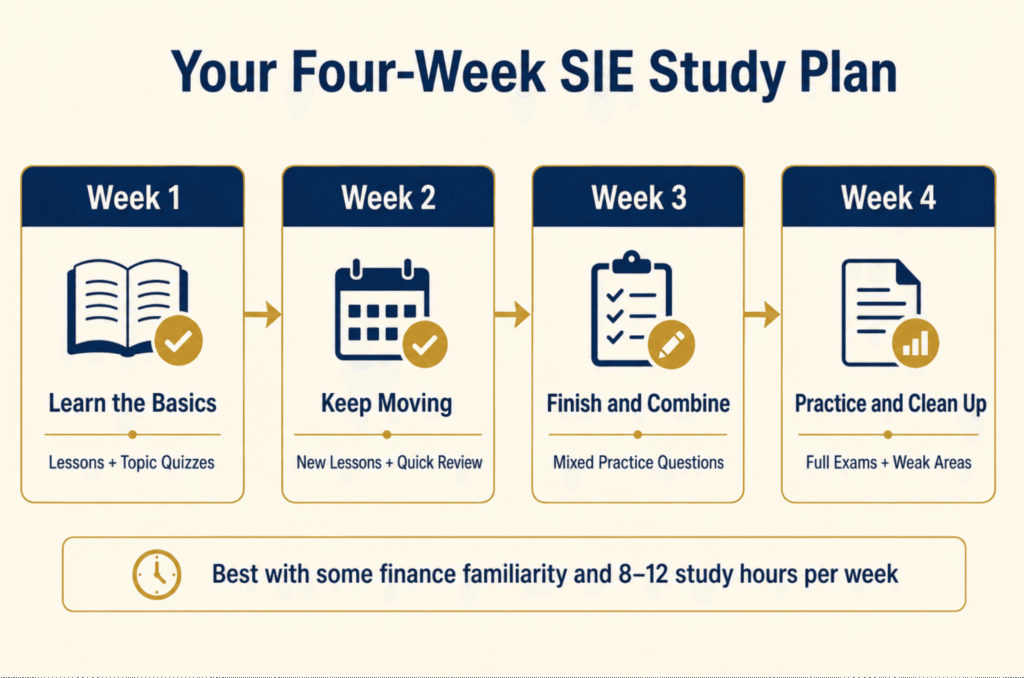
A four-week plan can work when you have some familiarity with finance and around eight to 12 hours available each week.
Week One: Learn the Basics
Begin the course and focus on understanding the new language. Complete the quizzes attached to each lesson instead of saving every question for later.
Week Two: Keep Moving
Continue through the course and briefly review the previous week. Make a short list of terms or concepts you keep mixing up.
Week Three: Finish and Combine
Complete the remaining lessons and begin answering mixed practice sets. Go back to the topics that keep showing up in your mistakes.
Week Four: Practice and Clean Up
Take full practice exams, review guessed answers, and work through your weakest areas. Keep the final day light instead of trying to relearn the entire course.
If that schedule looks packed before you even begin, use six weeks instead. A realistic plan is better than an impressive one you cannot maintain.
What Might Make Studying Take Longer?
The first few study sessions should tell you whether your original timeline is realistic.
You may need more time when financial terms are completely new, the explanations require several rereads, or you keep forgetting earlier material. Work, school, and family responsibilities can also turn a four-week plan into six without anything going wrong.
Your timeline may be shorter when you:
- Already work around securities or investments
- Recently completed a finance class
- Can study consistently throughout the week
- Learn quickly through practice questions
- Have a course that fits your learning style
Do not rush because someone else finished in two weeks. They may have started with years of experience or spent several hours studying each day.
The better question is whether your current pace leaves time to review, not whether it matches another person’s schedule.
When Should You Change Your Exam Date?
Falling one lesson behind does not mean you need to reschedule. Use your catch-up time first and make small changes before moving the exam.
A new date may make sense when:
- You still have several lessons left during the final week.
- Practice scores are not improving.
- You have barely answered mixed questions.
- Large parts of the material still feel unfamiliar.
- You missed more study days than you completed.
- You are rushing through explanations to finish faster.
More time will only help when you have a plan for using it. If you reschedule, decide exactly what needs to change. That could mean completing one lesson per day, reviewing mistakes every weekend, or switching to a prep format that is easier to follow.
Final Thoughts on SIE Study Time
Your study timeline does not need to look perfect on paper. It needs to survive real weeks when work runs late, plans change, or one chapter takes twice as long as expected.
Start with the hours you can honestly give, then choose a timeline that leaves space for both learning and practice. Four weeks may be enough for someone with experience and plenty of free time. Another person may need eight weeks to reach the same place.
Neither one is doing it wrong.
If the SIE is your first step toward a registered role, it helps to know what comes after it. Our comparison of the SIE and the Series 7 breaks down how much more study time that top-off exam usually demands.
Keep an eye on your pace, build in catch-up time, and adjust before the final week becomes a scramble. A slightly longer plan is usually better than spending every study session worried about the date.
FAQs
It can be enough if you already know the material and have several hours available each day. Two weeks will likely feel rushed for a complete beginner.
Yes. Short weekday sessions and longer weekend blocks can make it manageable. Leave extra time in your schedule for busy workdays and missed sessions.
Four or five days can give you steady progress without requiring daily sessions. Consistency matters more than forcing yourself to study seven days per week.
Try to finish the main lessons before the final week. This leaves time for mixed questions, practice exams, and weak-area review.
Not necessarily, but a long timeline can make earlier material harder to remember. Include regular review sessions so the first chapters do not disappear by exam day.
Adjust the weekly goals or move the exam date if needed. Do not rush through the final lessons simply to stay loyal to a schedule that no longer fits.