Thinking about taking the CFP® exam for the first time? Second? Third?
You may be wondering how many chances you actually get in your lifetime. And that’s a valid question, considering this exam is one of the toughest professional certification tests in the financial industry.
It calls for months of study, serious focus, and a complete understanding of financial planning topics. So, if you’ve failed before (or you’re planning ahead), you want to know how many opportunities you’ll have before time runs out.
I’m going to walk you through how many times you’re allowed to take the CFP® exam, what happens if you fail, and how to plan your next move, so you don’t waste energy guessing and stressing.
Key Takeaways
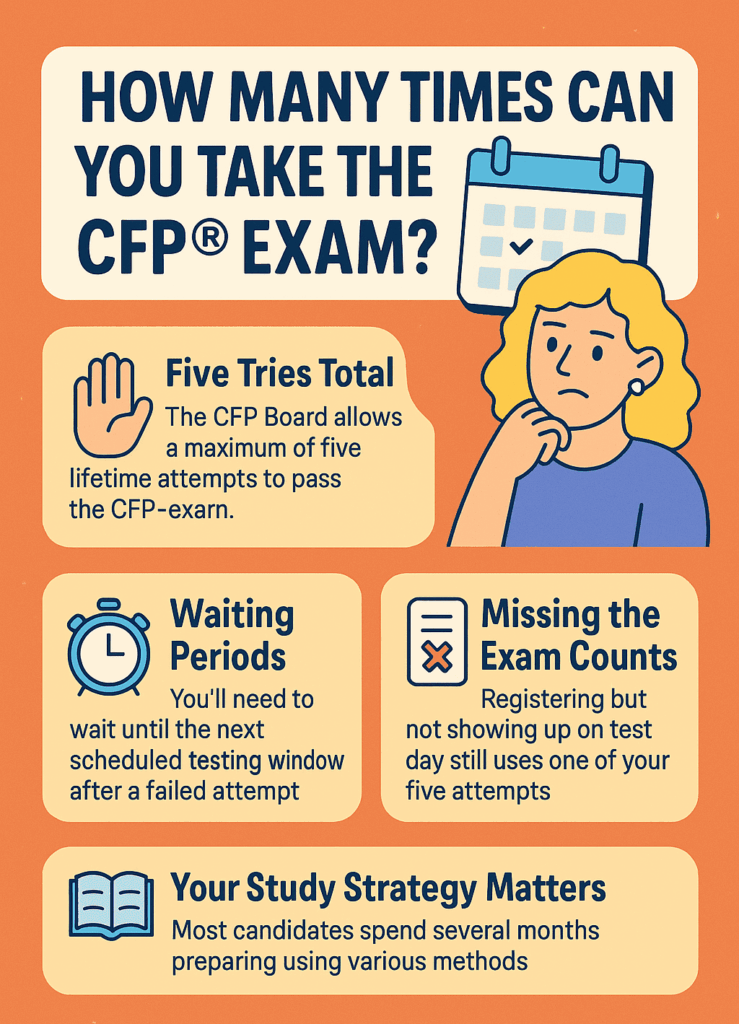
- ✋ Five Tries Total: The CFP Board allows a maximum of five lifetime attempts to pass the CFP® exam. Every failed attempt counts, so you have to treat each one seriously and come in prepared.
- ⏰ Waiting Periods: You can’t retake the CFP® exam immediately after a failed attempt. You’ll need to wait until the next scheduled testing window, and multiple failures may increase the length of the required wait.
- 📄 Missing the Exam Counts: Registering but not showing up on test day counts as a no-show but does not count as one of your five attempts. Always double-check your exam date, time, and location, and contact the CFP Board if there’s an emergency.
- 📚 Your Study Strategy Matters: Most candidates spend several months preparing using practice exams, CFP® review courses, and a great study plan. Focus on understanding financial planning concepts, especially in your weak areas.
- 💼 Meeting All Standards to Pass: Beyond just taking the exam, earning the CFP® designation requires meeting education and experience standards and following professional conduct rules.
CFP Board Retake Limits
You used to be able to take the CFP® exam as many times as you needed to pass. Unfortunately, that’s no longer the case. The CFP Board updated its policy in January 2012, so there are currently two limits to keep in mind:
- You can attempt the exam five times in your lifetime.
- You can attempt the exam no more than three times in any 24-month period.
Yes, you read that right. Five total shots. Three tries in two years.
These rules apply to all candidates. If you hit three attempts in a row within two years, you’re required to sit out for a full year before registering again. After your one-year timeout (and hopefully a lot of studying), you’ll still be allowed to test again, as long as you haven’t exceeded the five-attempt lifetime limit.
What If You Took the Exam Before 2012?
There’s a small exception here: if you attempted the CFP® exam four or more times before January 1, 2012, you’re eligible for two additional attempts. That gives you a little more room if you’ve been in the process for many, many years and took attempts before the current policy kicked in.
But keep in mind those two extra tries are final. There’s no appeal or extension after that.
You Have to Retake the Full Exam Every Time
If you fail the CFP® exam, you’ll have to retake the entire thing. There are no partial retakes or skipping over sections you passed before (bummer, but completely fair).
Each attempt also requires you to pay the full exam fee again. So, aside from the emotional weight of another try, it hits your wallet, too.
This also means you have to start from scratch when it comes to your preparation. You won’t be able to breeze through just because you remembered a few questions. The exam is regularly updated, and what you studied last year might not be the same version of the test you will get next time.
Don’t be deterred by that, though. There are plenty of success stories:
“I thought it was easy. Probably because I studied too much. I used Kaplan and their QBank religiously. Their mock test seemed harder than the real thing. I was pretty much out of there with a little less than half-time left. My thought process is if I did not know the answer right away, to just skip to the next question.”
u/moabal
Need to Reschedule or Withdraw? Here’s What Happens.
Life happens. Maybe you get sick, need to move your test, have a baby, or just aren’t ready. You have options, but they come with rules and fees.
If you need to reschedule your Prometric appointment (meaning you want to change the date, time, or test location), you can, depending on how early you decide to do so.
- 61+ days before the exam: Free to reschedule.
- 31 to 60 days out: $35 rescheduling fee.
- 5 to 30 days out: $100 rescheduling fee.
- Less than 5 days: No changes allowed.
Keep in mind that rescheduling is only allowed within the same testing window. If you’re trying to move your test to a future window (say, from the March exam to the July exam), you’re not “rescheduling” anymore. You’re postponing or withdrawing, and different rules apply.
What Postponing Looks Like
When you postpone, you still intend to take the exam, but not this round. You can only postpone once per registration, and you have to take the exam within the next two scheduled windows.
The fee for postponing is a spicy $500.
It’s not cheap, so make sure you really need to move it before you make your choice. Also, remember that your postponement request must happen by the late registration deadline.
Didn’t Schedule a Prometric Appointment?
Let’s say you registered with the CFP Board, paid your fee, and got your education verified, but never actually scheduled a seat with Prometric.
If you fail to schedule by the withdrawal/postponement deadline, you’ll be automatically deregistered and treated as a postponement. That means (you guessed it) another $500 postponement fee.
You Can Cancel Altogether
Decided to just take the L and not go through with it? You can withdraw your exam application. You’ll get a $200 refund less than what you paid, but better than losing it all.
Again, make sure you act before the late registration deadline. And don’t try to cancel through Prometric. It won’t work. You’ll need to email the CFP Board directly to make your withdrawal official.
Sometimes, You Get a Break for Emergencies
If you have a medical emergency or something serious comes up, the CFP Board might waive your forfeiture fee.
You’ll need to send a written request within ten business days after the exam window closes. It has to be backed by documentation from a third party. For medical issues, you’ll need a letter from a doctor explaining why you couldn’t take the test. For other emergencies, third-party proof is still required.
Skip this step (or send it late), and your request won’t be reviewed.
What Happens If You Just Don’t Show Up?
If you miss your scheduled CFP® exam without an approved medical or emergency exception, you forfeit the entire exam fee. You will not receive a refund, credit, or automatic makeup date, so you’ll have to register and pay again for a future exam window.
The good news? A no-show does not count toward CFP Board’s lifetime limit of five exam attempts. CFP Board may also waive the fee forfeiture for a documented medical or other emergency, but you must submit the request within 10 business days after the exam window closes.
How Many Tries Should You Plan For?
Ideally? One. But realistically, give yourself room to take it twice or even three times. Just don’t fall into the trap of treating retakes casually. With a lifetime cap and a two-year limit, your number of shots is limited.
Each attempt costs time, money, and energy. So, plan your study schedule accordingly, and take each test seriously. And if you’ve already used up a few tries, make sure you take a big chunk of time to study. Those who find themselves constantly failing the exam are usually not dedicating enough time to learning. Treat it like a second job.
Final Thoughts: How Many Times Can You Take the CFP® Exam?
The CFP® exam is tough, and you only get five attempts to pass. Plus, you’re limited to three tries within any two-year period.
Fail three times in a row? You’ll need to wait a full year before trying again. Need to reschedule or postpone? There’s a fee. Skip the exam entirely? You’ll forfeit what you paid.
Set yourself up for success by knowing the rules before you register. When it’s time to test, make it count.
You’ve got this—just don’t waste your chances.
FAQs
You get five lifetime attempts. After each try, you must wait until the next window. Fail three times in a row and you’ll face a one-year wait.
Miss the deadline? Wait for the next window. Emergencies may qualify for a one-time deferral, but only under strict conditions.
Cover all major planning areas—tax, insurance, retirement, investments, and income. Practice with case studies and mock exams to strengthen weak spots.
Two three-hour sessions with a break. Expect challenging, scenario-based questions. Simulate the experience with timed practice.
CFP® focuses on holistic financial planning. ChFC® and CPA follow different tracks and specialties. CFP® also requires meeting ethics, education, and experience standards.