As of a count taken a few years ago, there were 931,640 PE licenses in the U.S. I don’t think I’d be wrong in thinking there’s probably well over a million now. One thing I know for sure is that the path each of those licensed PEs took was one paved with a lot of hard work and preparation.
Stamina is part of the score, and how long you are in the chair explains why the afternoon is where most candidates fade.
If you’re on that path, don’t let the exam’s tough reputation intimidate you. Passing is very achievable. In the following, I’ll help you demystify the PE exam pass rates, explore which disciplines are tougher than others, and give you the insights I believe you need to build a successful study plan.
Key Takeaways

- Rates Vary Widely: PE exam pass rates differ significantly across the various engineering disciplines, with some exams having much higher success rates than others.
- First-Timers Have an Edge: First-time test-takers consistently have higher pass rates than repeat test-takers, highlighting the importance of being fully prepared for your first attempt.
- The Structural Exam is a Beast: The PE Structural exam consistently has one of the lowest pass rates, largely due to its 16-hour length and complex engineering problems.
- It’s All Computer-Based Now: All PE exams are now computer-based testing (CBT) exams, administered year-round at approved testing centers, offering more flexibility in scheduling.
- Preparation is Everything: Your personal success has less to do with national averages and more to do with your study schedule, the quality of your study resources, and your dedication to working through practice exams.
A Closer Look at the PE Exam Pass Rates
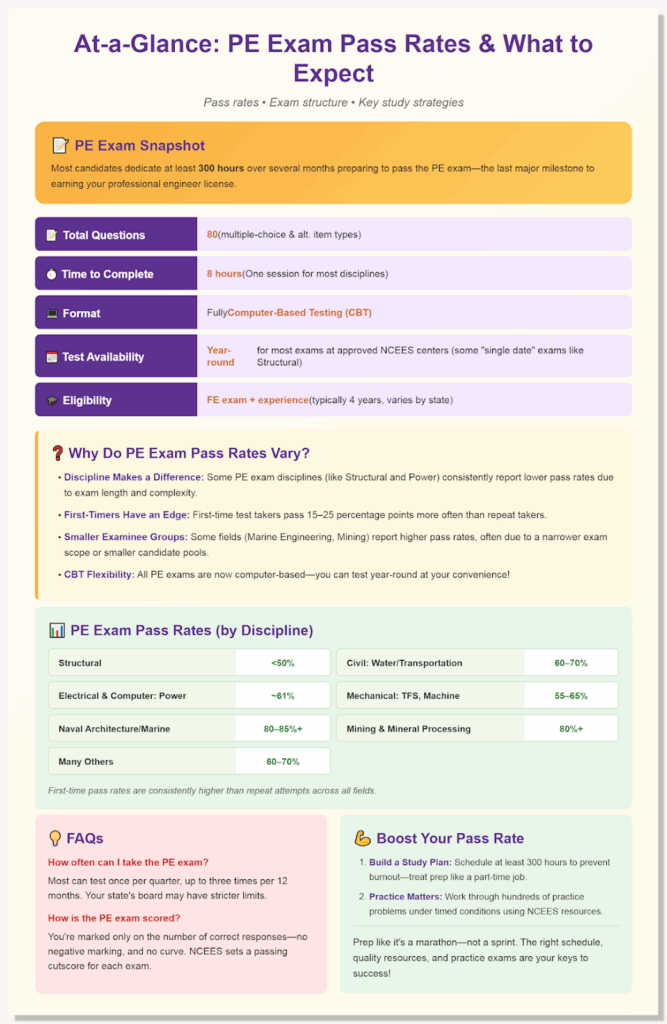
So, what do the numbers say? The National Council of Examiners for Engineering and Surveying (NCEES) regularly updates pass rates for each discipline. For most PE exams, the first-time pass rate often falls between 60% and 70%. However, that’s just a ballpark figure, so the rate for your specific exam could be different. Disciplines with a smaller examinee population, like Naval Architecture and Marine Engineering, often post higher pass rates.
One of the biggest factors, and one I always find to be telling, is the difference between first-time and repeat test-takers. Across the board, those taking the exam for their first attempt perform much better, often by 15-25 percentage points. This just proves how important it is to prepare thoroughly so you only have to take it once.
Which PE Exam Disciplines Are the Hardest?
While “hardest” is subjective, I think the exam pass rates give you a clear indication of which exam tests pose the greatest challenge. Some disciplines consistently have lower pass rates due to the ton of material or the complexity of the problems.
- The Toughest Nut to Crack: The PE Structural exam is the undisputed heavyweight champion of difficulty. It’s a 16-hour, two-day exam with a pass rate that is consistently among the lowest.
- Other Major Challenges: The Electrical and Computer: Power exam and certain Mechanical Engineering exams like Thermal and Fluid Systems or Machine Design and Materials also tend to have lower-than-average pass rates.
At the other end of the spectrum, some disciplines see higher pass rates. That doesn’t mean they’re easy—there’s no such thing as an easy PE exam—but success seems more frequent. The PE Civil exam, the most common PE exam, usually sees solid pass rates in specializations like Transportation Engineering and Water Resources, and Environmental Engineering.
Understanding the Exam Format and Scoring
All PE exams are now computer-based testing (CBT) exams administered year-round. This is a big change from the old paper format and offers much more scheduling flexibility for your exam day.
Most exams consist of 80 questions over an 8-hour period. Make it your strategy to answer every question because there’s no penalty for wrong answers. Your final score is just based on the number of answers you get right, so a guess is always better than a blank.
The exam isn’t graded on a curve. NCEES determines a minimum standard of competency, and if you meet it, yay, you pass the PE. So getting your hands on an NCEES practice exam is a great way to familiarize yourself with the CBT format.
How to Dramatically Improve Your Chance of a PE Exam Pass
Ultimately, national pass rates are nothing more than statistics. Your personal success is going to depend entirely on your preparation. Here are a few proven ways to significantly improve your chances:
- Build a Solid Study Plan: Treat your preparation like a part-time job. Dedicate at least 300 hours and create a realistic study schedule that prevents burnout.
- Use High-Quality Study Resources: Invest in good review manuals and online courses, but if you ask me, the most important resources are practice exams. Working through hundreds of practice problems under timed conditions is the best way to prepare. It’s the most effective way to eliminate the fluff in your knowledge and focus on what matters.
- Don’t Go It Alone: Join study groups, either online or in person. Explaining a concept to someone else is a powerful way to ensure you’ve mastered it.
Final Thoughts
Think of the journey to becoming a Professional Engineer as a marathon, and the PE exam as the final lap. If there’s one thing I hope you take away from this, it’s that you shouldn’t let the statistics define your expectations. Your ability to pass isn’t determined by a national average but by your commitment to consistent, high-quality preparation. By understanding the exam, creating a solid study plan, and putting in the work, you can significantly improve your odds and earn that PE license you’ve worked so hard for.
FAQs
The overall pass rate for first-time takers across most PE exam disciplines typically falls between 60% and 70%. However, this varies widely by the specific engineering discipline, with some exams being much higher or lower.
Based on consistently low pass rates—often below 50%—the PE Structural exam is often said to be the most difficult. Its 16-hour, two-day format and the complexity of its content are part of that.
No PE exam is “easy,” but some disciplines, like Naval Architecture and Marine Engineering or Mining and Mineral Processing, often have the highest pass rates, sometimes exceeding 80%. This is often due to a more focused scope or a smaller pool of examinees.
NCEES policy allows you to take the exam once per testing window and no more than three times in a 12-month period. However, your specific state licensing board may have its own rules regarding the total number of attempts allowed, so check with them.
The exam is computer-based and scored on the total number of correct answers. There is no penalty for guessing. Instead of being graded on a curve, it uses a criterion-referenced method where NCEES sets a minimum competency level required to pass.

![PPI2Pass FE & PE Promo Codes [Verified October 2026 ]](https://www.sacbee.com/careers-education/wp-content/uploads/sites/6/2025/04/PPI2Pass-Coupons-1024x569.png)