Earning a Professional Engineering (PE) license is one of the biggest milestones in an engineering career, whether you’re in civil engineering, mechanical, electrical, or another discipline. Becoming a licensed PE signals to employers, clients, and the public that you’ve mastered the fundamentals of your field and can practice engineering independently.
Further, you’ll be able to join a group of nearly 500,000 other licensed professionals in the United States.
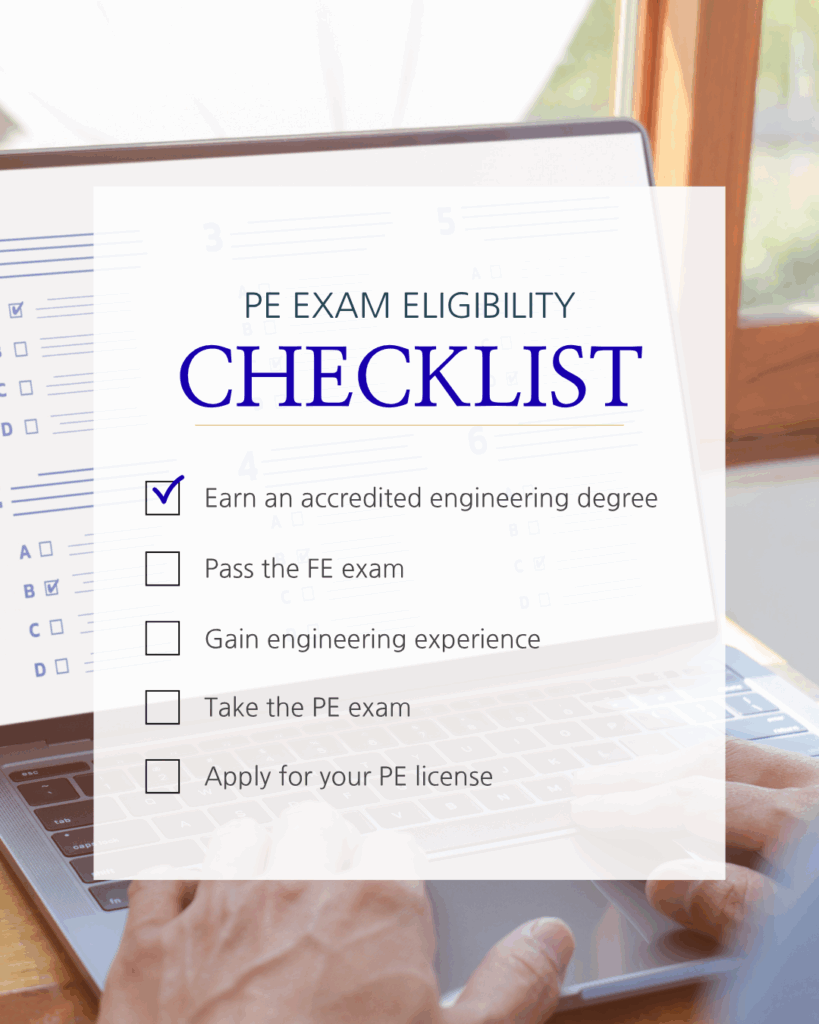
The PE Exam is a key part of this process, but it’s not the first step. Let’s walk through the education, experience, and examination requirements you’ll need to meet to become licensed in the U.S.
Key Takeaways
- Education First: Start with an ABET-accredited engineering degree to meet most state licensing board requirements.
- Early Exam Success Helps: Passing the FE early keeps engineering exam knowledge fresh and builds momentum.
- Experience Matters: You’ll need at least four years of progressive, supervised work before taking the professional engineer exam.
- Licensing Has Clear Stages: Requirements fall into three basic categories—education, experience, and examination.
- One License, Many Paths: States issue the same professional engineering license, but the path can vary for nontraditional candidates.
Step 1: Earn an Accredited Engineering Degree
The foundation of licensure is your education. In almost every state, you must earn a bachelor’s degree from an ABET-accredited engineering program. ABET, short for the Accreditation Board for Engineering and Technology, is the recognized body that ensures programs meet rigorous academic standards in engineering principles, mathematics, and science.
Completing an accredited engineering degree ensures you have the engineering knowledge needed for professional licensure. Some states also accept degree combinations—such as a non-accredited degree in engineering supplemented with graduate coursework—or recognize engineering technology programs with additional experience requirements.
If you’re unsure whether your degree qualifies, check your state licensing board’s board rules or the NCEES (National Council of Examiners for Engineering and Surveying) database for approved programs. Ideally, do this before earning your degree, so you aren’t in for a rude awakening after four years of irreversible hard work.
Step 2: Pass the FE Exam
After earning your degree, the next step is to pass the Fundamentals of Engineering (FE) exam. This exam, often taken shortly after graduation, tests your grasp of core engineering education topics like calculus, physics, statics, and discipline-specific subjects. Passing the FE demonstrates that you’ve mastered college-level engineering fundamentals and qualifies you as an Engineer in Training (EIT) or Engineer Intern (EI), depending on your state.
You don’t need work experience to take the FE—it’s designed to be passed early in your career while your academic knowledge is fresh. Many engineers sit for the exam during their final semester or shortly after graduation.
Step 3: Gain Progressive Engineering Experience
Passing the FE alone isn’t enough. To sit for the PE, you’ll typically need at least four years of progressive engineering experience under the supervision of a licensed PE. “Progressive” means that your responsibilities should grow over time—you’re not just performing calculations, but also applying engineering principles in real-world scenarios and taking on increasing professional judgment.
Experience requirements vary somewhat by state, but generally include:
- Working under the direct supervision of a licensed professional engineer
- Participating in engineering work relevant to your discipline
- Demonstrating competency in both technical skills and ethical practice
This period is where your classroom knowledge becomes professional expertise. It’s also where you build the work history needed to qualify for your initial license.
Step 4: Take the PE Exam
Once you meet the education and experience requirements, you’re eligible to take the PE Exam. Administered by NCEES, the PE exam (Principles and Practice of Engineering) tests for a minimum level of competency in a particular engineering discipline. It’s typically taken after four years of active practice and is required for professional engineering licensure in every state.
There are more than 20 different PE exams of varying difficulties, each tailored to a specific discipline—such as civil, mechanical, electrical, or structural engineering. Each exam focuses on topics relevant to that field, reflecting what licensed engineers need to know to protect public health, safety, and welfare.
The engineering examination is offered year-round at Pearson VUE testing centers. Most are computer-based now, though some specialized exams still follow fixed exam windows. Passing it demonstrates that you’re ready for active practice as a licensed professional.
Special Cases: Non-Traditional Paths
Not every engineer follows a straight path. If you earned your degree abroad, completed a non-accredited degree, or took an engineering technology program, you may still qualify. Many state boards have pathways for degree combinations or additional graduate degree requirements, often paired with more engineering experience (sometimes up to eight years).
Some states also have exceptions for individuals with significant experience who want to pursue professional engineering licensure later in their careers. In these cases, the state licensing board reviews applications individually, following national council guidelines but applying its own board rules.
Step 5: Apply for Your PE License
After passing the PE exam, you’ll submit your application to your state licensing board. This usually includes:
- Verification of your ABET-accredited engineering program degree
- Documentation of your FE and PE exams
- Records of your progressive engineering experience
- Professional references (often licensed engineers)
Once approved, you’ll receive your PE license, allowing you to practice engineering independently, sign and seal plans, and take legal responsibility for your work.
Choosing the Right PE Exam Prep Course
Preparing for the NCEES PE exam is a significant undertaking, especially if you’ve been out of school for several years. The best way to maximize your chances of passing is to use a structured PE prep course that aligns with your discipline’s exam specifications.
When choosing a course, consider:
- Format: Do you prefer live instruction, on-demand videos, or self-study?
- Practice Materials: Look for courses with diagnostic tools, practice problems, and full-length engineering examination simulations.
- Reputation: Prep courses with proven pass rates and strong instructor support can make a huge difference.
- Schedule: Pick a prep timeline that fits with your work and personal commitments.
While self-study over a long period of time works for some, a good prep program can save time and focus your efforts on the areas that matter most.
Bottom Line
Becoming a licensed PE is a multi-step process, but it’s also one of the most rewarding achievements in the civil engineering and broader engineering community. By completing an ABET-accredited program, passing the FE and PE exams, and gaining meaningful engineering work experience, you’ll join a respected group of professionals trusted to lead infrastructure projects, protect the public, and advance the profession.
Whether you’re just starting your degree or preparing for the exam, understanding the PE exam requirements early helps you plan strategically and stay on track toward professional success.
FAQs
Most states require an ABET-accredited engineering degree, passing the FE exam, four years of progressive work experience, and passing the PE exam.
In most states, no. You must pass the FE before sitting for the PE. Some states allow alternative experience-based pathways, but they’re rare.
It typically takes about eight years: four for your degree and four for professional experience. Some paths may be longer if your degree isn’t accredited.
Experience must involve applying engineering principles under a licensed PE’s supervision. Increasing responsibility over time is key.
Yes, but you may need additional education or experience. Many state boards review such cases individually, following national guidelines.