According to Nasdaq, the pass rate of the Series 65 exam falls in the 65% to 75% range. While that’s relatively high, that means 1 in 3 to 1 in 4 candidates fail.
One way to improve your chances? Know the exam like the back of your hand.
But before you dive into prep mode, let’s walk through what the Series 65 is all about, what the exam covers, how to study effectively, and how to boost your odds of hitting that passing score.
Key Takeaways
- License for Fee-Based Advice: The Series 65 lets you legally give investment advice without selling financial products.
- Test Covers More Than Just Rules: You’ll be tested on laws, ethics, portfolio management, and real-world financial planning.
- No Sponsoring Firm Required: Unlike many other securities licenses, you can take the Series 65 on your own.
- Low Cost, Big Opportunity: For under $200, this exam unlocks access to advisory roles and independent career paths.
- Prep Is Key to Passing: The test isn’t tricky if you study consistently and focus on ethics and scenario-based questions.
📋 What Is the Series 65 Exam?
Let’s keep it simple: the Series 65 is the Uniform Investment Adviser Law Examination. It’s required for most people who want to work as investment adviser representatives (IARs) and provide investment advice for a fee. Unlike other licenses, you don’t need to be selling securities or products to use it. Your job involves guidance, planning, and acting in the client’s best interest.
It’s also different from exams like the Series 7 because it doesn’t require a sponsoring firm—you can sign up on your own and get started independently.
The test is designed by NASAA and administered through Prometric, with registration handled via FINRA’s system. It’s a closed book test, meaning no notes, no calculators, and no lifelines.
🧠 What the Exam Covers
This isn’t a math-heavy exam, but it’s not a walk in the park either. The Series 65 covers a wide range of topics designed to test whether you can legally and ethically operate as a financial professional.
Here’s a breakdown of what the exam covers and how it’s weighted:
📚 Topic Breakdown
- Laws, Regulations, and Guidelines (about 30%): You’ll learn the rules laid out by the Uniform Investment Adviser Law and what counts as unethical business practices.
- Investment Vehicle Characteristics (about 25%): Think mutual funds, ETFs, insurance products, and other tools used in financial planning.
- Economic Factors and Business Information (about 15%): Covers how economic factors like inflation, interest rates, and fiscal policy affect markets and client portfolios.
- Portfolio Management and Strategies (about 30%): This includes risk analysis, asset allocation, retirement planning, and strategies for high-net-worth clients.
Altogether, the exam consists of 130 scored questions plus 10 unscored ones. You’ve got 180 minutes to finish, and you’ll need at least a 72% overall test score to pass.
💸 How Much Does It Cost?
The exam fee is $187. That’s it. No yearly subscription. No extra testing center charges. But that’s just the cost to sit for the exam—you’ll likely want to invest in a study program or prep materials, which could range from $150 to $500, depending on what you go with.
Still, considering what the Series 65 license lets you do (like become a paid adviser without having to earn commission from selling financial products), it’s a pretty reasonable entry fee for the securities industry.
📖 How to Study for the Series 65
This is where a lot of people either make it or break it. The Series 65 isn’t impossibly hard, but it’s detailed. If you go in cold, you’ll probably walk out with more questions than answers.
Here’s what works for most:
- Use practice exams. They help you get used to how questions are worded and where you’re weakest.
- Create a study schedule. Even 1 hour a day for a few weeks can make a difference.
- Don’t skip ethics. The unethical business practices section is heavily tested, and it’s where a lot of people slip up.
- Break it up. Try rotating between flashcards, videos, quizzes, and reading. It’ll keep your brain from going numb.
When I tested Series 65 prep courses, I noticed the best ones emphasized ethics, scenario-based questions, and real-world application. If a course skips that, skip the course.
👩💼 Who Takes the Series 65 (and Why)
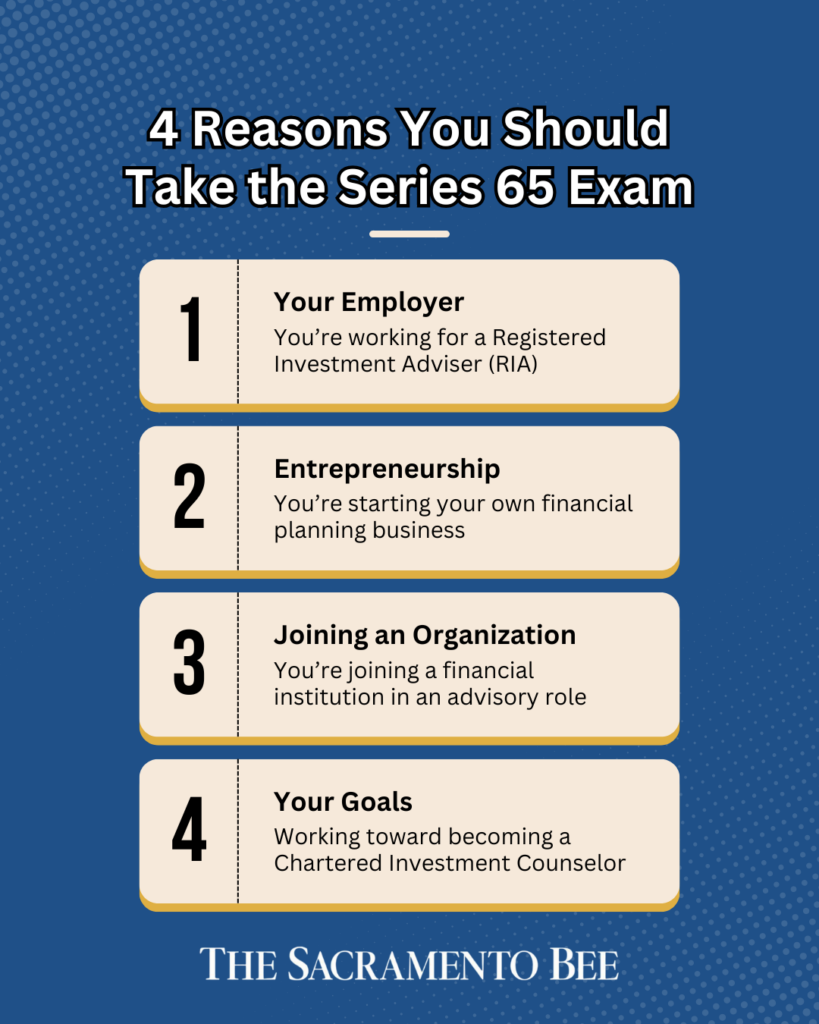
Most people who take the Series 65 are aiming to become financial professionals in a fee-only advisory role. That could mean:
- Working for a Registered Investment Adviser (RIA)
- Starting your own financial planning business
- Joining a financial institution in an advisory role
- Working toward becoming a Chartered Investment Counselor or pursuing other advanced credentials
It’s also a solid choice for people transitioning from sales roles as registered representatives in the advice world. If you’re tired of pushing products and want to focus more on strategy and guidance, this license is a significant pivot.
🧾 What Happens After You Pass?
Once you pass the exam, your score is valid for two years. During that time, you’ll need to register with a firm or file as an independent adviser in your state. Each state has its own process, but most follow a similar pattern.
After that, congrats! You’re officially qualified to provide investment advice and build a career centered around helping clients reach their financial goals.
✅ Final Thoughts
The Series 65 is more than just another test—it’s a gateway into a career where you can work with people, make a real impact, and build something meaningful (and profitable). Whether you want to advise individuals, run your own practice, or grow within a larger firm, this license is your launchpad.
It’s not just about passing—it’s about understanding what you’re walking into. And with the right prep and mindset, you’ll not only pass—you’ll be ready to thrive.
FAQs
The Series 65 exam qualifies individuals to become investment adviser representatives, allowing them to provide investment advice to clients for a fee legally.
It’s challenging if you go in unprepared, but manageable with a study plan, prep course, and Series 65 practice questions. Most of the difficulty comes from how the exam covers topics in-depth, not complex math.
The Series 7 is more complex and includes more math and product details. Series 65 is broader in concept, focusing more on ethics and planning.
The exam fee is $187. You’ll also want to budget for prep materials, which usually adds another $200–$500, depending on the course you choose.
No, the SIE (Securities Industry Essentials) exam isn’t required for the Series 65. You can take the Series 65 on its own without any prior exams.