The job growth rate of the financial advisor (a common role for Series 65 holders) is astronomical: 17% compared to a measly 4% average. But there’s more appeal to earning a Series 65 than growth alone; the salary is equally desirable.
But what Series 65 salary can aspiring investment advisor representatives expect?
Fair question—after all, getting licensed takes time, effort, and a little bit of cash up front. You want to know if it’s actually going to pay off.
Let’s walk through the real-world salary expectations for Series 65 holders, what kind of jobs you can get, and how your income might grow as you gain experience and build your client base.
Key Takeaways
- Solid Starting Pay: Entry-level salaries for Series 65 holders typically start around $50,000–$70,000.
- Room to Grow: Experienced advisers can earn $120,000+—especially with a strong client base or high assets under management.
- Flexible Fee Models: Series 65 professionals can charge by the hour or based on portfolio value, offering scalable income.
- Independent or Firm-Based: This license works whether you’re building your own business or joining a registered investment adviser firm.
- Low Cost, High ROI: With total startup costs under $700, the Series 65 offers a strong return on investment for most career paths.
💼 What Kind of Work Can You Do with a Series 65 License?
Before we dive into paychecks, let’s clarify what you can actually do once you’ve passed the Series 65.
Unlike other securities licenses like the Series 7, which is required for selling securities and mutual funds, the Series 65 focuses purely on giving fee-based investment advice—no product sales involved.
Here’s what that might look like:
- Offering financial planning services to individuals or families
- Building long-term investment strategies
- Working with high-net-worth clients on wealth management
- Charging an hourly fee or a percentage of assets under management (AUM)
You might work independently, join a small registered investment adviser (RIA) firm, or become part of a larger financial institution. The flexibility is one of the biggest perks of this career path.
💰 Series 65 Salary: What You Can Expect
Now onto the money talk. The good news? Most personal financial advisors and investment advisers earn solid, livable salaries, and there’s room to grow as you build strong client relationships and get more comfortable with the job.
Let’s break down the numbers.
📊 Average Salary
According to the Bureau of Labor Statistics, the average base salary for personal financial advisors is around $100,000 per year. However, that number swings pretty widely depending on your role, location, and client base.
Here’s a rough breakdown of what Series 65 salary ranges can look like:
- Entry-Level (0–2 years): $50,000–$70,000
- Mid-Level (3–7 years): $70,000–$120,000
- Experienced (8+ years or high AUM): $120,000–$150,000+
Keep in mind—those numbers don’t always include profit sharing, performance bonuses, or revenue splits from a firm, which can add tens of thousands more.
🕒 Hourly vs. AUM Fees
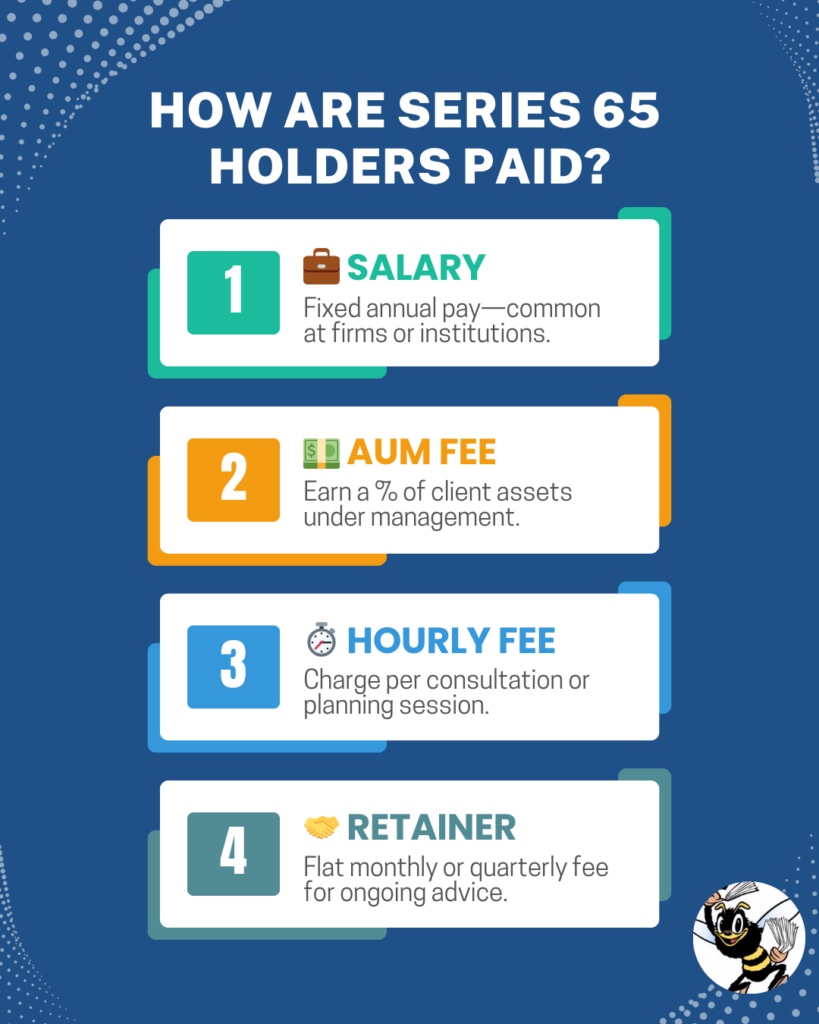
Some advisers charge clients an hourly fee, usually between $150 and $400 per hour. Others use an AUM model, taking around 1% of the client’s portfolio per year. That might not sound like much, but if you’re managing $10 million in assets, you’re looking at $100,000 per year in fees alone.
📈 Career Paths and Growth Potential
Here’s the cool thing: getting your Series 65 can lead to a ton of different career directions. You’re not locked into one job title forever. Many financial professionals use the license as a launching pad into more specialized or higher-paying roles.
Here are a few examples:
- Financial planner: Focuses on budgeting, retirement, and estate planning
- Portfolio manager: Works with high-value investment accounts, often for firms
- Wealth advisor: Handles holistic wealth strategies for high-net-worth clients
- Independent adviser: Runs their own practice, setting their own rates and client list
If you really want to climb the ladder, pairing your Series 65 with other credentials like the CFA® or CFP® can unlock even more opportunities.
💸 Is the Series 65 Worth the Upfront Cost?
Let’s do a little math.
The Series 65 exam fee is $187. Add a prep course ($200–$500), and maybe a few months of study time. All in all, you’re investing maybe $500–$700 in total.
Now, stack that against the average entry-level salary of $60,000+—and the potential to double or triple that in a few years.
It’s a no-brainer for most people. If you’re serious about providing investment advice, the Series 65 gives you a legit pathway into the securities industry without needing to sell financial products or work under a commission structure.
And the best part? You don’t need a sponsoring firm to get started. You can take the exam on your own and start building from there.
🧠 Final Thoughts
So, how much can you make with a Series 65 license? The short answer: a lot, if you’re willing to put in the work and build a solid client base.
This license gives you access to a wide range of well-paying roles in financial planning, investment advice, and wealth management. It’s flexible, it scales with your effort, and it doesn’t require you to be a natural-born salesperson.
If you’re looking for a career that’s both financially rewarding and centered on helping people make smarter money decisions, the Series 65 could be exactly what you need.
Ready to take the first steps? Check out the best Series 65 prep courses on the market.
FAQs
Most Series 65 professionals earn between $60,000 and $100,000 per year, with top earners bringing in significantly more based on client size and compensation models.
Yes, especially if you’re planning to provide investment advice. The relatively low cost and broad career potential make it a strong investment.
Common roles include financial advisor, investment adviser representative, financial planner, or portfolio manager—often in fee-based advisory settings.
It qualifies you to work as one. While “financial advisor” is a broad term, the Series 65 allows you to legally give investment advice for compensation.
The exam fee is $187. With a prep course and materials, total upfront costs usually fall between $500 and $700.