The Financial Industry Regulatory Authority (FINRA) plays a role in the adminstration and registration process for dozens of Series exams, explaining, “To become registered, securities professionals must pass qualifying exams administered by FINRA to demonstrate their competence in the particular securities activities in which they will work.” One such partner is the North American Securities Administrators Association, the developer of the Series 66 and Series 63 exams.
Let’s be honest: all those numbers can get confusing fast.
Series 66 vs. 63: Which do you need? Do you need both? And what’s the difference, anyway?
This guide is here to explain everything in plain English—no law degree required. Whether you want to sell securities, provide investment advice, or wear both hats, I’ll help you figure out which exam is the best fit based on your role, goals, and learning path.
Key Takeaways
- Series 63 Covers Sales Only: It allows you to sell securities at the state level but not give investment advice.
- Series 66 Is a Combo License: It combines the Series 63 and 65 into one exam, but only works alongside the Series 7.
- Series 7 Is Still Required: Whether you take the 66 or both the 63 and 65, you still need the Series 7 to sell securities.
- Pick Based on Career Goals: Choose the Series 66 if you plan to both sell and advise; go with the Series 63 if your role is sales-focused only.
- State Registration Matters: Always check with your state’s securities administrator to confirm the required exams for your role.
What the Series 63 Covers (And Who It’s For)
The Series 63 exam, officially called the Uniform Securities Agent State Law Exam, is all about state-level securities regulation. If you’re working for a broker-dealer and your job involves selling things like stocks, mutual funds, or bonds, you’ll probably need it.
Passing the Series 63 qualifies you to become a securities agent who can transact securities business in most U.S. states. It covers topics like:
- The Uniform Securities Act
- Registration of securities and agents
- Prohibited practices and ethical standards
- Communication rules with clients
This test doesn’t let you give investment advice for a fee. It’s all about sales, so if your role is more about client trading or product recommendations (and you’re not offering full-blown financial planning), this is the exam you’ll want to pair with your Series 6 or Series 7 license.
What the Series 66 Covers (And Why It’s Broader)
The Series 66 exam, or the Uniform Combined State Law Exam, combines the content of both the Series 63 and Series 65. It’s designed for people who want to be both a securities agent and an investment adviser representative—but only if you also have the Series 7 license.
The Series 66 is a better fit if you plan to:
- Sell securities and
- Provide investment advice to clients
Topics on the Series 66 include:
- State securities laws and regulations
- Business ethics and fiduciary responsibility
- Portfolio management and investment strategies
- Rules for investment adviser representatives
Unlike the Series 63, the Series 66 allows you to offer advisory services if you’re working for a registered investment adviser (RIA). This exam makes more sense if you want to do financial planning or manage portfolios in addition to executing trades.
Series 66 vs. Series 63: Key Differences at a Glance
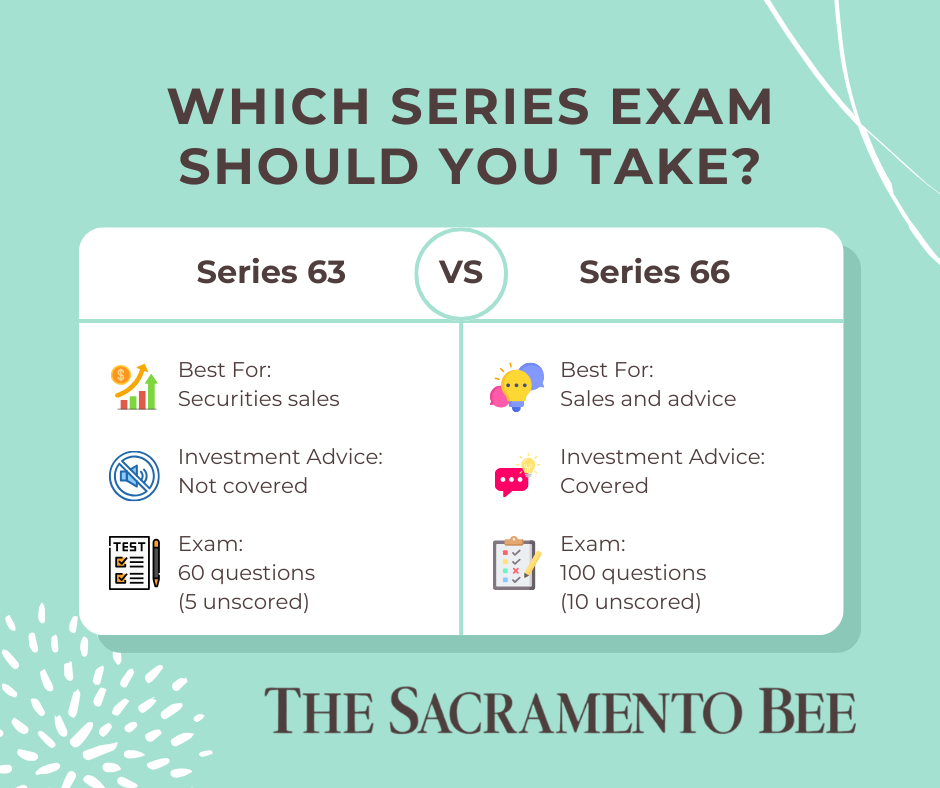
Here’s a side-by-side comparison to make things easier:
| Feature | Series 63 | Series 66 |
|---|---|---|
| Primary Role | Securities agent (sales) | Dual role: agent + adviser |
| Topics Covered | State laws & ethics | State laws + investment advice |
| Requires Series 7? |  |  |
| Authorizes Advice for Fee? | | |
| Ideal For | Broker-dealer reps | Dual-role reps & IAR candidates |
| Administered By | FINRA / NASAA | FINRA / NASAA |
| Who Needs It? | Sales reps across most states | Those who advise and sell |
When to Choose the Series 63
Go with the Series 63 if:
- You’re going to be working at a broker-dealer
- Your main job is to sell securities like stocks, bonds, or mutual funds
- You don’t plan to provide investment advice as a paid service
- You’re pairing it with a Series 6 or Series 7 license
Many securities industry professionals seeking roles in product sales or client account support start here. It’s a solid choice if you’re more focused on transactions than advisory services.
When the Series 66 Is the Better Fit
The Series 66 is your best bet if:
- You want to be both an investment adviser representative and a securities agent
- You’ve passed or plan to take the Series 7
- Your career goals involve financial planning, fee-based advising, or asset management
- You’re working at or plan to work at an RIA firm or a hybrid advisor-broker model
This license is beneficial for people with a personal financial specialist, CFA®, or financial planner background who also want to sell securities. It bundles the Series 63 and Series 65 exams into one exam, saving you from taking them separately.
Do You Need the Series 7 Too?
If you’re taking the Series 66, the answer is yes—you must pass the Series 7 to make the 66 valid. Think of the Series 7 as your core product license, while the Series 66 adds on the ability to act under state securities laws and provide investment advice.
Without the Series 7, the Series 66 won’t count for anything on its own. The same goes for the Series 63 and 65—even if you take both to cover state law and advisory services, you’ll still need the Series 7 to be licensed to sell securities. In short: no Series 7, no selling.
The Series 63 doesn’t require the Series 7, but it’s typically taken alongside it since most sales roles require both.
Which Exam Is Harder?
This depends on your background. The Series 66 exam is longer (100 scored questions plus 10 unscored) and covers more topics than the Series 63 (60 scored questions plus 5 unscored questions). If you’re comfortable with investment advice, fiduciary standards, and securities regulation, the 66 may feel easier despite being broader.
While shorter, the Series 63 can still be tricky because it focuses on nuanced securities laws and ethical rules. It’s easy to underestimate.
Whichever exam you decide to take, I highly recommend a Series 63 prep course or Series 66 study materials to help increase your chances of passing on your first try.
What About State Requirements?
Most states require either the Series 63 or 66 (with the 7) to register as a securities professional. Always check with your state’s securities administrators to confirm what you need based on your job.
For example:
- Working at a broker-dealer? You’ll probably need Series 6 or 7 + Series 63.
- Joining an RIA or hybrid firm? You’ll likely need Series 7 + Series 66.
Conclusion: Which One Should You Take?
If you’re just getting into the securities business and plan to sell securities—but not offer advice—the Series 63 is a straightforward, no-frills option that pairs well with the Series 6 or 7.
But if you’re aiming to do both—act as a securities agent and provide investment advice—and you’re already taking or have passed the Series 7, the Series 66 exam is a more efficient, all-in-one path.
Choose the license that aligns with your long-term goals. Whether you’re focused on transactions or planning to guide clients through their financial futures, there’s a license—and a path—for you.
FAQs
The Series 63 qualifies you to sell securities under state law, while the Series 66 covers both sales and advisory services—but only when paired with the Series 7.
It qualifies you to act as both a securities agent and an investment adviser representative, assuming you also have the Series 7.
It lets you transact securities business at the state level as a broker-dealer agent. It’s commonly paired with Series 6 or 7.
No. If you’ve already passed both the 63 and 65, you don’t need the 66—it covers the same ground in a single exam.
It’s not necessarily better, but it’s more efficient if you’re also taking the Series 7 and want to combine state law and advisory credentials.