
‘Where do you want me to go?’ What’s next as Elk Grove clamps down on homeless camps
Elk Grove’s tough new anti-encampment ordinance goes into effect this week banning homeless people from camping near schools, day care centers, playgrounds and youth centers while largely barring camps of four or more people in the city limits.
The ordinance also allows the city to seize violators’ belongings with three days’ notice for a minimum of 90 days. The city council passed it last month as the two members who introduced the city code — State Assembly candidate Stephanie Nguyen and Pat Hume, who is running for a Sacramento County supervisors’ seat — completed election campaigns in which they highlighted homelessness in Sacramento County.
About 150 people live unhoused in Elk Grove, say city officials, but the clampdown passed by council members in June comes as homelessness has become more visible in this city of nearly 180,000. A fire on the morning of July 19 gutted a homeless camp in the bowels of a pedestrian bridge that crosses Highway 99 north of Elk Grove Boulevard, temporarily closing the span.
“The encampment problem is getting out of hand in other cities. We need to take action,” Nguyen said at the June meeting. She and Hume lead an ad hoc council committee to address homelessness in the city.
“We need to be leaders here in this city to ensure the encampments are not going to happen in different pockets throughout the city as you see in other areas,” Nguyen told council members. “We’re not saying they can’t have their encampments set up. We’re saying that within certain parameters — keeping it clean; giving incentives for making sure they’re keeping them clean. We need to act now.”
But Elk Grove’s tough action on homeless encampments also comes as city staff, homeless advocates, law enforcement and the city’s unhoused say more resources are needed.
“Those experiencing homelessness in Elk Grove don’t have a lot of options,” Alicia Tutt, city housing and grant specialist, told council members in June.
Rents have risen 30% from costs before the COVID-19 pandemic, according to Elk Grove city staff and competition is fierce for the apartments that are available. Housing in a still-hot Elk Grove market remains scarce. For every open apartment, as many as 20 people have applications in the queue hoping to move in, Tutt said.
Meantime, Tutt said, small landlords enticed by rising home values are selling their rental properties, in turn forcing out longtime tenants and shrinking inventory even further.
“Someone who may have lived in their home for 10 years is now being given 60 days’ notice,” Tutt said.
“It’s a sad situation — we’re seeing a lot of people with high inflation on the verge of being homeless. People who are worried about losing their homes or losing their apartments,” said Marie Jachino, executive director of Elk Grove Food Bank Services. “Everybody’s being pushed to the edge — people who live in Elk Grove.”
‘I’ll need somewhere to lay my head’
On a hot Wednesday afternoon last week, Leigh Cobb of Elk Grove Food Bank Services made the short drive from the food bank to east Elk Grove’s Camden neighborhood, winding along its leafy streets and past its well-groomed lawns to a neighborhood park where she pulled bottles of water out of her SUV. She walked along a dusty path worn into the field of dry grass toward a tiny dot barely visible at the end of the trail.
“Ding dong. Doordash,” Cobb called out.
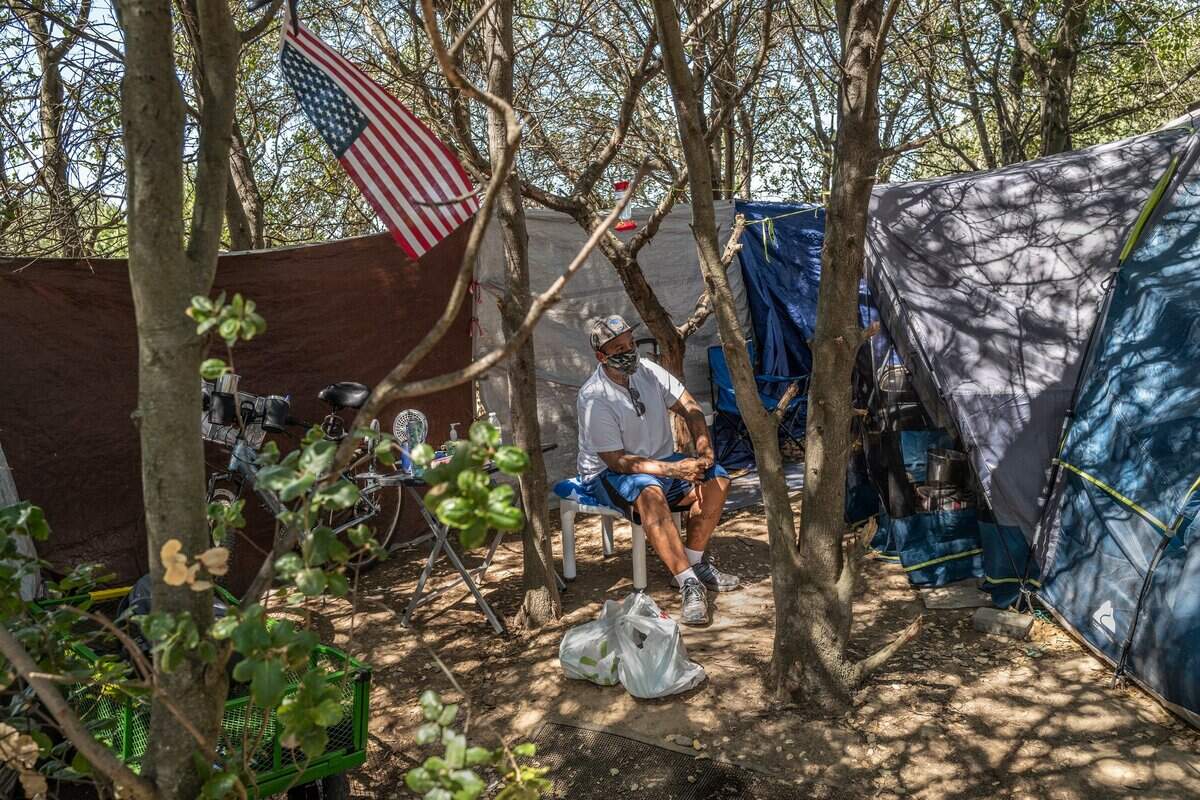
Joseph de la Cruz, 37, normally walks to the food bank on Kent Street, but sick with COVID, he is sticking close to his camp — a blue-tarped tent under the canopy of trees he and his wife call home.
A small tray carried a hardcover Bible, a battery-operated fan and a bottle of hand sanitizer. A small cooler sat behind him, its door closed against the 100-degree heat. A hummingbird feeder hung above his head from an overhanging branch. On another tree, a small American flag flew from limbs above a leafless dirt floor.
De la Cruz has lived here for more than a year. He had endured a brutal winter and suffered a heart attack in March that left him in intensive care for 10 days even before his present COVID battle.
The sleeves of tattoos tell of his years in the gang life, the San Francisco Giants’ interlocking SF logo inked below his Adam’s apple giving away his former home. Jail followed and addiction hounded him but, now clean and sober, he’s looking for a second chance and, maybe someday, enough work to afford an apartment.
The winter’s cold, a stubbornly enduring pandemic and now July’s triple-digit heat have been hard on them, he said. He is trying to find a job and get out of the homeless cycle.
“I still struggle to find ice to keep my food sanitary, disinfectant to take care of myself,” he said. “Really, I want to get out of this tent, where I can walk into that apartment.”
The Elk Grove Food Bank has helped with food and clothing, even bedding and a bicycle for wife, Veronica; and showers are open twice a week at Elk Grove Methodist Church in Old Town. But de la Cruz said he and his wife need resources to find work and more permanent housing not an ordinance that might kick them out of their tent with no place to go.
“So if you’re trying to kick me out of this tent or trying to give me fines, where do you want me to go?” de la Cruz said. “Go from one camp to another camp to a side street to the front of a business? And you’re not offering showers in this town and you’re not offering a place for someone to sleep at all?”
“They’re trying to enforce laws, they’ve got to come up with a resource for that,” de la Cruz continued. “There has to be something to meet everyone in their own walk. Even if I find a job, I’ll need somewhere to lay my head.”

‘Being punitive is not the goal’
Elk Grove leaders said the new code doesn’t signal a shift in how the city tackles homelessness, insisting the city code is an effort to get some help for the unhoused through the city’s housing resources — and to provide a mechanism for enforcement.
“Being punitive is not the goal,” said Councilman Hume, who with Nguyen, brought the ordinance to council members. “Changing outcomes is the goal.”
Elk Grove has opened a trio of affordable housing complexes in Bow Street, Gardens at Quail Run and Poppy Grove; and has introduced a shared housing and landlord incentive program to try to open more doors. Elk Grove has also long worked alongside nonprofit homeless advocates Elk Grove HART and Elk Grove Food Bank Services.
Elk Grove Mayor Bobbie Singh-Allen in a July interview stressed that compassion and the partnerships with the city’s nonprofit and faith communities must remain part of any plan to address homelessness.
Singh-Allen said anti-camping ordinance is one component to deal with the encampments. “Homelessness and poverty are not a crime,” she said. “There are a large number of people complaining about homelessness but our point-in-time counts are low. We are concerned but we want to be thoughtful.”
In June, Elk Grove gave Light of the Valley Church the go-ahead to proceed with its 84-unit Cornerstone transitional housing project on Bruceville Road near Laguna Boulevard. The project will have a mix of apartments for working families, adults with intellectual and developmental disabilities and those transitioning out of homelessness.
“Light of the Valley is providing affordable housing,” Singh-Allen said. “It’s these kinds of creative solutions — we can provide solutions, not just punitive solutions. As a city, we have a lot of resources we’re able to provide, but this is ongoing.
“We don’t get a lot of money to address a lot of these (but) it’s still about being compassionate,” Singh-Allen continued. “They’re suffering for a lack of housing. There are mental health issues, there are drug and alcohol issues. We can’t provide a Band-Aid by doing one thing. This requires a regional approach to be thoughtful of these resources.”
But even as Elk Grove disbursed $2 million toward funding what Singh-Allen in her March state of the city address called “flexible homeless solutions,” from federal COVID relief funds, housing staffers say Elk Grove’s unhoused have few alternatives.
Varied stories, similar struggles
The stories of Elk Grove’s homeless are as varied as their numbers are elusive. Many are camped in tents or live out of their cars. Some have roots in Elk Grove or are connected to the city by friends or their children’s schools. Others, like de la Cruz, left the Bay Area. Still others are more far-flung or have survived outdoors for years here. Many say they feel safer in the city.
“They have a connection to Elk Grove. We know most of their names. We know who they are,” Singh-Allen said from the council dais in June. “So we want to be helping transition out of that situation and help those that we can.”
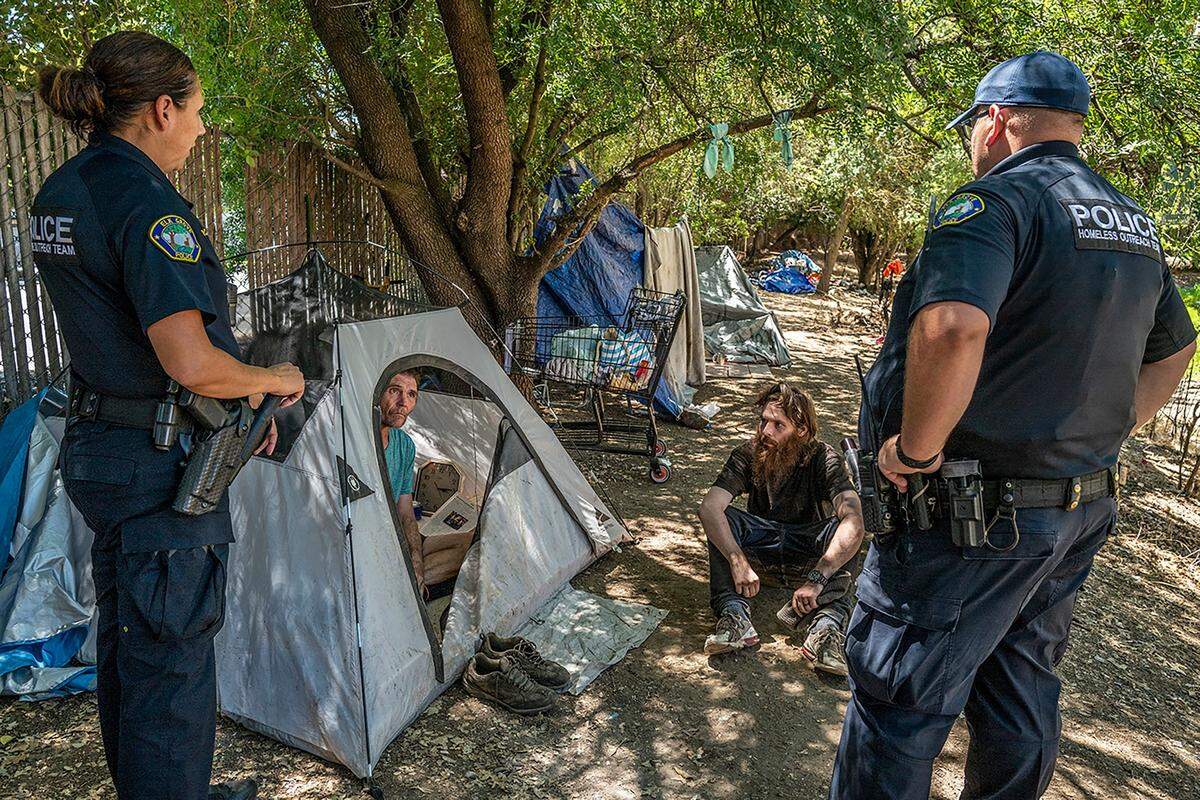
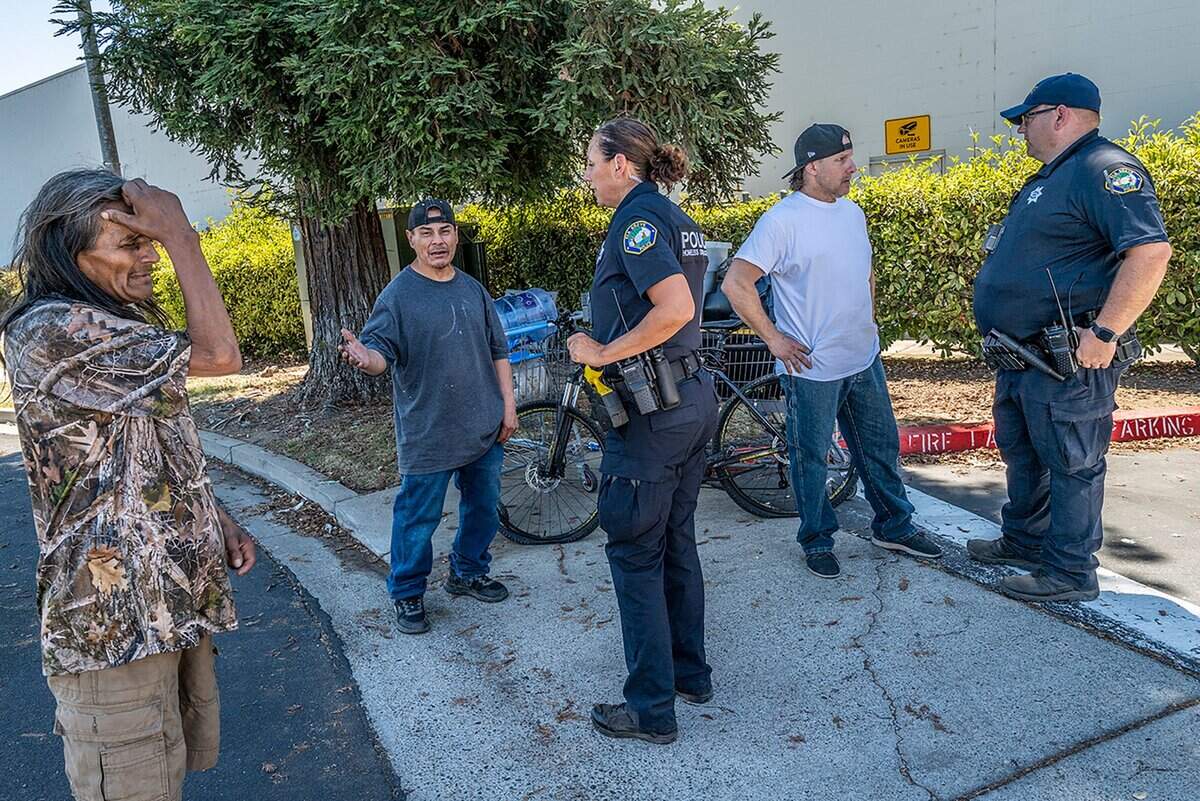
“The question we always get is ‘how many are there in Elk Grove?’ It’s like counting butterflies,” Chris Cahill, Elk Grove Police’s homeless outreach officer, said outside Elk Grove Methodist Church in Old Town Elk Grove, long a sanctuary for the city’s unhoused and those living on the margins. He is a 12-year department veteran in his second year as a homeless outreach officer.
“They’re passing through today, but at night, who knows?” he said. “People who live in their cars and sleep at night, but have jobs in the morning. The homeless navigator at Methodist — she’ll contact people we haven’t heard of. We have lots of movement up and down the state.”
A week ago Tuesday, everyday struggles were hidden in the brush behind storefronts on Elk Grove Boulevard near the city’s historic Old Town, in a shopping center’s parking lot a short drive from Elk Grove City Hall — people living in the camps that likely would be subject to the new city code.
So were the dangers. Under the Laguna Creek pedestrian bridge near Highway 99, blackened evidence of the fire that raced through a family’s makeshift camp Tuesday morning.
“It was so hot. There was so much fuel,” said Cahill.
Inside, under the bridge, the detritus of a life lived outdoors. Charred clothes and bedding, a discarded sofa; rubberized storage bins and a cardboard box that once held a small stove.
No one was hurt, but nothing was left. The family, homeless for a second time, were back on the move.
They first found Cahill’s partner. Elk Grove Officer Jennifer McCue has worked with the city’s unhoused for most of her 14 years on patrol. Empathetic, firm, on the street she’s “Cue,” the first face in uniform many homeless people here see.
“The housing market is so high, people can’t afford rent,” McCue said afterward as she surveyed the smoldering campsite. “If they have kids, we see if we can get them to a shelter — these are our priorities.” Others grapple with mental health issues, she said. “I feel like we’re lacking the resources to help with that.”
“A shelter — that’s what we need,” McCue added. “People call and they want to know what’s available. That’s the challenge right there.”

Complications abound
The city last winter teamed with the faith community to open overnight warming locations — OWLs — at local churches and other sites to give homeless people a warm place to sleep, but Elk Grove’s lack of a permanent shelter has become the elephant in the room in a city with a growing homeless population.
Another challenge, though, is persuading unhoused people to get to area shelters that are available. Complications abound. Often, men and women cannot shelter together. Dogs — companions and security, especially for women living outdoors and alone — are often banned. Sobriety and mental health issues add yet more barriers for many. Most, however, are wary of leaving their possessions behind, McCue said.
“A lot of our Elk Grove homeless don’t take advantage of (shelters),” the homeless outreach officer said. “They don’t want people to take their stuff. They’d rather stay outside instead of going to a shelter.”
But de la Cruz from his tent site said he wants to see a shelter where people like him and his wife can find a roof away from the elements.
“Give us a place where we don’t have restrictions other than being on drugs. If they’re on drugs, test them. I believe that. We do need a place where more than twice a week we can take a shower,” he said. “They’re opening up these casinos, what about opening up a shelter? Give people a chance. Open up a place. I believe there’s enough money to help out.”
“Everything should be on the table,” Singh-Allen said of a shelter in a July interview. “We’re mindful of the overall numbers, they’re still very low, but everything should be explored. We should look at all opportunities. First, we want to make sure our residents can afford to live here.”
Searching for answers
Meantime, the consequences of homelessness are being increasingly felt at places like Elk Grove Food Bank Services, said executive director Jachino.
Jachino who has worked for years on the front lines of food insecurity in Elk Grove says the city code itself is a needed next step in a city where homelessness is increasing.
“It’s such a difficult subject. It’s getting worse and worse,” Jachino said.
Jachino estimates the food bank’s new offices on Kent Street in east Elk Grove serve about 10,000 people a month. Nearly all live under roofs but need the services to keep food on the table and clothes on their backs.
But, Jachino added, “we’re seeing homeless people every day. The mental health issues are really serious. They feel the food bank is a safe haven for them. They come to us on a regular basis. It’s become a big issue in Elk Grove. The one thing they need the most is mental health care and alcohol and drug (care). It’s a difficult situation — it’s not an easy decision for the city.
“I worry about my staff, my volunteers. You have to keep your guard up, but they need help,” Jachino said. “I don’t know what the answer is, but something needs to be done.”

This story was originally published July 27, 2022 at 5:00 AM.
.JPG)