
Auburn-based filmmaker puts focus on musician’s struggles with his faith
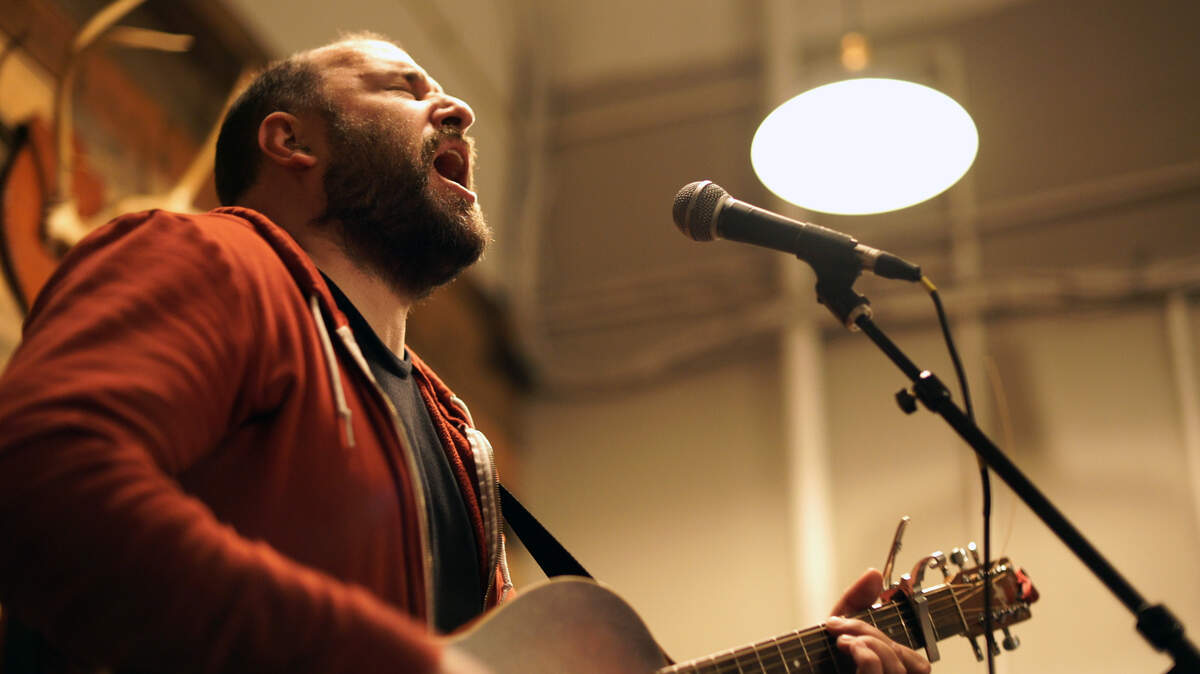
Singer-songwriter David Bazan, of the successful early-aughts Christian/indie crossover band Pedro the Lion, is the subject of Auburn-based filmmaker Brandon Vedder’s new documentary out this month “Strange Negotiations,” which chronicles the aftermath of the artist’s “break-up with God.”
“Strange Negotiations finds a good part of its motivation and timing in the much overlooked influence modern organized religion has on today’s pressing social issues in America,” Vedder says in his director’s statement. “With half a lifetime on the inside of mainstream Christian religious institutions and a bible college education, David has a very rare voice in this conversation. Given his history as one of the most well respected Christian songwriters in mainstream culture, his voice still figures large within the evangelical community.”
The film follows Bazan’s internal struggles with faith and with himself as he roams miles of highways, touring solo while rebuilding his musical foundation after publicly breaking away from Christianity and vocalizing his struggles with addiction. Bazan has continued to connect with his fan base by playing house shows, featuring songs that are at once intensely personal but that also speak to shared themes in our collective human experience like the expression of spirituality, belonging, family and the struggle to know oneself.
The film was shown in a series of screenings this week in Seattle and will be featured in Oakland on Sunday. A link on the film’s website allows people to sign up to host a screening. It’s also available for purchase on iTunes.
Vedder said he felt uniquely qualified to make this film, as he found the Christian faith on his own in high school after moving to Auburn with his family.
“Faith is so uniquely human. It can be the most dangerous and powerful thing on earth,” Vedder said. “This faith stuff is something I will always be trying to have a conversation about.”
Bazan talked with The Sacramento Bee about the film “Strange Negotiations” as well as his upbringing in the Pentecostal church, his crisis of faith, his outlook on the U.S. political climate and the new incarnation of Pedro the Lion.
Q: How would you describe the spiritual environment you grew up in?
A: On the one hand it’s an embarrassing feature. Is it being a kid that you think your denomination is the right one?
Q: Well, it’s the environment you grew up in and the adults around you are telling you this is what’s right, this is what’s true. What was it like being a child in the Pentecostal church?
A: It was special in a certain way. The environment I grew up in was unique because still to this day, even as much as I disagree with their viewpoints about the world, my parents were some of the most caring and devoted people in any of the churches we ever were apart of. They cared about the people in the church and my dad spent a lot of time doing visitation stuff. Whatever the theology and the doctrine, which in the Pentecostal environment isn’t so much the focus, the worship service and your feelings are a big part of it. It’s quite emotional.
Q: So it’s more of a spiritual outlet? It’s not so much about the nuts and bolts of belief and more about your actual spiritual experience and expression in the service?
A: Yeah, the thing that set apart Pentecostal theology from the rest of evangelical Christianity was the end-times theology, which at its most rigorous is actually pretty vague.
Q: But it’s actually very literal at the same time, correct?
A: It is, but the way it works itself out is it’s sort of these pet theories; it’s not uniform across denominations. Because it wasn’t very doctrinally rigorous you just get a lot of interpretations of people and pastors. Then you go to some big event and you realize that’s not really what they teach at the Pentecostal seminary.
The other thing is speaking in tongues. Really in the day-to-day, speaking in tongues is what sets Pentecostals apart.
Q: What is that all about?
A: It’s referred to as a second blessing in a lot of cases. The idea is that being filled with the Holy Spirit is a post-conversion event and the initial physical evidence, or I.P.E., the abbreviation in the culture, of being filled with the Holy Spirit is speaking in tongues.
Q: So it’s kind of like proof?
A: It is. It’s sort of like proof you’re in the process of sanctification. It’s proof you’re filled with the Holy Spirit. And so there was sort of a hierarchy within it, if you were spirit-filled you had a slightly different status than someone who wasn’t spirit-filled. This is my interpretation. Some of my family would be very hurt to hear me say this.
Q: Because it is still very real for them?
A: Oh yeah. My dad was the music pastor, and I haven’t heard to this day my dad speak in tongues.
Q: So it’s not exactly something that people consciously pretend to do?
A: Well, it’s hard to say. What is it when people are doing that? There are people on the internet who are bisexual and moving away from Christianity but still insist that tongues-speaking and spirit-filled-ness is a thing. I’m trying as a grown person to understand. My take is, what is the real phenomenon? What is happening that has been given this label? Where I grew up, it caused people to be second-class citizens if they couldn’t do it.
That said, my folks kept me a part of the movement for a lot longer because I really saw virtue in my parents. I felt like the religious experiences I was having were grounded in that virtue, in the care they showed for other people. But that was just their personality and who my family was too, even if now they’re supporting Trump.
Q: How would you define your spirituality now? How has it moved away from where you came from? Would you say you’re agnostic? Atheist?
A: I’d say I’m agnostic. One of the ways I think of it, it’s funny because it’s sort of apologetic to my former life, but if we have free will then we have to take the reigns of our faith.
I feel like so often I’ve been described as having lost faith – the fact that faith, seemingly, is the verbal property of Christianity, and that no other faith is faith when Christians talk about it.
I’ve just expanded and tried to collect as much data about the world and myself. I want to find peace and balance for myself, and through that I can promote peace and balance where I’m planted, where I live and work. And so for me it’s definitely a spiritual pursuit, to whatever degree that word has a distinct meaning.
Q: Do you see yourself as someone who is redefining spirituality for more people, or someone that other people can look to who may be asking a lot of the same questions about the nature of faith?
A: Well I’m redefining spirituality for myself. In that sense I think that people can look to what I’m doing, but I would really hope that people are observing their own data while they’re doing it and not someone else’s. Not my data.
We just all have such different experiences and unique perspectives on little aspects of how the world works, and I think that’s the path.
The Earth has become the object of my spiritual imagination in the way that God was before. Where I was trying to connect with God and with people, now I’m trying to connect with myself, and through that, hopefully with what is.
I feel like connecting with myself is the conduit, is the portal to transcendence in all of its forms. Accepting your self and starting with that – it’s taken so long to get there for me, and it’s so tenuous. To a degree, I think that’s helpful for everybody to find that.
But I don’t know if I’m unique in that. I just think I’m somebody who is silly enough to do it in public. That’s my personality somehow, or my dysfunction. In the sense that I can be fodder for other people’s process, that’s cool.
Q: So you don’t have any conclusions to share with others?
A: Even to the degree that I do, they’re changing so I’m happy to share as I go, but the feeling that no feeling is final is really neat. Just knowing this process.
We all have to accept our stones a walk through it until the end. And if that’s what people get from me, I’m happy to have influence.
But the specifics of it, that’s the scary part. We all have to find our reason. We all have to find our purpose. We try to assign that to the group, or assign the group’s purpose to ourselves, and it just can’t work that way.
Q: What would you say was the catalyst for your spiritual changes? What began this? When did the seeds begin to be planted that you were changing, that something wasn’t right?
A: It goes pretty far back. Playing drums and music helped me forge a connection with myself and my feelings and my body that were able to grow into the relationship I have with myself now.
Along the way, I definitely got a feeling, I remember in high school, that this is somehow… how do I say this? I remember this vague sense that there’s a deep misunderstanding within Christianity. There’s a mean, authoritarian way this is going. There’s been little seeds planted throughout that something is not quite right.
Q: Like something is not cohesive?
A: Yeah. Like there’s a way it winds up being mean-spirited. Then I had no sense of right or left politically, I didn’t really understand the political spectrum very well. But I guess that I saw there is an open-handed way to do this that I recognized, that stood in opposition to the close-handed way that I felt it was being done.
Q: Strange Negotiations was filmed in the time leading up to Donald Trump’s 2016 election. It was very interesting to watch you playing out your own sort of struggle during this time period, when probably a lot of people you know and love were politically conservative. How did your crisis of faith coincide with this time period? Was the political climate then a part of that struggle?
A: It was, but it was its own kind of second blessing. I had already had the conversion experience like a decade before, and my initial deconversion experience happened in the context of the Bush years, seeing the way that Christians responded to the manipulations that he and his cronies were engaged in.
Q: Does is bother you that Christians would buy into the agenda of right-wing politics?
A: Yes. It didn’t make sense to me because I didn’t understand at the time what I think now, that doctrinal Christianity is authoritarianism. Once I understood that, then I was like, oh yeah, that does make sense. But before that, I bought the idea that it wasn’t a club, it wasn’t favoritism, that all the ideals I had when I was a kid doing it were the same reason other people were in it.
Q: Which was, what, following the teachings of Jesus?
A: I mean yeah, that, within the teachings, just recognizing. I was telling my parents last night, that when I was in grade school, in Christian school, I learned that America was less than 10 percent of the world’s population at the time, or whatever it was, but we used 50 percent or more of the world’s resources and I thought, we need to fix this. We’re Johnny the Hog. So the ill I was introduced to, I saw Christianity as being the anecdote to it. I saw the good parts of it. Something I could belong to, to make the world a better place, to move the needle in the right direction and be part of the solution.
I’ve struggled with belonging so badly for my whole life. I wanted to belong to my parents, so if they’re expressing these views that don’t make sense to me, that I just can’t make sense of, I feel like I don’t belong to them.
So what happened was I left Christianity, but for a long time I was kind of neutral about it. Like, this is not for me. I kind of talk about it in the movie – I’m not a believer but I think that believers might be on a path to yield good outcomes. But there just came a point where I don’t even think that anymore.
Q: So you have moved beyond that?
A: Yeah. The odds that you could hand somebody a Bible, some commentary and a choice of communities to get involved in, the odds that they would end up in a gospel of peace rather than a gospel of authoritarianism or fascism are just not great. It’s just not a good gamble.
Q: Is it that you think people in current American culture, in our current political climate, we just don’t line up with the teachings in the Bible? Or are you saying there are things in the Bible that fuel problematic parts of our culture?
A: I mean, the trick is that the Bible is many, many expressions grouped together and we’re meant to believe that they are one expression. Within the Bible there are plenty of things that would lead a person to a life where they were kind to themselves and other people and promoted harmony in the group they were a part of, and that group would promote harmony in the greater group. But there are also even more, maybe even way more, things in there that would cause somebody to sign on to authoritarianism.
Somehow oppressed people have always found the good parts of Christianity and held those up. And privileged people have always seemed to find the authoritarian parts of Christianity and hold those things up. So it just makes me think that it itself is not good or bad, it has a lot of good in it, and it has a lot of bad in it.
Q: So it just depends on who is reading the Bible and what they’re looking for?
A: Yeah. To me, I just think why do we elevate that document then? Isn’t it just a part of the firmament of culture the way that everything else is, that every movie and book and song is just as eligible to show us a good path? That to rely on that document as somehow unique and special … I just think that everything is natural revelation and that the idea that anything is a special revelation is a slippery slope to what Christianity would call idolatry.
Q: Do you think the evangelical Christian voting block has changed their opinion at all on Donald Trump and what he represents? Why or why not?
A: I don’t think they’ve changed their opinion. I’ve been the dupe that with every new revelation thinks, surely now they will see. The thing that you hear a lot when you just talk directly with people about Donald Trump’s character and behavior, I hear, well, King David did a lot of evil things but God still used him.
I really think that evangelical Christianity is authoritarianism enforced through respectability politics. And all you have to do is adopt the look and the speech and they will accept you because that’s the system they understand.
Q: Compliance?
A: Compliance and conformity. The thing they’re really concerned about is maintaining the status quo. That’s the point of it all. The privileged people are on top, they don’t deserve to be there, and they need to keep their identities intact and the way they do that is respectability politics. If you step outside that line, you’re suspect.
Q: What are evangelical Christians trying to achieve by buying into the right-wing political system? Do they have political priorities?
A: Abortion and gay marriage.
Q: You’re saying their priorities are stopping those things from being legal?
A: Yeah.
Q: I know I’m asking you to speak for a large group, but you grew up within that group and have first-hand knowledge. If their priorities are things like stopping abortion, how do they reconcile that and the mistreatment of children through detention and family separations at the border, for example?
A: A comment that I’ve heard indicates that somehow God’s favor is on America, and the implication is that people who are born outside of our borders do not deserve the same kind of safety.
It’s fingers in the ears and “la-la-la.” It’s not rational. Kids are being molested and dying from the flu in detention. It’s such a nightmare.
Q: So evangelicals have a very strong sense of people being “the other”? It’s us and them, we’re not all one?
A: The one true way is always going to “other.” That is how the one true way works.
q: Well, on a lighter note, how is playing in a band again as Pedro the Lion versus doing solo house shows?
A: It’s cool. There are some aspects of it that are exactly what I was missing and hoping for, and there are other aspects of it that have highlighted parts of my process that are still incomplete or unknown.
Personally there have been a lot of ups and downs because touring at that level takes so much more planning and so many more resources – five or six or seven heads plus a bunch of gear and a trailer, versus a car and a guitar.
There’s a kind of release, a kind of high, a kind of expression on a scale that is just not possible at the house shows I was playing. It’s taught me a lot about how that notion of being in a band is still vague. I’m beginning to understand what it is I was missing and what it is I shouldn’t involve myself in.
Q: What do you mean by that?
A: The creative process and the relationship with oneself is very complicated if you have spent your life avoiding your feelings and music is sort of the path to your feelings.
Q: Would you say music is the path to your feelings?
A: It has been. Now I have a lot of other paths that I’ve been developing, but that has been the main one. And because of that it’s tricky. So, I’m good at collaborating with other people on things that aren’t my solo music or Pedro the Lion Music.
The first three Pedro records, I made them more or less by myself in terms of the creative force behind them. I had help on bass on the first one, and buddy helped shepherd the process on the second one, but the arrangements, the nuts and bolts, were me just sitting and playing and working stuff out.
I gave that up in 2002 because I thought, this is not how a band is supposed to work. I gave that up for 15 years, even though that was my native process. So coming back, I’m coming back to my solo process, but to make band music and go perform.
Q: So you are the one who is driving the content?
A: Yeah, totally.
Q: How does the content differ in the current incarnation of Pedro the Lion from the earlier material?
A: It’s the same. It’s my search. It’s really what drove it then, and I didn’t understand it, that that’s the place I can connect with my feelings about the world and sort of be seen and heard, at least by myself in the form of songs, like Secret of the Easy Yoke, and other expressions that I didn’t have access to in the culture I was in. And that’s what I’m still doing. I’m trying to make sense of the world through my feelings and making music.
Q: Would you say the themes of your current work are introspective or outward looking?
A: They’re starting introspective and looking outward. I’m in the middle of a several album cycle and Phoenix is the first one. It starts autobiographical and it will move outward, but the subject is somehow always relating to the self, grounded in my experience or feelings.
What I’d love to do is show how lovely people get co-opted into authoritarian structures, and wind up being pawns or protectors of authoritarian structures. And I think I have to start with how that happened for me to show how that might work for other people.
Q: In that case, what do you think is an alternative to authoritarianism? Because people need something, that much is clear. There’s an aspect of let’s break this down, explore it, get rid of it, but people will need something else. What do you think is a good alternative to destructive structures in our culture?
A: Community is essential. Play is essential. Play is a communal form of self-acceptance. To be at play you have to really be able to face yourself and let go of concerns for the moment.
If you watch a movie like “The Master” [A 2012 film from director Paul Thomas Anderson] you see both the upside and downside of community. I’m talking about community that’s distinct from creedal community. Community where your acceptance is based on orthodoxy is the problem, I think. You see in The Master, community really benefits Joaquin Phoenix’s character up until the dogma just makes it a place that is not safe to be. But the community, the care, the interaction, it matured him a lot.
The real answer is I don’t know. That’s what I’m searching for. I think metaphorically planting a garden is an anecdote to this intense binary of Christianity and other authoritarian religions where you’re either “saved” and in, or you’re going to be a sex addict or materialist pig or whatever.
I just think there’s a middle ground. We have to eat, we need shelter, we need water. Everybody needs those things, and there’s a way we can find balance.
Q: How was the filming of the movie for you? Did it move you in one direction or another upon watching it? Did you learn anything about yourself?
A: Coincidentally, the time period where I was shooting the movie was the lowest point of my life. I was really struggling mental health-wise and it was a lot of work.
Q: Brandon was there, obviously, to film. But from the looks of it, this was a time period in which you seemed very isolated.
A: It was. Over the course of four years, Brandon spent about five weeks with me in the van. I spent another 75 weeks just on my own.
Q: What’s it like spending that much time alone?
A: Well, it just depends on where I’m at. At the time Brandon and I were working together I was kind of hitting bottom, or what I thought was the bottom at that point, and just sitting there trying to process that.
Luckily, during that time I stopped drinking and that clarified things for me. Being alone all the time and being drunk for some part of the day, even if I’m sober driving all day, I still have that alcoholic brain where what I’m looking forward to everyday is drinking and there’s no other carrot that can get me to do anything. So when I was able to stop drinking there was just a lot more facing myself and the mess and debts I had accrued, that was very overwhelming.
Then, it was a process of me reaching out to myself and trying to make some sense of how to move forward when I had to keep doing my job and being a dad and a husband and trying to juggle all of that.
Q: What do you hope people can glean from watching your experience?
A: I hope that people feel free to explore themselves and the possibilities, just to take another look and be allowed to. I struggled so much just to have permission to do any of this stuff. Somehow my personality and psyche formed around this authoritarian culture I was a part of, so I just needed permission. So I hope people see my struggle and process and find permission to engage in their own. In making the movie I had to learn self-acceptance.
Q: Is it hard to watch yourself?
A: I have a lot of anxiety about, like, if I give an interview and say something that my grandma might get upset about it’s less in her face, but she’s gonna watch the movie and it’s right there. It’s not like a conversation we’re having, but one we’re having, sort of, at her.
I still don’t really know how to reconcile it. I’m still working through my history of not belonging anywhere, and facing the likelihood that I will belong fewer places because this movie exists.
Q: I might argue you will belong more places, because I think you are able to vocalize a lot of things I think many people struggle with. Our own relationship to ourselves is probably one of the most relatable struggles people go through if they’re honest. I think people will find your experience relatable.
A: Really? That’s been our big hope. Certainly mine. It could be just like a big vanity project, like an advertisement for my music or my career, and that’s what I hoped it wouldn’t be.
Q: So, what is next for you as far as your plans for music and albums and tours?
A: There will be a Pedro record coming out in May, and we are going to do house show tours in support of that.
Q: Will you be touring with the band or just yourself?
A: With a smaller version of the band. The scope of the record is bit more like the Care record, or the Blanco record or the Headphones record with electronic drums mainly. It’ll be kind of a two-piece version.
Even before the record comes out in May, I think in February, I’ll be coming down Hwy 99, hitting Chico and Sacramento and Modesto. I love the central corridor, whatever that is. Sacramento is one of the most underrated places in America.
Q: Where can people find information about the house shows?
A: At pedrothelion.com. You can sign up for emails about tour dates. It’s a little bit lower profile than a big club-show tour, because in a club-show tour every venue is doing advertising. The challenge for house show tours is that you have to promote them, but it takes less people to make it work. It’s a way of laying low while still going out and hitting the pavement, connecting with people and playing the songs for people.
See the official trailer for Strange Negotiations on YouTube and purchase the full-length film on iTunes.