
With eyes on the inside, ‘Ear Hustle’ makes the big time with its look at prisoners
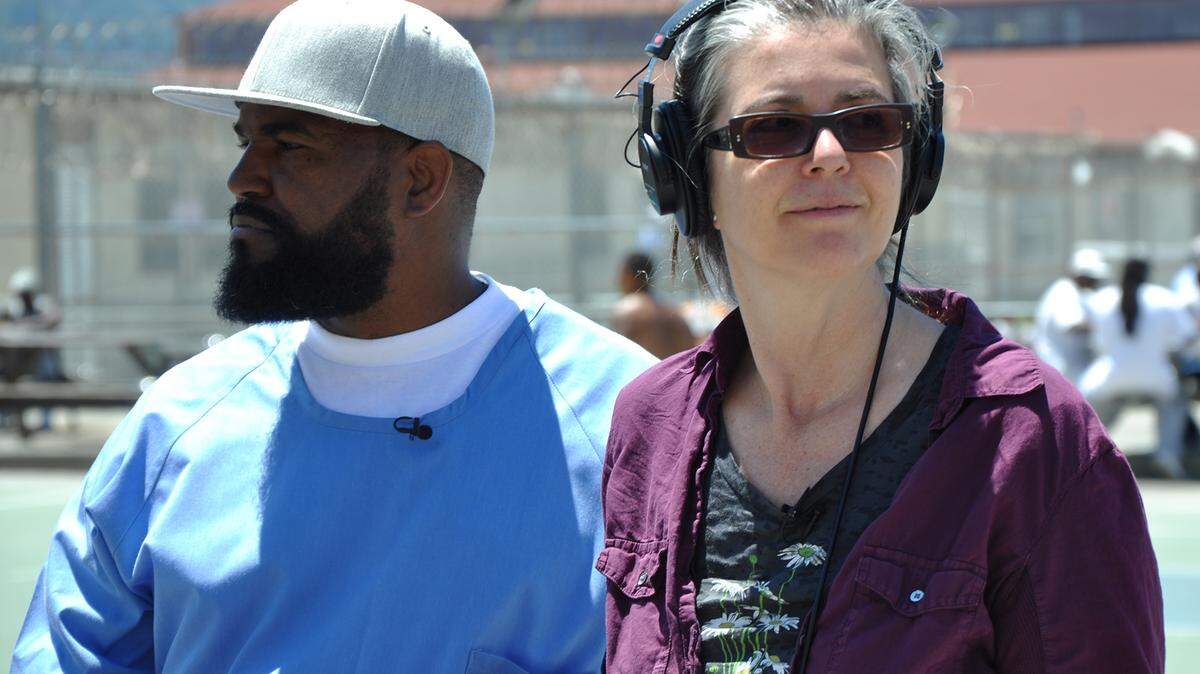
When Sacramento State photography professor Nigel Poor began volunteering at San Quentin prison a decade ago, she wanted to learn more about the men serving time there.
Little did she know.
Now Poor – along with collaborator Earlonne Woods – has turned stories of life behind bars into a hit podcast, Ear Hustle, and it was recently nominated for a Pulitzer Prize.
With raw, redemptive storytelling, Ear Hustle chronicles the lives of prisoners in a way the Pulitzer committee called “consistently surprising and beautifully crafted.” The show has more than 40 million downloads and listeners throughout the world, including celebrity fans from the cast of “Hamilton” and the actor Alan Alda.
“To me, it came as a shock, a total shock,” Poor, 57, said of becoming a finalist for journalism’s top award. “I am an artist who is working on a podcast and I have huge respect for what journalists do.”
The Pulitzer went to another podcast on immigration corruption by This American Life. Yet the Ear Hustle nomination was a victory. It also sent a message about the importance of pulling back the curtain on life behind bars, where roughly 2.3 million people live in the U.S.
“We didn’t win, but we did win,” Earlonne Woods, 48, Ear Hustle’s co-creator and co-producer, said during a recent Zoom interview.
Joe Richman, one of the seven Pulitzer judges in the audio reporting category, said Ear Hustle was “a really unexpected finalist.”
While many people think of traditional journalism as investigative, with lots of shoe leather spent understanding different sides of an issue, Richman, founder and executive producer of the production company Radio Diaries, said finding compelling characters involves significant skill.
“That is why I was proud of Ear Hustle being a finalist,” he said. “It brings us into a world we don’t have access to, it helps us understand a world that is hard to see.”
Each episode of Ear Hustle — prison slang for eavesdropping — must receive a green light from San Quentin authorities before being aired. Public Information Officer Lt. Sam Robinson plays a cameo role, often with humor, at the end of every episode as he approves the content.
“The California prison system is heavily restricted. It’s difficult to get access to real stories inside prison,” said Keith Wattley, founder of UnCommon Law, which offers pro-bono representation to prisoners serving life sentences. “This is a filtered view. But even with that filter, the humanity comes through. That is the piece that makes Ear Hustle most valuable.”
From Photography to Podcasting
The odyssey that is Ear Hustle began in 2011, when Poor, 57, became a volunteer teacher for the Prison University Project at San Quentin.
A Sac State professor since 2003 and a former resident of Woodland (she now lives in San Francisco), Poor uses photos and objects to tell unusual stories. Her work is in the collections of the San Francisco Museum of Modern Art and the Corcoran Gallery in Washington, D.C., among other places. When Poor first started teaching at San Quentin, she worked with inmates to illuminate their perspectives on art.
Then she met Woods. At the time, Woods had been incarcerated for more than a decade. He had dreamed of going to film school; instead, he was serving 31 years to life for driving a getaway car in an attempted second-degree robbery.
“We are from very different backgrounds, but we just get along,” Poor said. “When you find someone you can collaborate with, it doesn’t matter where they are. We found each other. It happened to be in prison and we just went for it.”
Together, they created an in-house radio show with other inmates for San Quentin’s station to tell stories from the inside. The show launched in 2013, and still airs today.
They started mulling more expansive storytelling. Then a contest caught Poor’s eye: a competition run by PRX’s Radiotopia. The winner would have their podcast idea professionally produced.
Poor and Woods – with inmate Antwan Williams – entered a sample podcast and the rest is history. Ear Hustle won, selected from more than 1,500 entries.
‘It Matters Who Your Cellmate Is’
“Cellies,” the first episode, aired on Radiotopia in June of 2017.
It’s about choosing a roommate when you live in a 10-foot by 4-foot box with two beds, a toilet and storage lockers. It’s a space so small that outstretched arms each touch a wall.
In the show, Woods interviewed fellow inmate Ron Self, a tough ex-Marine serving time for attempted murder; he describes encountering a roommate for the first time: “I meet this guy. He’s a Native American like myself and his name’s Duck and I stick my hand out. He may as well spit on me. This guy is just evil. I mean, he just, he scared the s--- out of me. I mean it is not often that things or people scare me, but this man actually scared me.”
Woods sums up Self’s story with characteristic understatement: “The moral of Ron Self’s story: In prison, it matters who your cellmate is.”
Inmate Ronell “Rauch” Draper is the subject of a subsequent episode, “Looking Out.” Rauch is gentle and shy, in jail for second degree murder. He’s known for the love and care he gives to spiders, grasshoppers and any “critter” that comes across his path. He can often be found sitting barefooted and cross-legged, alone, on the prison tarmac.
Listeners come to learn why Rauch prefers solitude: “My relationship with people is pretty strained. I don’t trust them. … When I was a child, before I was removed from the care of my mom’s custody, she tried to drown me a couple times in the tub.” Rauch went on to live in foster care and become homeless before committing a crime that landed him in prison.
The “Today” show brought a crew into San Quentin after the first few episodes to interview Poor and Woods. Ear Hustle quickly hit No. 1 on iTunes, with 1.5 million downloads, Woods said.
Taboo topics: The unwritten rules of race
In the three years and more than 40 episodes since Ear Hustle’s debut, the show has covered topics ranging from solitary confinement to death row to managing a marriage behind bars. It balances stories in ways that are humanizing, heartbreaking and often humorous.
Themes emerge: the violence, poverty and abuse many prisoners endured as children, generational trauma and the stark racial lines that define so much of life on the inside.
For example, when a “fish” (prison slang for a new inmate) arrives, Woods said, he must declare his race. Inmates sleep, recreate and dine almost exclusively with members of their own race; transgressing the line is dangerous. The one group where racial lines are acceptably blurred is among those who play Dungeons and Dragons and Magic the Gathering on the prison yard, Woods said.
“For people with no experience of prison, this racial landscape is, it’s weird,” Woods said in the episode “Unwritten.” “It’s confusing. It’s the same racial landscape that’s on the outside, though.”
Music plays an outsized role on the show, helping augment and sculpt the story lines. It highlights inmates who perform original songs and scores, including work from Grammy-nominated artist and songwriter David Jassy, who was incarcerated at San Quentin until April.
A song Jassy produced, “Never be the Same,” was written by an inmate named Dinero G., who is in his 30s and been behind bars since he was 14. Haunting and beautiful, the tune’s lyrics talk about being raised by a single, teenaged mother, growing up with many relatives in prison and regretting his own bad decisions.
“A lot of us are in that song,” co-producer Antwan Williams said of the tune in the episode, Inside Music. “That’s my story, too.”
San Quentin is the kind of place prisoners want to transfer into, because of its music, media, educational and therapeutic programs, which in turn offer pathways to parole.
Alex Busansky, president of Impact Justice, a criminal justice organization in Oakland, said the number of volunteers at San Quentin outstrip the total volunteers found in all of California’s 35 prisons combined.
“The criminal justice system doesn’t allow for healing,” said Busansky, whose organization promotes programs to help inmates rehabilitate. “It’s a blunt instrument: guilty or not guilty, and how long [the sentence will be].”
Gov. Jerry Brown Steps In
Like any good tale, Ear Hustle has its dramatic plot twists.
The most memorable one came the day before Thanksgiving in 2018, when then-Gov. Jerry Brown set Woods free by commuting his sentence.
It was one of about 150 commutations Brown facilitated at the end of his term.
Woods served more than 21 years behind bars. Ear Hustle covered his release, firsthand, in a special segment featuring Woods’ call to his mother, letting her know the news.
Roughly 11 months later, Ear Hustle co-founder Williams was also released, having reached the end of his 10-year term. As he prepared to leave prison, Williams gave an interview to Woods: “I’ve been in this place, (voice breaks) longer than I’ve lived anywhere in my entire life,” Williams said. “So, you guys have been a part of my life longer than my family has been a part of my life…”
Woods now lives in Oakland and remains on parole. He works as an Ear Hustle producer for PRX, while Williams works as sound producer for the show. The new co-host on the inside of San Quentin is Rahsaan “New York” Thomas, who was named, along with Woods and Poor, a finalist for the Pulitzer.
Poor and Woods have travelled to speak about Ear Hustle, going to Italy last year, Poor said. Celebrities have become supporters, including Alan Alda, who opened up a recent Ear Hustle episode after he invited Poor and Woods to join him on his own podcast, Clear + Vivid; the actress Sabrina Sloan, who plays Angelica Schuyler in the musical “Hamilton,” also did an introduction for the show when she and castmates visited inmates at San Quentin.
Recent episodes have focused on how prisoners are dealing with COVID-19, since there is no such thing as social distancing behind bars. Woods sees the stay-at-home order experienced by 40 million Californians over the last two months as opportunity for empathy.
“COVID is really allowing people to look at incarceration in a different way,” Woods said. “Because everybody is sheltered in place now. So people are really looking at, ‘There are people that shelter in place for 50 years?’ ”