
Two galleries showcase the ethereal, mesmerizing work of Christine Hodgins
Becoming an artist is an odd and unpredictable thing. It can sprout early in an artist’s life or exist for long years like a slow drip deep in the system before bubbling up to the surface and the light. There’s no timetable, no schedule, no “use by” date.
Sacramento artist Christine Hodgins grew slowly into her work. Unlike artists who hit the ground running, racking up graduate degrees, grants, residencies and shows before they’re 30, Hodgins took an indirect and circuitous path. She taught English as a second language for 20 years, raised a son and traveled the world before committing herself full time to art in her late 30s. Nevertheless she had 10 solo shows and participated in 26 group exhibitions after her first group show in 1992 at Sacramento City College and her death at 52 in 2012. Her first solo show was in 1995 at the Pamela Skinner Gallery and her last was at the Morris Graves Museum in 2012.
Curated by Gwenna Howard, “A’Cross Town” is an exhibition of Hodgins’ work installed at both Artspace 1616 and Gerald Walburg’s Gallery 1632. It’s billed as a survey exhibition, but with a few exceptions, it’s actually a single body of sculpture and drawings from 2010. Hodgins’ work is not new or groundbreaking. Such artists as Lynda Benglis, Eva Hesse, and Neil Jenney tilled her terrain in the late 1960s. But to the extent she makes poetic objects from protean materials such as chicken wire, Polystyrene and spray paint that evoke ambiguous and transient movement, the work succeeds.
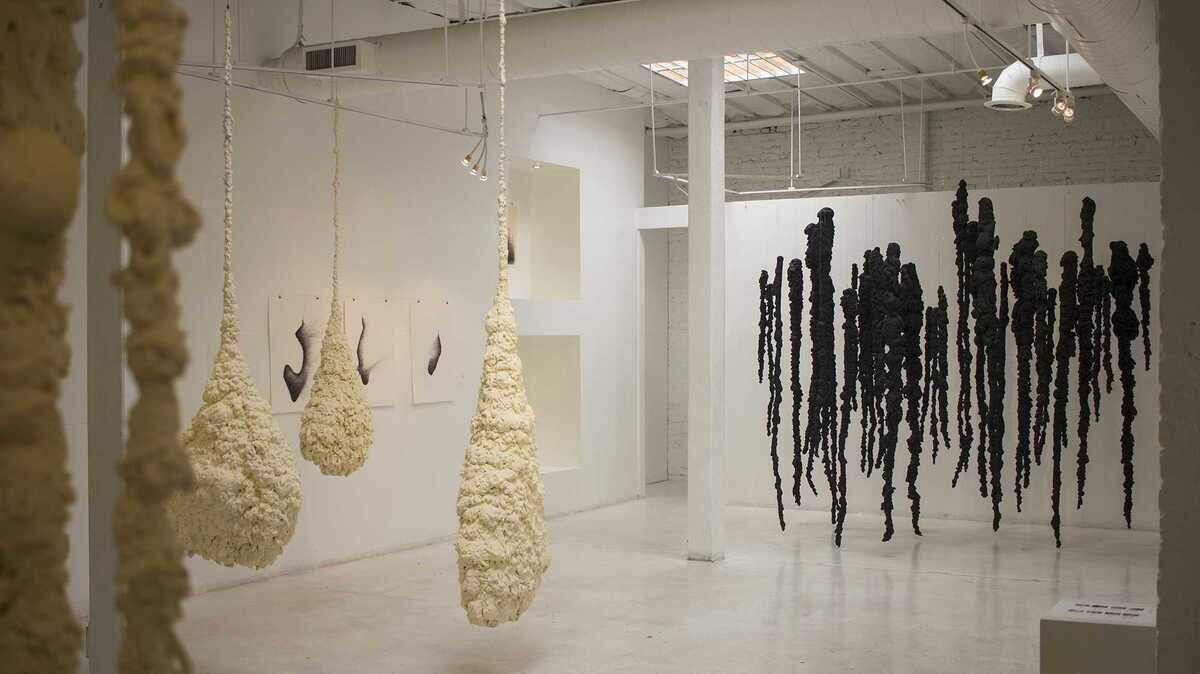
The installation optics of Hodgins’ Polystyrene sculpture at Artspace 1616 are spectacular. The scale of the gallery enables unfettered long-distance viewing. Suspended in the gallery’s wide-open space, clusters of elongated entities appear to hover between matter and spirit, engaged in primal ceremonies of being and becoming.
Hodgins fashioned tubular armatures of flexible chicken wire over which she poured or inserted Polystyrene foam, which then expanded and contracted according to its nature. Like Benglis, Hodgins was interested in relinquishing directive control to permit happenstance and arbitrary forms. The hardened globules of foam spray painted either flat black or flat white are devoid of definitive configurations. They are perceived in the round, without primary viewpoints, fronts or backs. Yet their anthropomorphic protuberances engender intimations of visceral physicality.
Placement and context is key to Hodgins’ sculpture. The silhouette of black painted clusters such as “Conventio” is undeniably theatrical contrasted against the gallery’s white walls and floors. Movement gives Hodgins’ sculpture its energy. When the individual components are presented as a group, causing the eye to toggle back and forth between positive and negative space, the work embodies movement and expansive implications of life. But pieces such as the large “Descent,” shown as singular objects, lose that energizing magic. The work’s surface, materiality, and fabrication come into focus as props, without the intrinsic value of ethereal energy.
Hodgins’ large untitled ink drawings are controlled exertions of line. Rapidly sweeping over the paper with a ballpoint pen, Hodgins built up tumescent, breast-like forms hovering between abstraction and figuration. Floating in white grounds, the forms exist in ambiguous states of either unraveling or coalescing and reforming into organic entities.
A smaller installation of Hodgins’ work is on view at Gallery 1632. The domestic proportions of the gallery are challenging to sculpture that is best seen in interiors at the scale of Artspace 1616. Nevertheless, the installation is an opportunity to see how large wall work and large objects can be successfully accommodated in a domestic setting.
At the end of her life, Hodgins had found her footing and her artistic territory. She was connected to her voice, and vast bodies of work aside, that alone should be enough.
If you go
A’Cross Town: A Survey Exhibition
Artspace 1616, 1616 Del Paso Blvd.
Thu-Sat 12-6 p.m., Sunday 12-3 p.m. and by appointment
Gallery 1632 1632-35th Street
Gallery hours by appointment
More information: Mima Begovic, 916-849-1127 or Gwenna Howard 916-204-4936
This story was originally published September 20, 2018 at 4:00 PM.