
Play review: ‘Doll House, Part 2’ offers a challenging take on marriage, society
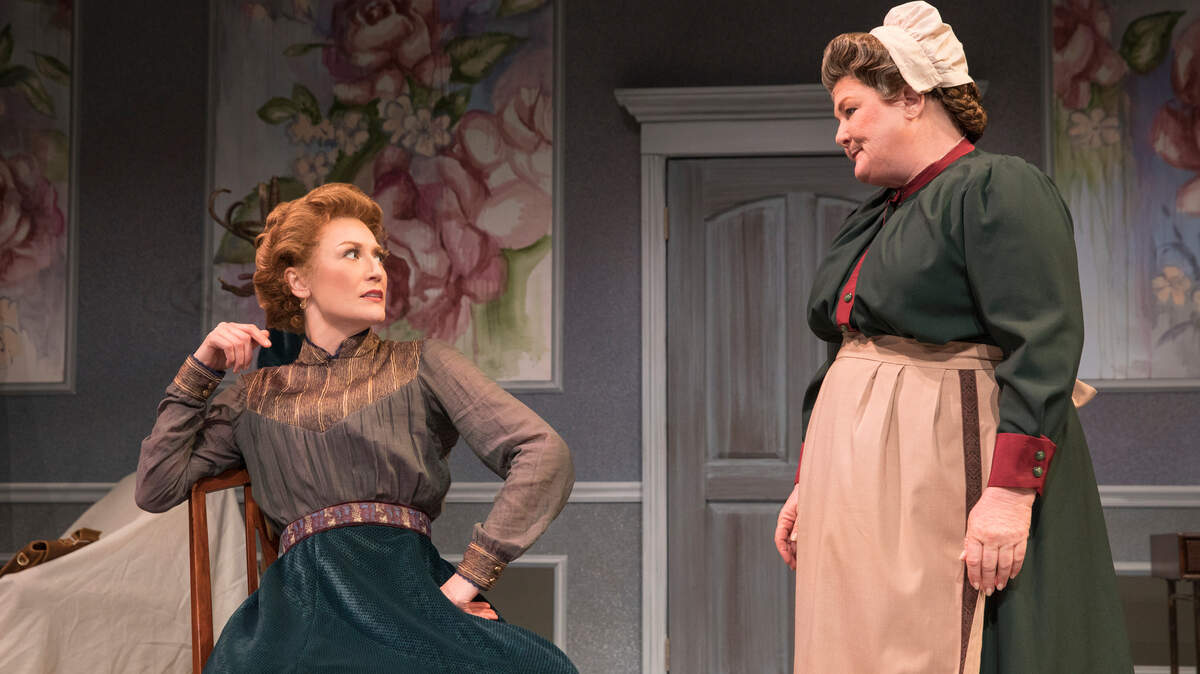
A thrust stage dominates “Doll’s House, Part 2” and dramatically moves it from Henrik Ibsen’s 19th century Norway to 21st century America: emotionally where we all live. The actors in B Street Theatre’s rendition keep thrusting challenging ideas and action forward by advancing to the front edge of the stage and periodically talking directly to the audience, even seeming to question them, as if these were lectures or sermons rather than dialogue.
The B Street Theatre production of “Doll’s House, Part 2,” directed imaginatively by Dave Pierini, is an intellectually and emotionally challenging production, staged creatively and acted thoughtfully, powerfully and subtly by the cast. This doll’s house is a very recent play by Lucas Hnath and cleverly entwines elements of the past and the present. The cast wears 19th century period costumes, but breaks emphatically into very contemporary epithets.
It starts with Nora, who left her husband Torwald and three children in 1879. Her departure lit an intellectual fire. She felt treated like her husband Torwald’s doll baby, his “little squirrel.” He had admonished her “before all else you are a wife and mother.”
The issues she raised are still around. When we hear the insistent knocking at that door as the play opens 15 years after Nora’s departure, we can imagine, in various ways what’s about to occur. Nora has returned, allegedly to obtain an official divorce, and she’s angry that divorce is legally easier for men, and that without divorce she would be prosecuted for signing contracts during her life without him. And that door is still prominently there at middle stage rear, illumined occasionally in gleaming red neon as a beacon and threat to all of us.
Though the thrust stage suggests the contemporary milieu, the back wall offers stuffed versions of an earlier era, with four giant paintings of roses, a parsons table, and two large pieces of furniture covered as if from disuse or in preparation for a move. The two straight-backed chairs downstage were all the actors needed for furniture as they regularly rearranged and dramatized their relationships, emphatically and demonstratively picking up a chair and placing it as they wished, sometimes facing away from the other chair, or dramatically toward the audience.
In this spare environment and structure, four characters confront the audience (compared with eight in the Ibsen play). The prominence of characters and the play’s modernism are highlighted by the absence of act divisions and no intermission. Before each of the five individual scenes a character name is highlighted in neon on the back wall. Nora, the play’s center, is played admirably by Melinda Parrett, dressed in elegant formal wear, befitting a woman of her status and evident success. But despite Nora near iconic status, she still has to be introduced to us and, in effect, to each of those other three characters.
Her husband Torvald (Brian Dykstra) enters and stares a bit uncomfortably at this interloper in his household, whom he doesn’t even recognize for a while. The contrasts between the two could not be more evident. Dykstra is hesitant, often silent, and periodically awkward in speech and physical movement. In contrast Parrett’s Nora is glib and gives lectures. Sometimes her lectures go on for so long she must retreat to stage rear and consult her very 21st century water bottle. She then gestures with it emphatically and uses it to underline or heighten moments in her talk. It’s a prominent and anachronistic prop, subtly emphasizing for us, lest we forget as we sit here in our own very modern world, somehow, with the same issues, the same problems.
Nora eventually contends with each of the other characters. Anne Marie, the nanny, played with comic flare by Stephanie McVay, is initially agreeable, but ultimately offers her cogent lower-class critique of Nora’s assumptions.
Nora’s daughter Emmy (Tara Sisson) is the person most distant from Nora and suggests an unappealing solution to Nora’s dilemma. Emmy begins for us as an overly prim, somewhat disengaged young woman. But in one key sequence she turns the tables – and chairs – on her mother and offers Nora a very surprising “correction” to her assumptions. Her emphatic attitude, firm convictions and self-assurance offer such an assault on Nora’s views that Nora (along with the audience) actually recognizes a version of herself.
The dialogue is filled with talk of marriage and divorce and fraud and trials and family accusations: you might think this 90-minute uninterrupted play would be pretty heavy and fiercely serious. But it’s not. There is a great deal of comedy here, visually and orally. In a climactic moment, Nora breaks her elegant superior mode and in her elegant, expensive dress rolls on the floor in laughter at Torvald’s supposed view of himself. Pretty soon he’s rolling on the floor too, explaining how he can’t understand her.
We can debate forever who’s right in marital conflict, and that is undoubtedly part of the play’s purpose: Who’s right in this marriage, and is marriage a valid or desirable social institution? So what’s right, is marriage still viable or should we seek something else? How can a self be independent and part of a social unit?
Nora envisions for her daughter a transformed future 30 years hence. How transformed is it? Go see “Doll’s House, Part 2” and figure out what you think.
If You Go
“A Doll’s House, Part 2”
When: Shows through April 7.
Where: The Sofia Center, 2700 Capitol Avenue
Cost: Tickets are $28 to $47.
Info: Call the box office (916) 443-5300 or go to www.bstreettheatre.org.