
’The Wickhams’ offers up a tasty holiday sugar biscuit for Sacramento
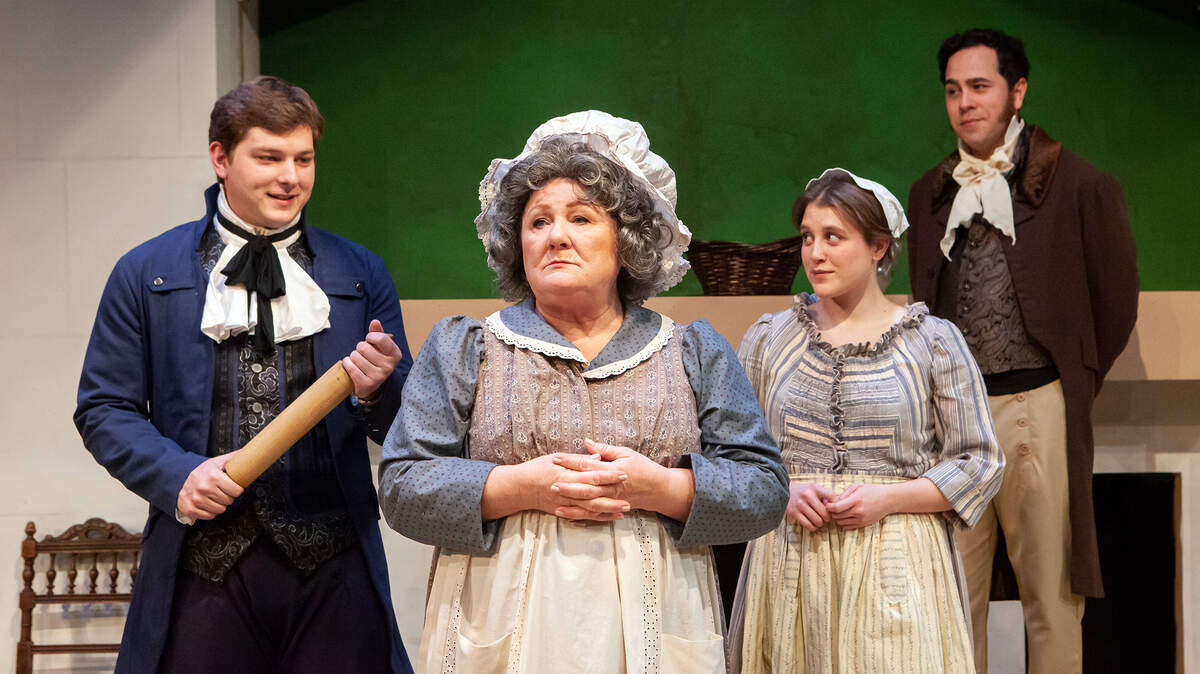
Would you like a biscuit? This is a repeated stage strategy in the new “The Wickhams: Christmas at Pemberley,” a Sacramento premiere that debuted this weekend and runs through December 29 at Capital Stage. For biscuit, read “cookie,” and apparently they are delightful. Virtually every character on stage wants one, regularly seeks them out, enjoys them at key pauses in the plot. Mrs. Reynolds, the family housekeeper, creates and dispenses them liberally, keeping several available in her apron pockets as well as in a canister on the sideboard. They are an analgesic for the entire family, both upstairs and downstairs. And this play serves as an end-of-year biscuit for the audience. The need for them and their regular appearance is one form of comic artistry here.
The sugar biscuits almost begin to seem like the social drug of choice of the early 19th century. The housekeeper offers them periodically like dog biscuits, to keep her charges “trained” and behaving. It’s also just one of the food strategies the play displays, including a regular appearance of raisins and raisin pudding, devoured by some, detested by one particular character. The food focus and the appearance of a freshly cut tree making its way across stage and upstairs are among the few features that earn the Christmas designation.
Just as “biscuit” is a misleading label (in the 21st century) for this 1815 treat, so “housekeeper” is a misleading rank for Reynolds, played artfully and slyly by Stephanie McVay. For Reynolds is the supervisor of everything and everyone below stairs, and to a certain extent of the master and mistress of the house as well — and the stage manager of much of the action. McVay may appear critical at times, occasionally stern, but always consistent, rational, and articulate. She is periodically warm and humane — inviting in her guise of apron and biscuits. She has rules, and she is always making judgments about character and deportment and moral judgment. And the actress’ comic timing is finely tuned, subtle.
Much of the audience will recognize Wickham, Mrs. Reynolds, and Lydia as minor characters transported from Austen’s Pride and Prejudice — and Pemberley as the location of Mr. Darcy’s (and now Elizabeth’s — née Bennet) estate. Here, we see Pemberley only from below, in the common room for the servants, with its coat rack backstage left, its crockery in a breakfront in the middle — along with a series of bells backstage right, adjacent to the stairs leading up to the main rooms and the masters’ quarters. But the minor characters from the novel are the major characters in the play, though Darcy and Elizabeth do offer significant minor roles in the action. Elizabeth (Brittni Barger) has a masterful turn as a kind of prosecutor using language and motion in a peripatetic weaving across the stage.
There’s something of upstairs/downstairs here, with the emphasis on downstairs. All the visible action takes place downstairs, primarily among the servants and the “servant class” — a housekeeper, a footman, a housemaid, among others. We see players enter from above via the stairway stage right ,but of course never see what goes on upstairs. It’s all pretty much a servant affair.
Despite the opening happy Christmas atmosphere, many tensions lurk below the surface, as in the conflicts occasioned by Lydia (née Bennet) Wickham and her marriage. Or between Fitzwilliam Darcy and Mrs. Reynolds, in a forceful exchange where they differ about the character, prospects and role of George Wickham, son of a former steward in the house who had grown up alongside Darcy and is now a disreputable army officer married to Lydia. Reynolds’ comments on Wickham are the most poignant addressing of the class conflicts and inequality, for the most part subdued in this play, occasioned by the social situation of Austen’s characters. Lydia (Melissa Brauch) is regularly a bubble of nervous and selfflattering as well as intentionally annoying and vapid laughter — flirtatious wife regularly left mysteriously alone by her, apparently philandering, husband.
Wickham’s entrance on the scene is notable, initiating the chaos that presents the main conflict in this drama. Played by Colin Sphar in a bravura performance, he arrives forcefully through the only door on stage —disheveled, half-undressed, scarred, and apparently drunk. He’s regularly one of the most entertaining characters on stage with his convincing portrayal of a rake and con man. He lounges about the set, at one point draping most of his body across a common room table, while he almost constantly spouts a plausible line of deceptive explanation and entreaty — with recognizable clichés from many eras
We can guess what will happen. And it does.
The play is popular, funny, comforting and likeable — but not very challenging. It’s also the second Austen “knockoff” on a Sacramento stage this fall.
If you go
“The Wickhams: Christmas at Pemberley”
Where: Capital Stage, 2215 J St.
Performances: through December 29. Shows are Tuesdays, Wednesdays and Thursdays at 7 p.m., Fridays and Saturdays at 8 p.m., with matinees at 2 p.m. Thursdays, Saturdays and Sundays.
Price: $32 to $44
Info and tickets: 916-995-5464.
Writing/directing: The play was written by the team of Margot Melcon and Lauren Gunderson, the most produced American playwright two of the last three years, and directed by Peter Mohrmann.