
California State Fair courts farmers while expanding beyond agricultural origins
.JPG "Gracie, a cow, shares a pen with her calf Rowdy at the California State Fair on July 11.")
AI-generated summary reviewed by our newsroom.
- State Fair offers livestock exhibitors more support to retain agricultural ties.
- Agricultural Heritage Club honors six farms for longevity amid limited outreach.
- Fair expands programming while rebuilding council to reconnect with farmers.
Natalie Reis, 38, has in recent years ranked among the top cattle producers at the California State Fair. But last summer, she had had enough.
Reis said she complained to organizers about the onerous paperwork, restrictions and costs associated with bringing cows to compete at the State Fair in Sacramento.
“Hey guys, I’m getting tired,” she recalled saying. “I don’t have to come here. We love this. We feel like this is very, very important. We feel like promoting to the public is very important. So you guys have to help us out.”
The State Fair heeded the call this summer, Reis said, giving livestock contest participants more time to set up in the cavernous barn, more passes for guests to access the fairgrounds, and bedding for the animals. It appeared to be one way that the State Fair, about midway through its 17-day 2025 rendition this weekend, has tried to woo farmers and stay true to its agricultural origins even while broadening its focus.
The State Fair and the California agriculture industry have long been intertwined, but the two are not as central to each other as they once were.
The fair now promotes a variety of industries, and California’s agriculturalists no longer depend on it to build a reputation and market their products to the world — as they did when the California State Agricultural Society sponsored the first fair in San Francisco in 1854, according to local historian William Burg.
“There weren’t farmers here yet, for the most part,” said Burg, a former president of the Sacramento Historical Society, explaining that the fair was meant to attract farmers and buyers. “It showcased and showed off the potential for California’s agriculture.”
‘Pride, culture and identity’
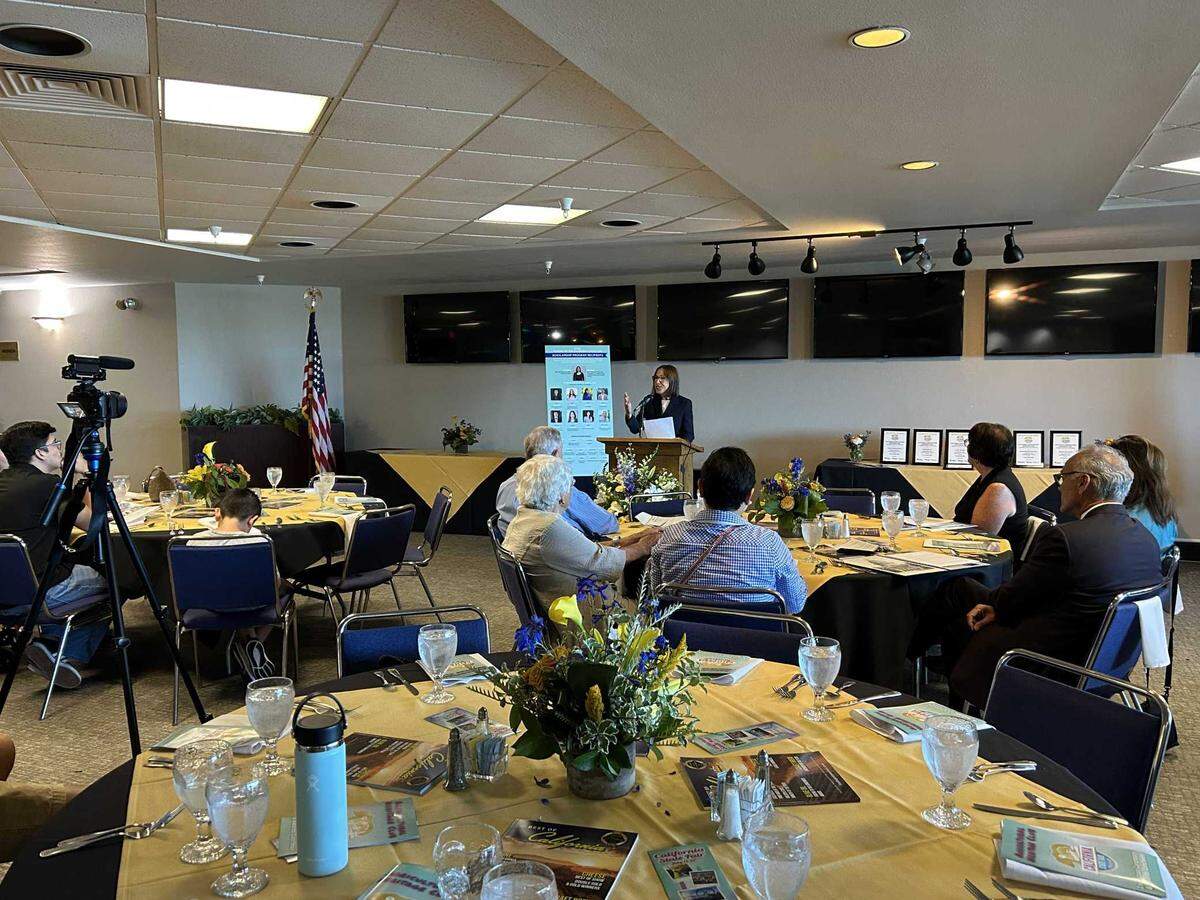
The State Fair hosted its annual induction ceremony for the California Agricultural Heritage Club, which honors longstanding farms, over lunch Wednesday on the second floor of the grandstand overlooking a horse-free racetrack.
Six farms were recognized — two each in categories for 100, 125 and 175 years of operation. They included a Butte County Concord grape farm founded in 1925, whose owner brought his father and son to the luncheon, and a plant nursery in Los Angeles County that a Japanese family rebuilt after internment.
Speakers at the event celebrated the honorees’ resilience. Lt. Gov. Eleni Kounalakis said the agriculture industry has been a constant for California amid change and uncertainty.
“California agriculture feeds the country and the world,” she said. “It’s a $55 billion industry, but beyond the numbers, it is a source of pride, culture and identity for our state.”
The people representing each farm were called up to receive plaques and posed for photos with a State Fair board member, in front of a gold California grizzly bear model.
Ethel Hoskins, 83, was recognized in the club’s 175-year tier as the owner of the Hoskins-Pleasants Ranch, which her grandfather founded in 1850 in Solano County. She said she first attended the induction ceremony about a decade ago, but that a neighbor who runs a similarly longstanding farm had not heard about the club before learning Hoskins was joining it.
“It’s not very well advertised,” Hoskins said. “It needs to have somebody to advertise it, especially for all the farmers.”
State Fair spokesperson Darla Givens did not respond to an emailed question about how the Agricultural Heritage Club is promoted.
Expansion and recent struggles
Tom Martinez, the CEO of Cal Expo and the State Fair, entered his job in 2023 with “one real, big objective, and that was to modernize the State Fair,” he said in remarks to reporters July 9.
“Nothing was wrong with the State Fair before that,” he added. “I just wanted to add other things in addition to the agricultural roots that have been here on display for 170 years.”
Agriculture-focused offerings remain — ranging from a year-round educational farm to child-oriented exhibits such as “Life’s Big Ag-Venture,” from wine and olive oil tastings to the classic livestock competitions. And the State Fair maintains an Agricultural Advisory Council to advise on programming and communicate with the industry.
After the COVID-19 pandemic earlier this decade, however, the fair struggled to staff agricultural programs and fill that council, according to its current chair, Adam Borchard, a former agriculture lobbyist who leads a Central Valley flood control organization.
“It’s been an ongoing challenge over the past few years to populate the council and to better connect the State Fair with the ag industry,” he said in a phone interview Friday, “but we’re making good progress.”
The council has 13 members, Borchard said, roughly double its size when he joined in 2023. Several members attended the Agricultural Heritage Club luncheon, where a presenter asked them to stand up and invited other people to inquire about joining the council.
‘I believe in this’
For Natalie Reis, the livestock competitions are a sentimental as much as a promotional proposition.
She has raised her cows — the white Charolais breed — in Butte County since she was a girl, when she took them to the State Fair and participated in Future Farmers of America.
Reis said she owned as many as about 100 cows at her company’s peak and now owns about 60. One of her cows twice won the top award, in 2022 and 2023, a boon for her business of selling the offspring.
In the world of livestock competitions, Reis said, the State Fair itself faces increasing competition from national shows in the Midwest and from California county fairs, which are concentrated in the summer and which, unlike the State Fair, generally allow participants to sell livestock.
“I can go to whatever show I want to, try and win that one and have the same promotion,” she said as her four cows rested Wednesday afternoon, with her 8-year-old daughter Carter nearby. “But I believe in this. I’ve been doing this for my whole life.”
The next day, one of Reis’ cows won the highest prize for any breed or age, she said.
Besides earning laurels for individual cows or producers, livestock farmers serve as representatives of their industry to fairgoers who stop by the barn. Reis said she feels a “responsibility to be here as a positive experience for the average consumer,” particularly because she believes animal rights activists have pinned negative connotations to her line of work.
If the State Fair originally helped build California’s agriculture industry into a behemoth, it can now educate people who may consume its products without knowing their origins, said Borchard, the Agricultural Advisory Council chair.
“As California has progressed,” he said, “more and more generations, even families that came to California as a farm family, they are more removed from our food source.”
This story was originally published July 20, 2025 at 5:00 AM.