
What’s brewing at UC Davis: Global Tea Initiative studies one of our most popular drinks
Want more food news? Sign up for the Food & Drink newsletter at sacbee.com/foodnews to get your weekly fill.
UC Davis has long been known for agriculture, veterinary medicine and a slew of other science-y programs. Thanks to the efforts of certain faculty and students, it’s becoming internationally known as something new: a tea school.
Started in 2015 by Katharine P. Burnett, a UC Davis associate professor of art history, Chinese art and culture, the university’s Global Tea Initiative examines one of the world’s most popular drinks through an academic lens.
More than 40 faculty, staff and students author or contribute to formal studies of all things tea, often working with industry leaders and researchers at other universities. Burnett’s not-so-far-off hope is to turn the Initiative into a larger Institute, similar to UC Davis’ Robert Mondavi Institute for Wine and Food Science.
At tea symposiums around the world now, Burnett said, industry members tell her they have been looking for something like GTI for the last 40 years. At UC Davis, it inspired a club that drew 90 people to its first pre-COVID tasting and plans to resume meeting soon, and students are encouraged to work with GTI faculty to craft their own tea-related majors.
I sat down with Burnett, a midtown Sacramento resident for the last 20 years, over cups of organic mint tea this week. Here’s our conversation, condensed for space and clarity.
Benjy Egel: How would you describe the Global Tea Initiative to someone unfamiliar with it?
Katharine P. Burnett: The goal is to advance evidence-based knowledge about tea through research and teaching. We’re helping people just the way UC Davis helps people learn about viticulture or brewing or milk. And what is the history, the culture, the anthropology.
What we’re doing is unique in the world. We’re the first and only organization that emphasizes the culture along with the science at such a rigorous level. It’s not that we’re the first institute to study tea, but by and large, they focus on their national product and we are product-neutral.
BE: You think about the history of tea and what a large cultural role it plays in East Asian countries, in India, in Britain, in the Middle East. Why do you think tea has been so culturally significant in so many different places?
KB: I think it’s the storytelling that makes it fascinating, and then it’s a healthful drink, which also makes it good in a way other beverages aren’t. It has theanine in it, which is a calming, soothing chemical compound found in very few things.
But another reason is that it’s been an exotica. People wanted the tea, the blue-and-white ware, the teapots — all the things the tea people were using to sell this (product) made it interesting, and then. just like a good bottle of wine that you want to share with friends, here’s a conversation (starter).
BE: How would you describe the greater Sacramento tea scene for consumers?
KB: There’s the Tea Cozy, which has loose-leaf tea to-go. Leo Hickman’s Classy Hippie Tea Co. has mostly herbals — nice guy, I’d love to see his store supported. Peet’s head of tea, Elliot Jordan, knows tea, and they select really good quality teas — you’re not going to fail there. There’s boba tea, which can have some tea camellia sinensis in it but not necessarily. If you’re not worried about calories, go for it.
I’d love to see the tea scene developing more as people are increasingly wanting to drink tea. One thing that people from the industry complain about is you go to a really nice restaurant, and too often (the tea) you get is something so-so that doesn’t match the quality of the food you’ve just eaten. I’d love to talk to Sacramento restaurant (owners) about what a tea sommelier might do for them, that it’s possible to serve good-quality tea.
BE: What are some of your favorite teas?
KB: You know, it’s like asking “what’s your favorite child?” Chinese green tea, the classic longjing dragonwell tea, is lovely, absolutely nothing better. Green teas from Japan are extraordinary — they’re really loaded with umami, so they have this little fishy flavor that if you’re eating sushi, what a match.
Oolong teas made in Taiwan or Fujian — exquisite. I’ve recently gotten into China’s oldest form of black tea, lapsang souchong, which has a bit of a pine-smoked flavor and aroma. Black teas from Darjeeling are the classic; it’s the Champagne of teas.
For more insights: The Global Tea Initiative will host its seventh annual colloquium via Zoom on Jan. 13, titled “Tea and Beyond: Bridging Science and Culture, Time and Space.” Online registration will soon be available at Tea Cozy.
What I’m Eating
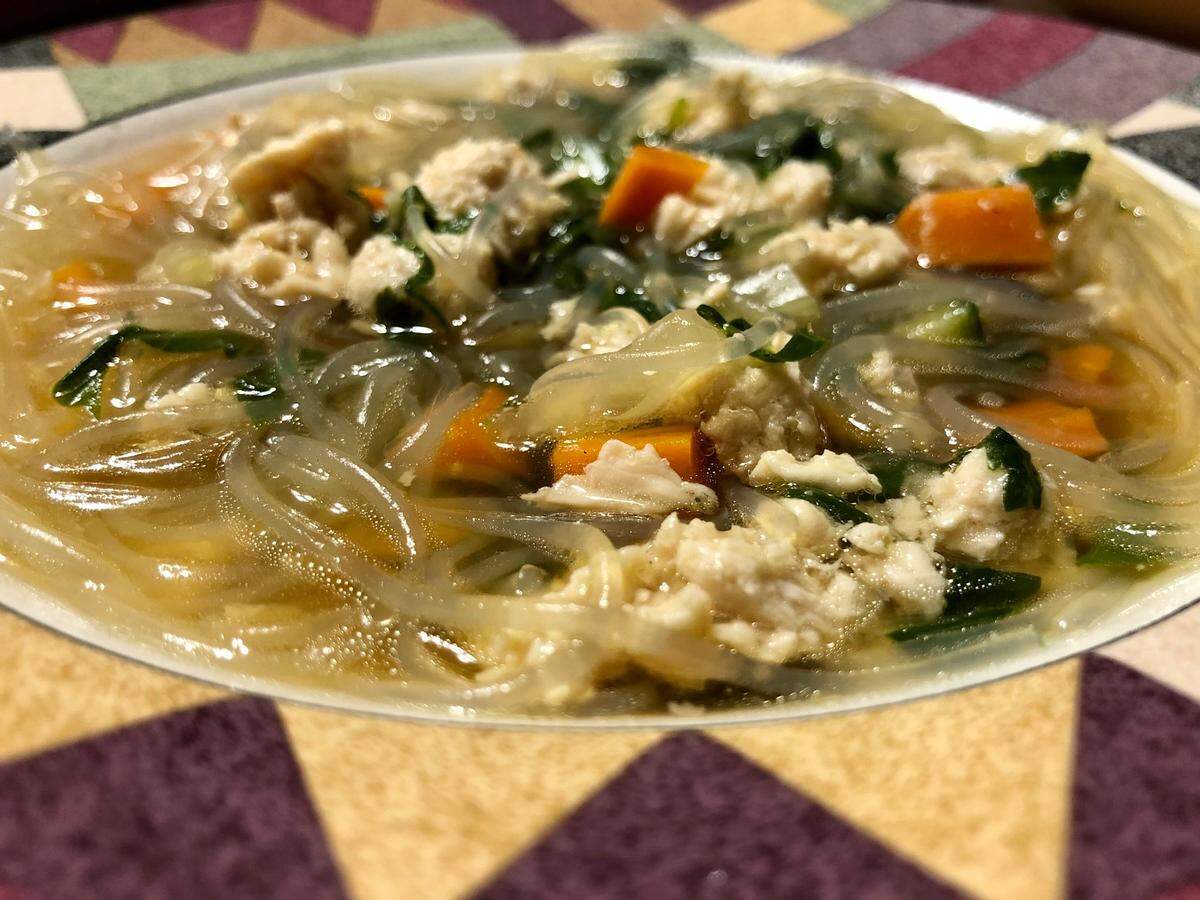
Nursing a bit of a cold and incapable of not over-dramatizing the slightest illness, I trudged down to Thai Basil in midtown Sacramento for some takeout chicken noodle soup earlier this week. Not my grandma’s recipe, though.
Suleika Sun-Lindley’s Thai Basil at 2431 J St. (and her sister Wannipa Raff’s restaurant by the same name at 1613 Douglas Blvd. in Roseville) is one of the few places around Sacramento to serve a soup called gang jeard ($7.50 for a cup, $12 for a bowl). The salty mushroom-soy broth packed with ground chicken, glass noodles and chopped carrots, zucchini and kale soothed my scratchy throat and made me appreciate my sense of taste still being intact.
Sun-Lindley also owns plant-based Veg Cafe upstairs, and Thai Basil is similarly veggie-friendly. There’s a robust all-vegan menu, no curries on the main menu use animal products, and Impossible meat or JUST Eggs are listed as protein options alongside tofu, shrimp, chicken, beef and pork. That makes it easy to go for items like the slippery lad nha ($16), flat, wide rice noodles wok-fried with broccoli and served in a thick soy gravy.
A steak dish called nuah-yang ($23) spun in the opposite direction but relied again on a soy-based sauce, an assertive one stocked with chilis, ginger and garlic. It was delicious, and needed to cover up regrettably tough strips of medium-rare sirloin served alongside zucchini, broccoli, onions and carrots.
This story was originally published November 19, 2021 at 5:00 AM.