
The rise and return of Robert Paylor: ‘I was looking death in the eyes’
Clustered in a tangle of arms, legs and torsos, elite-level athletes scrambled to move and get up off a South Bay grassy pitch just over three years ago.
Robert Paylor was not one of them. He could not move. He felt nothing.
He was at the bottom of that pile, on his back, his 6-foot-5, 235-pound frame motionless. He was in Cal Bears blue and yellow rugby colors in this collegiate championship match in Santa Clara on May 6, 2017. These were supposed to be the best of times, a dream life in full motion — a UC student with honors, a starter for a nationally renowned program — when suddenly, everything came to a crashing halt.
Paylor could only feel the fear well up inside. A moment after the sophomore out of Jesuit High School was dragged down in headlock by an Arkansas State player, illegal in this sport, Paylor’s life was reduced to what his lips and eyes could do. He looked up and saw his parents, the anguish and worry in their expressions. They hustled onto the field to tend to their oldest child.
And then he told them something from the heart. Jeff and Debbie Paylor soaked in those words.
“There I was, lying on that field,” Paylor recalled this week from the El Dorado Hills home of his parents and brother, Brant, “and I was thinking that I always tried to make my parents so proud — as a student, as an athlete, as a good person. I was on that turf, broken, completely and mentally broken.
“They told me everything was going to be OK. I knew it wasn’t going to be OK, and I said, ‘I love you both more than anything.’”
Continued perspective
Paylor lost a lot that spring afternoon, but he never lost an ounce of hope or perspective. Mainly this: He’s alive, and that catastrophic injuries don’t have to define a person. Paylor vowed to have better days. He has a lot of them and he appreciates all of them.
On Saturday, Paylor pulled himself out of wheelchair from his home and, through a virtual video ceremony, delivered a moving commencement speech for Cal athletes as a freshly minted graduate from UC Berkeley’s Haas School of Business. All graduates find a way. Paylor found his. A speech can unnerve people. Just the thought of sharing inspires Paylor.
He graduated in less than four years, which included a year of grueling rehabilitation to get his body to work again. Paylor is a story of courage and remarkable resolve.
This month has been a whirlwind. Paylor was recently awarded the Wilma Rudolph Student-Athlete Achievement Award to honor those who have overcome odds to achieve. Said Cal rugby coach Jack Clark, “Robert epitomizes the human spirit. He is the most inspirational and accomplished athlete I’ve ever coached. He is, quite honestly, a legend to us.”
“Pride, all pride,” Paylor said of his recovery and ambitions.
He added, “At first, just living was a concern because it was that bad. Doctors told me that I wouldn’t be able to walk again, wouldn’t be able to put a piece of pizza to my mouth. I was listed at 1 percent of being able to do any of those things. I was going to beat those odds. I had to. I went from not feeling anything below my neck to now being able to stand, and walk a little. I’m independent. I can get out of bed, dress, shower, cook for myself. It takes awhile, but I can do it, and I’ll continue to get better.”
Paylor said after a pause, “I have no remorse. I don’t think that way. In a lot of ways, this injury is a gift. And I’m graduating! I’m happy, I’m lucky and I’m grateful.”
‘Looking death in the eyes’
Long before he could envision graduation, Paylor had to endure the first leg of his recovery. He had to get through each night in a Santa Clara hospital intensive care unit, a short distance from where the injury occurred. He had to adjust to the tubes in his body, the fluids building up in his chest with no way to cough. He called a lot of it “pure survival mode.”
He had to accept being trapped in his own body, of trying to comprehend what happened and what it all means and what loomed.
Paylor was yanked down on that play in a headlock. A mass of players closed in — a maul — and the pile went down. These sorts of plays happen a lot in this physical sport. But what isn’t common is the result. When played the right way, rugby players don’t end up broken.
Three of Paylor’s vertebrae in his neck were shattered as he hit the turf, slicing into his spinal cord. He was paralyzed from the neck down. He spent a month in that Santa Clara hospital, which included moments of “sheer horror.”
“I got pneumonia, couldn’t cough on my own with my diaphragm in my throat paralyzed,” Paylor said. “Every three hours, a doctor or nurse would slam on my chest, like CPR, to push my body and push the stuff out of my lungs. There was no rest. I had a tube down my nose to feed me. I lost 60 pounds that first month. Was told I wasn’t going to make it. Those were dark moments. I was looking death in the eyes.”
Paylor was told by his doctors that his efforts would dictate how much he could regain the use of his limbs. He would concentrate on his toes, urging them to move, pleading for them to at least twitch.
“I was looking down one day at my gnarly feet that had been in cleats for so long, and then two toes on my right foot ... they moved,” Paylor said with a laugh. “I had a vision. I had a goal. I had super lucid dreams then that I was walking, fully functional, running, footwork. I’m completely fine. Then I’d wake up — ‘Oh, man! I’m not doing that.’ But I kept going. My goal from Day 1 was to be independent of a wheelchair, to use a walker or a cane or something. That’s going to happen, or I’ll die trying.”
Soaring pride
Paylor spent 11 months in Colorado for rehabilitation. His story became global, much like his beloved sport. People rallied for him. They mailed notes, cards, jerseys. He’d run into unfamiliar faces and was greeted enthusiastically with, “are you Robert Paylor, the rugby guy?”
He became a social media star on Twitter and Facebook, a reluctant hero who has used his platform to inspire millions. A GoFundMe account raised more than $1 million to assist in medical expenses.
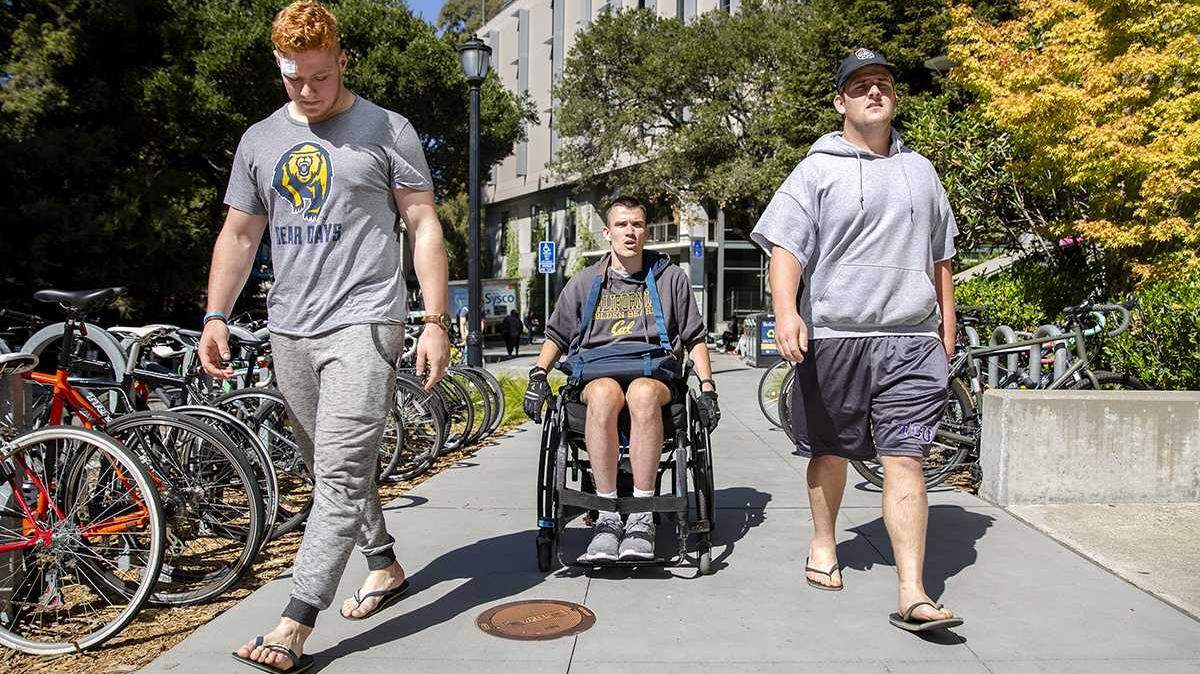
After his Colorado rehab stint, Paylor vowed to return to Berkeley to finish his Cal studies, to work even more on his body. Cal rugby coaches Jack Clark and Tom Billups made sure that a teammate would escort Paylor, in his wheelchair, to class every day. He would not do this alone.
The goal was to take a step, then several. One has to learn to crawl before he can walk. Billups worked with Paylor to stand, to walk, to exercise, to sweat, to study up on neurological rehabilitation.
“That man is a saint,” Paylor said of Billups.
Said Billups, “No one knows how they’ll respond when tested, or severely tested. Robert has done it at an entirely different dimension. His situation was very singular and unique. That fostered the bond we have. The apex of his life, his greatest moments are ahead. We know that the science now shows that the brain can rewire and the body can reconfigure after this sort of injury, but you have to put the time in. Robert answered the bell. Just incredible.”
Paylor wondered three years ago in a moment of panic about the pride his parents had for him. It’s still there, still growing. Parents never outgrow pride.
Jeff and Debbie were with their son last fall in Berkeley for a home football game. They cried as Paylor shuffled across the Memorial Stadium turf, and all were moved by the standing ovation. They cried some more on Saturday morning, watching their son’s online speech to Cal graduates, the theme heavy on pride.
“Amazing young man,” Jeff Paylor said of his son. “He’s always had that smile and he still has it. He’s just thankful. We all are. Thankful for every single day. The injury doesn’t own him. He has interests and hobbies and dreams like any able-bodied person. He’s living life. So proud of him.”
‘I wanted to be angry’
Paylor’s plight has led him down a new career path. He initially planned to attend graduate school at Cal but now has a new calling as a motivational speaker. Paylor had several engagements canceled during the coronavirus pandemic, but he will be a natural with his ability to express and share, to reflect and laugh.
“Faith carried me through a lot of this,” Paylor said. “My whole purpose now is to inspire people, to tell them that they can do anything. I am on a mission from God to inspire, to use my story.”
Paylor doesn’t go a day without thanking those in his corner — family, friends, teammates, people who cared enough to reach out.
“I’m forever grateful to so many people, people who kept me alive, who poured ice all over my body in that hospital room when my temperature spiked to 105 degrees, and my parents, and friends,” Paylor said.
The one person Paylor has not heard from is the guy who brought him down in that rugby match. It was, by any measure, a dirty play, an unthinkable tactic. This pains Paylor, but he won’t dwell on it. He calls it wasted energy. (The Bee reached out to Arkansas State without reply.)
“I haven’t talked to that guy who broke the rules and broke my neck, and he hasn’t reached out, and neither has the head coach,” Paylor said. “That play happened so fast. It was until two days later that the evidence started pouring in, the pictures and videos. It was a blatant play, a bind around my neck, completely illegal.”
Paylor added, “I wanted to be angry. I wanted to hate, but my faith saved me on that, realizing that the more power I gave to him and to the past, the more it wasn’t helping me. But I know who he is and I presume that he knows who I am. I forgive him, whether or not he cares or not.”
Cal rugby coaches were disappointed that no sanctions or punishment was handed down to Arkansas State by rugby’s sanctioning body. The Paylor family considered a lawsuit, then decided not to at the urging of Paylor.
“That money wouldn’t do anything for me, wouldn’t mean anything,” Paylor said. “I really don’t want any pity. I have no self-pity.”
Paylor added, “I’m not a victim. In the beginning, this was pure horror. I was trying to get through every day, to survive. Now, every day is a gift. I am so lucky. You hope people are inspired by life and that they realize the good in their life.”
This story was originally published May 16, 2020 at 1:40 PM.