
With coffee and crafts, Sacramento women push through pandemic with pop-up businesses
On September 18, 2018, former Gov. Jerry Brown signed Assembly Bill 626 into law — it was the most ambitious food bill since 2013’s California Homemade Food Act.
The bill, dubbed “Microenterprise Home Kitchen Operations” or “MEHKOs,” gave home businesses a platform in the California Retail Food Code. For the first time, homeowners could legally sell perishables and nonperishables alongside commercial kitchens. The home business was in business.
Now, these pop-up businesses are exploding in popularity. Parallel to COVID-19’s increase in e-commerce, customers are rushing for vendors’ wares — everything from food and beverages to paintings and prints.
For many, these small businesses offer a diversity, creativity and flexibility their larger competitors lack; the pop-up promises intimacy and understanding.
Two Sacramento-based pop-up owners brand their businesses around that. Owners Jess Mill and Savanna Muñoz are not only using their platforms to sell products but to spread a message: The best things often come from unconventional places.
Jess ‘Luna’ Mill: Weird City Coffee Roasters
When customers enter Weird City’s limits, they dive headfirst into a sci-fi narrative titled “Our Story.” Featured in “Coffee People Zine,” Weird City Coffee Roasters is a coffee pop-up gone intergalactic.
Three extraterrestrials set the scene.
In a parallel universe, aliens Luna, Roach and Mudge reside in Normal City. The metropolis scorns individuality and values complacency. Its rules and regulations encompass the entire planet, leaving the interstellar trio nowhere to flee.
Desperate, they make a radical decision: Luna, Roach, and Mudge bravely man a rocket ship, The Quest, in search of a planet all their own. After trial and error, they arrive on an intergalactic garbage dump. From the trash, they begin to build their home.
“They built a beacon,” the tale reads, “an impossibly strong beam of light that sent the Weird City signal into the furthest reaches of the universe — a call to Freaks and Weirdos everywhere to join the cause and build their community.”
Jess Mill’s pop-up bases everything — its design, layout, coffee and merchandise — on the lore. The pop-up’s socials are painted neon orange, purple and green. Subscribers are dubbed “Weird City Citizens,” and merchandise features alien flora and fauna.
In her cottage-licensed home-kitchen, the 32-year-old blends unique coffees in an Aillio Bullet Roaster. Customers can purchase these Martian brews by the pound. Some flavors are conventional, despite the alien aesthetic. There’s a medium roast, dark roast and decaf. Weird City also features some exotic flavor profiles, revealing more about Weird City’s fantasy origins.
“We want to offer a coffee for everyone, and we want coffee to be fun for the consumer,” she said. “It’s darn good coffee without all the pretense. You like cream and sugar? Cool. Dark roasts? We gotcha. You like hella fruity, anaerobic-processed coffee from Costa Rica? Come on in!”
But, being a business, Weird City Coffee Roasters isn’t just whimsy. Weird City is a place where the lines of fiction and reality meet. “Our Story” isn’t a fantasy but a reflection of the obstacles Mill faced in developing her pop-up.
Each Weird City character represents a real individual. Mill found her name, Luna, in a cat from her favorite childhood cartoon “Sailor Moon.” Roach represents her partner, Andrew Roach. Mudge is longtime friend and graphic design head Kit Bear.
“Our Story” really did start in Normal City. Mill described what it was like living and working under its social strictures.
“Working in the beer and wine industry, and then eventually coffee,” Mill said, “I encountered a lot of sexism, homophobia, and ageism; that has never stopped — you’re either too young, or you’re too old. I’ve learned to hide who I really am in order to stay safe and have access to opportunities I might not get otherwise, but there’s only so much you can do, and living like that definitely doesn’t feel good.”
“As a person who has struggled with their mental illness, sexuality, and gender identities,” she continued, “Luna (AKA me) has come to realize that a lot of the struggle has come from outside pressure. I spent a lot of my young adulthood chasing someone else’s vision of success and constantly feeling like a failure because, of course, it’s difficult to achieve something you don’t really want for yourself.”
Mill struggled — and continues to struggle — with depression. It was mentally and physically taxing to exist within an industry she loved but treated her so poorly.
And then COVID hit.
Two weeks before lockdown, Mill lost her job as a roastery manager. She was unemployed for months, struggling to find a job in the same industry that had been so poor for her health.
After little success, she pivoted. Mill bought a Quest M6 roaster. She filed for a cottage license to home roast. An idea was taking shape. Roach, who has an MBA from UC Davis, helped her form a business. She turned to California State University, Sacramento student Kit Bear for design.
In August of 2020, Weird City Coffee Roasters launched.
“Oddly enough,” Mill said, “we exist in some ways because of the pandemic. I would never have thought to start a home business had I not been stuck inside without any employment prospects.”
“Our Story” ends with a heartwarming note:
“Weird City is everyone’s fantasy: diverse, open, and full of feeling,” the story ends. “Most build and give what they can, and some don’t do anything at all — it doesn’t matter; if you want to live in Weird City, your existence is contribution enough.”
You can find Weird City Coffee Roasters through its website, Facebook and Instagram.
Savanna Muñoz: The Hippies Bungalow
“I wanted something witchy or mystical,” Savanna Muñoz began, “but I also wanted a home, a space to be me. That’s how the name came to me — ‘The Hippies Bungalow.’”
Muñoz is a 24-year-old stay-at-home mom. She describes herself as “Latina, engaged, and the mother of one human and two dogs.”
Her online shop has everything: earrings, sculptures, glass paintings, pots, plants, knits, crochets, and clothing —the list is long.
But for this business owner, an eclectic collection is essential; her wares need to be an extension of herself. They’re not only an outlet but a way for Muñoz to spread a message.
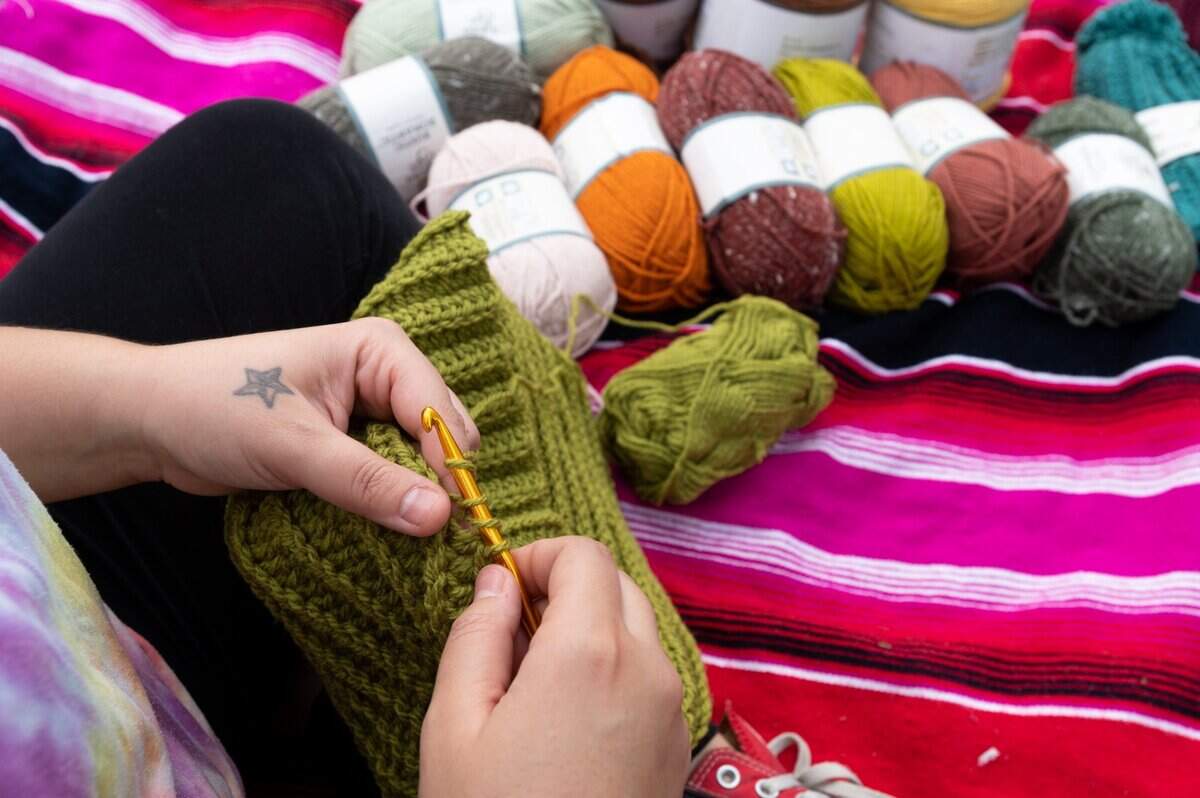
“I’m bipolar I,” Muñoz said. “It feels like I have multiple personalities. I got diagnosed at 14 after my parents divorced. I didn’t really know what to do with all these emotions. My art became a very real and very big thing in my life. ‘The Hippies Bungalow’ is a name I love so much because I can be anything I want to be under it. My bipolar has me in different moods, so everything you see is honestly a different mood on a different day — a different feeling I’m having.”
“I have no shame in it at all,” she continued. “I’m normal. There’s nothing wrong with me. There’s a stigma towards people like me, and I want to spread awareness. I want it to be known and for people to talk about it. bipolar is so common.”
The National Institute of Mental Health reports that over 4.4 percent of US adults experience bipolar disorders. The population shows increased rates of social marginalization, isolation and unemployment. Up to 60 percent of bipolar individuals will attempt suicide once in their lives.
Muñoz’s home business began in 2019 under the name Savvy’s Succulents. Muñoz’s daughter was born the previous year. Though being a stay-at-home mom was fulfilling, Muñoz wanted more.
She began growing and collecting succulents with her young daughter. She remembered long days spent gardening with her own mother, a tradition she wanted to carry on.
“I grew up in the dirt,” Muñoz said. “My mom always had me outside while she was gardening. I grew up with a veggie garden, and so it came naturally, after I had my daughter, to go outside and garden with my daughter right beside me.”
Though selling her succulents was profitable, Muñoz soon realized that a plant business was seasonal. What was she going to do the rest of the year?
She began to ponder. There were so many things that she wanted to try — so many outlets that her mind was itching to try.
Enter COVID-19.
It was like watching the world around her stop, she said. As a stay-at-home mom, the home always moves forward.
Muñoz began to devise a plan during her quarantine. She started collecting odds and ends. She looked up YouTube videos on crafting techniques. She thought about her mother. She thought about her father, a former mechanic at Fender Bender International. She listened to her mind.
“My thoughts are like unfurling yarn,” Muñoz explained. “I open my brain. I start YouTubing. I practice and practice when I’ve found something, step-by-step. I mess it up, and I try again until I have five versions of what I want. My judges are my fiancé and my daughter. My brain freezes, and I go back to the car magazines that my dad gave me. I look at them to remind me of things that I love.”
By June 2020, Muñoz had enough inventory to start her business.
She offers customers her handmade goods and takes commissions. She wants a business for all.
“If I had to describe The Hippies Bungalow in one word,” said Muñoz, “I would say non-judgmental.”
Contact The Hippies Bungalow through Etsy, Facebook, and Instagram. Muñoz’s goods are also found at Typewriter and Moss.