
Gucci’s decision is another example of Roseville becoming a luxury retail destination
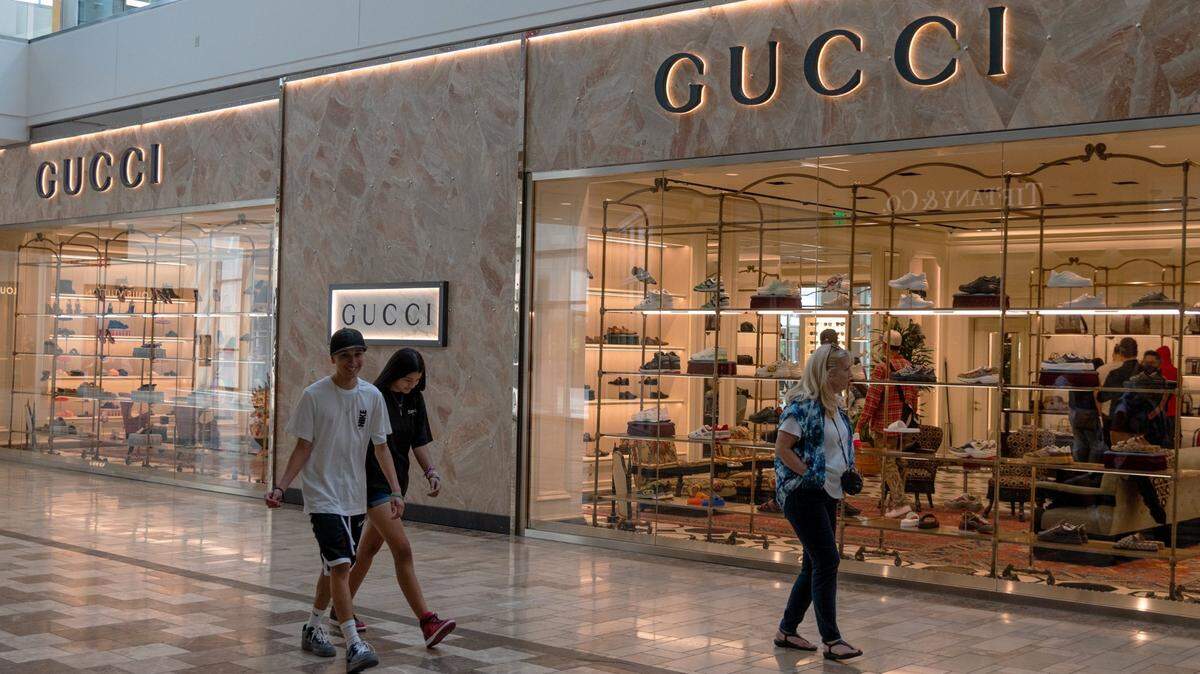
The opening of a new Gucci store in Roseville in some ways exemplifies the current reality of the luxury retail market.
For one, those inflation-spiked gas prices and groceries that have stretched the budgets for so many just don’t have much of an impact on those who can afford luxury.
But also, the Roseville location is an indication of how the pandemic has inspired luxury retailers to adjust to their customers’ shopping habits.
The Roseville store opened in April at the Westfield Galleria. It is the only full-priced Gucci location in Northern California outside of San Francisco’s Union Square, the Valley Fair Mall in Santa Clara and San Francisco International Airport’s Terminal A. Gucci also has an outlet store in Livermore.
Why Roseville? For the most obvious reason: wealth attracts wealth.
Gucci is now part of a fashion triangle on the first floor of the mall, one that consists of a cluster of stores that would be more expected on New York’s Fifth Avenue or San Francisco’s Union Square.
Opposite Gucci on one corner of the mall is Saint Laurent, another high-end fashion accessory brand, which opened in September and is owned by Gucci’s parent company, Paris-based Kering. The other corner is occupied by Gucci rival, luxury accessory brand Louis Vuitton, which opened its mall location in 2018.
Gucci spokeswoman Danielle Balzano would not comment. on the retailer’s decision, but high-income demographics are essential for luxury goods stores. Roseville and surrounding committees, such as Rocklin and Granite Bay, fit the bill, said Steve Edwards, owner/president of Sacramento commercial real estate firm, The Edwards Group.
‘There is certainly money up there’
“They have the highest wealth levels in the Sacramento region,”. s.aid Edwards, who’s worked in the Sacramento commercial real estate market for 30 years. “There is certainly money up there in Placer County and lots of growth.”
Statistics bear that out. The U.S. Census Bureau’s American Community Survey shows that in the period from 2016 to 2020, residents in Granite Bay, 6.2 miles from the mall, had the highest median household income in the Sacramento area at $170, 584, up 38.4% from the period of 2011 to 2015.
It was followed by Rocklin, four miles from the mall, where the median household income was $100,664 between 2016 and 2020. It was up 14.9% from 2011-2015. Roseville, home of the mall, saw a median income of $95,519 from 2016 to 2020, up 15.2 % from 2011 to 21015.
Sacramento in contrast had a median income of $65,847, between 2016 and 2020. That is up 18.8% from the 2011 to 2015, but still represents a huge income difference.
The affluent population is also growing overall faster in Placer County than other parts of the Sacramento region.
Roseville’s 147,773 residents in 2020, the Census Bureau said, was up 24.4% from a decade earlier. Smaller Rocklin, population 71,606 in 2020, saw an even greater 25.7% population growth. Smaller Granite Bay, with a population of around 10,000, saw its population stay around the same between 2020 and 2010.
Sacramento, population 524,943 in the latest 2020 census, saw a growth rate of 12.5% from 10 years earlier.
Edwards said thousands of more residential houses are planned for the area near The Galleria mall, which will add to the large growth that has already occurred in recent years. And, certainly, some of that growth is attributed to higher-income Bay Area transplants.
“I believe that the thinking from luxury merchants is that it will continue to get better,” he said, “adding density to the Galleria trade area.
“It’s all demographic based. It’s all income and density based on how they choose these locations.”
COVID changes luxury retail strategy
Still, so-called secondary markets such as Roseville might not be so attractive to luxury retailers if not for another phenomenon.
The pandemic restricted travel, meaning many luxury retail customers still had money but not the opportunity or inclination to visit such places as San Francisco or Beverly Hills.
Analysts noted that Gucci sees more than 90% of its customers from actual visits to its brick and mortar stores. The drying up of much of the tourism trade in large cities, which contributed to a large part of the revenue of luxury merchants, forced luxury chains to look at alternative locations populated by locals, analysts say.
In a February press conference, Kering Chairman and CEO Francois-Henri Pinault said the group was weighing opening more stores in the secondary markets. Besides Gucci and Saint Laurent, the company also owns Bottega Veneta, Balenciaga, Alexander McQueen, Brioni, Boucheron, Pomellato, DoDo, Qeelin, as well as Kering Eyewear.
In addition to Roseville, Gucci is scheduled to open a store this month at The Fashion Mall At Keystone in Indianapolis, the first Indiana location for the luxury brand.
The Roseville Gucci store spans 5,268 square feet and showcases handbags, women’s and men’s shoes and sneakers, leather goods, fragrances and jewelry.
Gucci, for the uninitiated, is not the kind of place where you’re going to find a bargain.
Men’s wallets that start at $500 or sneakers that sell for $825 are among the lowest-priced items in the Roseville store. Women’s canvas handbags with small sections of leather, do also start at $500, but if you’re looking for all-leather version, you can easily spend $5,000. Thinking of traveling, a Gucci leather suitcase carries a $3,200 price tag.
Saint Laurent also offers high-end fashion accessories, similar to Gucci, but at price points about a third less.
And, yes, there is still a market for such items amid the current tough economy.
“The folks that are possessed of resources remain possessed of resources and have sufficient discretionary income,” said Randy Getz, executive vice president of the Sacramento area for commercial real estate broker CBRE. “Shopping at a luxury location like Gucci is is well within their means and viewed as highly desirable.”
The market is still there for luxury
Consider this: After a troubled pandemic induced 2020, Kering and Gucci recovered in 2021 with revenue that exceeded 2019 pre-pandemic levels.
What’s unclear is if Gucci and other luxury merchants, for that matter, will be able to remain on an upward trajectory.
In the first quarter of 2022 ending March 31, Gucci, which accounts for a large part of Kering’s sales and profits, grew revenue to 13.4 % to €2.59 billion ($2.76 billion) from the same quarter a year earlier. However, stock analysts predicted a 19% average revenue growth rate.
Kering attributed the smaller growth level to its exposure in China, noting that 40% of the store network in the county were affected by some form of COVID-19 restrictions.
China is Gucci’s largest market, accounting for up to 38% of its sales followed by North America at 27% Kering said Gucci saw strong revenue from North America in the first quarter of 2022 but did not offer financial figures.
At its Capital Market Days in Paris on June 8 and June 9, Kering officials said they plan to grow Gucci into a €15 billion ($15.7 billion) revenue brand a year by improving its leather goods and menswear offerings and expanding its young client base.
They did not offer a timetable.
Galleria’s retail domino effect
Locally, there is general reason to believe the market might sustain luxury retailers.
Edwards said the fact that Louis Vuitton has operated out of the Roseville Galleria mall since 2018 is likely another factor in Kering opening Saint Laurent and Gucci, though the pandemic may have pushed back timetables.
“It’s just the nature of the retail business,” he said. “The first guy in has taken a chance. And then if it looks like they’re going to succeed, then all of the complementary high end tenants go, ‘hey, let’s go to the Galleria.”
But not all luxury goods stores have survived the pandemic intact. British chain Burberry closed 18% of its stores in 2020 and the first part of 2021 — and that included its location at the Westfield Galleria at Roseville.
The Saint Laurent store occupies the former Burberry store.
Burberry officials didn’t respond to requests for comment.
Gucci is occupying the space of the Omega Boutique and designer Hugo Boss. The two stores were combined into one. The high-end Switzerland-based watch brand closed its location in 2020 while Hugo Boss moved to another location in the mall.
Omega officials did not respond to requests for comment.
On a recent weekday afternoon, the Gucci store only had several patrons. The store and Saint Laurent, set their own hours, slightly different from the mall.
While the Galleria is open from 10 a.m to 8 p.m Monday through Thursday, Gucci and Saint Laurent, open at 11 and close 7. On Friday and Saturday, the stores follow regular mall hours from 10 a.m. to 9 p.m. and on Sunday from 11 a.m. to 7 p.m.
Edwards said it’s unclear if the stores are suffering from a worker shortage, but even that might be less of an issue for luxury retailers, whose customer habits allow such stores to have more flexible hours. Luxury retail customers are typically not “browsers” but rather people focused on a particular purchase, He noted that the luxury stores depend on less walk-up traffic than a typical mall shop, meaning that shoppers will likely have checked hours in advance.
Optimism in a volatile economic environment
Still, whether Gucci and other luxury brands will succeed in Roseville and around the world in the coming year may well depend on how comfortable the upper-class view spending money in the volatile current financial environment. .
”Luxury sales thrive on customers feeling affluent and secure in their wealth,” said Sanford C. Bernstein analyst Luca Solca in a June 9 report on luxury goods stocks.. “A higher interest rate environment would dampen asset prices and cause the richer to feel poorer. This would be a severe blow to luxury. Asset price trends are important to support confidence of luxury consumers.”
Since his report, The U.S. Federal Reserve has raised interest rates by three-quarters of a point and stock market volatility has continued.
At its Capital Markets Days presentation, Kering Charman and CEO Pinault offered a postive note.
“While we remain attentive to economic and geopolitical conditions,” he said, “we invest in all our brands, whose attractivity will continue to fuel our growth and profitability.”
This story was originally published June 22, 2022 at 5:00 AM.