Railyards financing deal passes. Business groups call it ‘new era for Sacramento’
Sacramento’s city council unanimously approved a deal Tuesday to expand a special taxing district in the Railyards, laying the groundwork to repay developers for infrastructure costs associated with their work.
The move saw a contingent of opposition, and critics noted that the council was scheduled that evening to weigh a series of challenging budget decisions. But the move ultimately succeeded on councilmembers’ aspirations to spur construction in the largely vacant area that borders downtown.
Two housing projects have been completed in the Railyards so far, and Kaiser Permanente broke ground on a hospital there earlier this year, slated for completion in 2029. Sacramento Republic FC and the Wilton Rancheria tribe plan to build a 12,000-seat soccer stadium there, which could be expanded to 20,000 seats.
Councilmember Roger Dickinson told attendees that Sacramento has to “grow our way out” of the city’s financial woes by encouraging economic development and job creation.
“This is a tool — an important tool, used correctly — for doing exactly that,” Dickinson said.
The unanimous vote moves the city closer to expanding a special taxing district for the Railyards, an area that has remained mostly empty since railroad operators pulled out in the 1990s. The proposal is structured so that as the land is developed and its property taxes rise, the increases would be used to repay the costs of infrastructure needed for the project. The expansion deal will return to the committee overseeing the project’s financing, but passage by full council marked a significant milestone.
Fifty people signed up to speak at the meeting, and the majority favored the proposed agreement. Construction union members, business groups and soccer fans urged the council to expand the taxing district and approve a term sheet for the project.
“The Railyards is not just a development project. It’s the beginning of a new era for Sacramento,” Downtown Sacramento Partnership Executive Director Michael Ault told the council. “This is making a difference, and will change the way this city is perceived.”
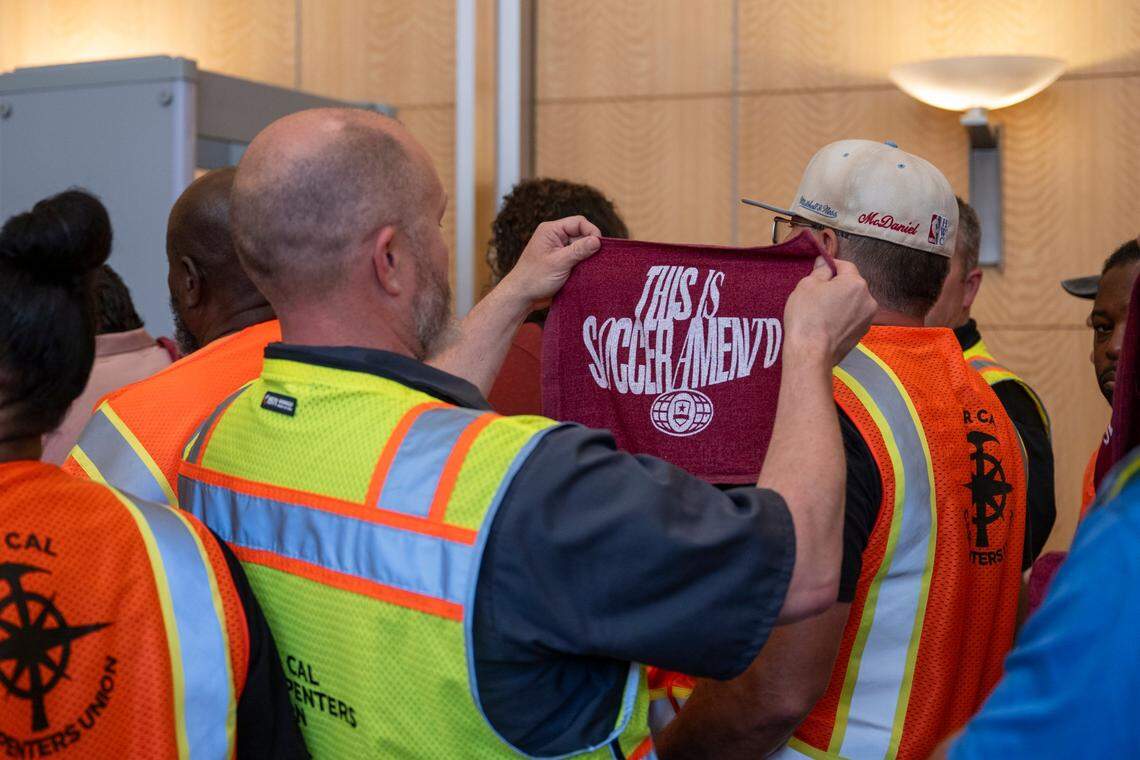
Some opposition over housing
A group of local labor and housing advocates held a news conference last week to oppose the deal, mainly arguing that it should include more affordable housing. They argued that the city should require 15% to 20% of the project’s housing to be affordable. The developer said in an email to The Sacramento Bee last week that 500 of the first 6,000 units built in the district will be affordable, or about 8%.
The labor organizers also advocated for neutrality agreements for the soccer stadium and any hotels that might materialize in the district. Such deals would require employers to voluntarily recognize a union if the majority of workers sign union cards, rather than requiring an election overseen by the National Labor Relations Board.
Several members of Unite Here Local 49, the union that represents local hotel, casino and food service workers members, spoke out against the deal Tuesday, and a handful of attendees displayed signs that said, “Stop the Railyards Ripoff.”
But the project’s proponents have posited that the land will never be developed without support to build the associated infrastructure, and that the city must seize the opportunity while it exists. In their view, the developers are fronting costs for infrastructure that the city would otherwise have to cover and should be reimbursed. Last week, Greater Sacramento Economic Council CEO Barry Broome called the tribe and soccer team’s investment in the site, “borderline philanthropy.”
“It’s been too many years,” the project’s lead developer, Denton Kelley, told the council Tuesday. “Let’s build, and let’s make this happen today.”
Kelley is the president and CEO of Downtown Railyard Ventures, which owns much of the real estate in the district, and of LDK Ventures, the lead developer on the project.
In an interview following the vote, Kelley said that the project would not be possible without the special taxing district.
“It’s always needed public support,” he said. He said the funds will largely go toward building roads, sidewalk and water infrastructure.
Some opponents of the deal had also argued that the city should not be taking on such an agreement amid a challenging budget landscape. The city is expected to see annual deficits of $580,000 for the Railyards through 2033, said Jamie Gomes, the managing principal with Economic & Planning Systems, a firm contracted with the city to prepare the infrastructure financing plan, during Tuesday’s meeting. However, part of those deficits comes from tax-exempt statuses for parts of the district, he said, like the planned Kaiser Permanente hospital and affordable housing sites.
Beginning in 2034, the city is expected to see surpluses on the project, which are estimated to hit $1.4 million by 2040.
The debate over the past week made clear the sense of urgency many officials feel to build and maintain momentum with the long-vacant district.
Former Mayor Darrell Steinberg, who led the effort to put an agreement together for the project last year, attended the meeting to speak in favor of the deal, the first city council meeting he has attended since leaving office in December.
“This is a generational opportunity and decision,” Steinberg told the council. “I strongly urge an aye vote.”
This story was originally published June 10, 2025 at 7:17 PM.