Sacramento-area chipmakers need workers. Sierra College tries to meet demand
When the region’s civic leaders argue that Sacramento is poised to win jobs, investment and tax dollars from the chip industry boom, as evidence they point to the corridor of silicon stretching from Solidigm’s headquarters in Rancho Cordova to Bosch’s semiconductor plant in Roseville.
The notion took on new relevance recently when Bosch, the German industrial giant, pressed leaders at Sierra College to expand a program that will prepare students for work in factories like those that build semiconductors. Bosch plans to begin manufacturing soon at the former TSI Semiconductor plant in Roseville, which it acquired in 2023 and has been retooling ever since.
When Bosch acquired the facility, it made offers to the site’s 222 employees to stay on during and after the factory renovations. All but one accepted, said Scott Olsen, director of HR and administration.
While the site is idled, Olsen said, workers receive their normal paychecks, and some have undergone training to learn new skills. Some have assisted with landscaping, painting and organizing sections of the factory.
“There was a commitment that we made — to making sure that they were financially whole,” Olsen said. “It doesn’t mean that you sit home, you need to come to the workplace and participate. But we made a commitment to them.”
The facility’s workforce was part of the reason Bosch acquired the site, but the company still needed more, Olsen said. The $1.9 billion renovation of the facility began in January of 2024, and Bosch is preparing to begin manufacturing in 2026. Olsen said the facility, today, has grown to around 300 employees.
The company turned to Sierra College, which has spent years building out its mechatronics program, which blends electronics, mechanics and computer control, to prepare workers for the highly technical pieces of equipment Bosch will use.
“They’re hydraulic, they’re pneumatic, they’re high-vacuum, and they’re electronic, and they require precision that goes beyond your imagination,” Olsen said. “A one-degree temperature change inside that chamber is catastrophic… A 3% change in humidity inside that chamber is catastrophic.”
A new employee, he said, may spend a year in training.
“The automation in those buildings is cutting-edge,” said Roy Ingram, a professor and department chair for mechatronics at Sierra College.
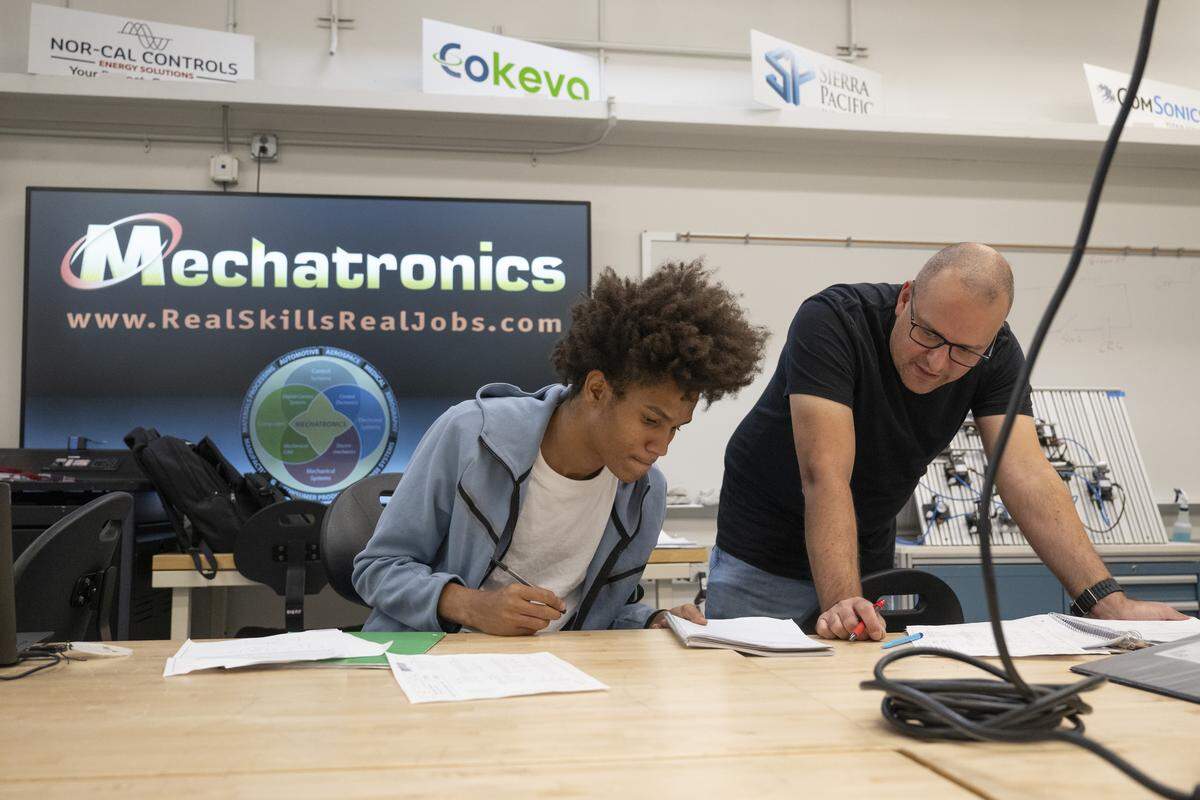
The mechatronics program has existed for years, said Sierra College President Willy Duncan. But more recently, the college began building mechatronics labs at local high schools, to reach more people, earlier.
Still, school leaders say the program gives students highly transferrable skills. On the wall in Ingram’s classroom, there are posters listing dozens of employers who have hired mechatronics graduates, from local water and utilities agencies, to automakers, to defense contractors, to casinos and food and beverage manufacturers.
“Every industry is going to have its ups and downs,” Ingram said. “These skills are transferrable… All of these systems, under the hood it’s the same.”
On a recent morning in Ingram’s classroom, Eric Santa Cruz, a 31-year-old from Citrus Heights, said he dreams of working in water purification and reclamation. If he can’t find a job in that industry, though, he expected his mechatronics skills could always land him a job with a casino. His classmate, Cianna Huisking, a 19-year-old from Penryn, hadn’t decided what job she wanted to pursue after graduating. But she said she thinks about one day working in the mountains, repairing chairlifts at ski resorts.
“I’m sure there’s a lot of maintenance with those,” Huisking said.
The certificate includes eight classes, and high school students can finish three before graduating. With an additional 10 general education classes, students can get associates’ degrees.
College leaders said they want to meet the needs of the moment. But they also want to set students on a trajectory for employment over the long term.
“There’s a lot of focus on the semiconductor workforce, which we really need to respond to. But the transferable skills that students are gaining in this program really work across industries,” said Amy Schulz, executive dean of workforce and strategic initiatives for Sierra College. “Having a skilled workforce in automation is going to help our region, no matter who comes to town.”
This story was originally published September 24, 2025 at 5:00 AM.
CORRECTION: Bosch planned to invest up to $1.9 billion into the Roseville site. An earlier version of the story provided the initial investment figure that was later updated to $1.9 billion.