
A new Sacramento development got millennials into their first homes. Can it be duplicated?
Just south of downtown Sacramento, a new neighborhood may provide a blueprint for addressing a key pressure point of the region’s homeownership crisis.
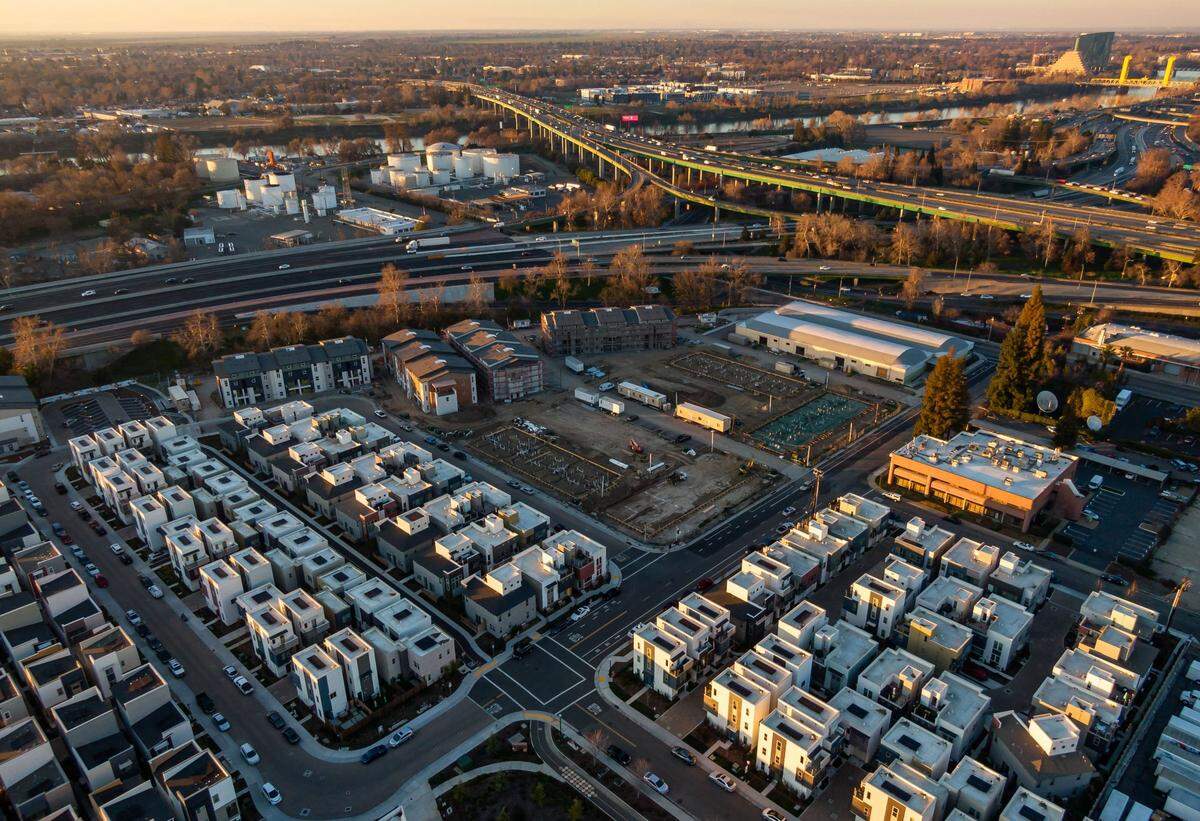
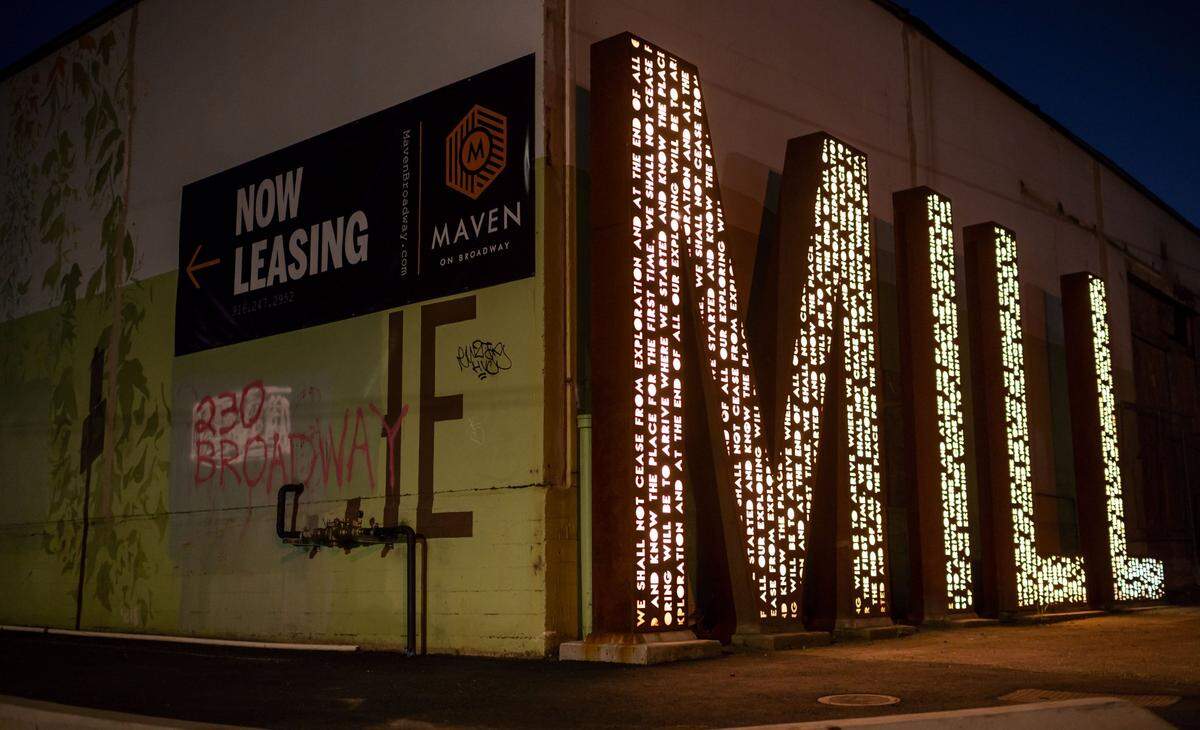
With its dense layout, proximity to the central city and relative affordability, the Mill at Broadway has transformed a former lumber mill site into a destination for first-time homebuyers, particularly millennials. By the time the development is finished late next year, more than 1,000 apartments and townhomes will be packed into roughly 30 acres south of Broadway.
For Riana King and Abram Diaz, an engaged couple and first-time homeowners, the three-story townhome they purchased in the Mill in June 2020 represented an opportunity.
“I’m really hopeful that more young families in Sacramento and more couples are able to put down an investment in the town and put down some roots and not worry about moving away because of rising rents,” said Diaz, 28. “I feel very lucky as a young couple of color that we’ve had this opportunity and I’m hopeful that more couples who look like us have this opportunity.”
One of the project’s developers, 29th Street Capital, recently submitted an application with the city of Sacramento to construct the final phase of the neighborhood — 252 market-rate rental units spread throughout eight three-story garden apartment buildings. Rob Hedrick, vice president of development at 29th Street Capital, said the apartments are being built “with a target demographic of young urban professionals.”
The final phase is expected to be finished in late 2023, roughly eight years after work on the neighborhood began. Those eight years have been a turbulent period in the Sacramento region’s housing market.
Rents have skyrocketed. Record-low inventory and a booming population have made it difficult for first-time homebuyers — especially younger ones — to compete. And a global pandemic shifted how and where many want to live.
Yet in 2021 — a year that saw Sacramento set records for home value increases — the Mill at Broadway was still relatively attainable for those looking to buy. Two-bedroom homes sold for well under $500,000 and some smaller units sold in the $300,000s. Sacramento County’s median home sale price ended 2021 at $500,000.

King and Diaz were renting in Rosemont when they bought their home. They never imagined they’d be able to afford a home close to downtown or the emerging Broadway corridor. They thought about renting in the central city.
Now they spend their evenings cooking meals in a modern kitchen with an island prep area and enjoying sunsets from their balcony. They didn’t own bikes before moving in; they do now and they’re a short ride to downtown restaurants and trails along the Sacramento River.
“For us, in our price range, this was really the only option that was close to downtown that wasn’t a complete renovation,” said King, 30. “It was the perfect situation.”
Millennial homeownership difficult
The millennial generation, born between 1981 and 1996, is the largest in the nation by population. However, while they account for more and more homeowners each year, millennials still lag their older counterparts in homeownership rates, due in part to student loan debt, economic hardship caused by the pandemic and their coming of age during a 10-year stretch of steep real estate price increases.
“For first-time homebuyers, especially, rising prices make housing more attractive but they also make it harder to get your foot in the door,” said Danielle Hale, the chief economist with Realtor.com.
Skyrocketing rents in many markets, most notably mid-sized metropolitan areas such as Sacramento, have made it even more difficult for first-time and younger homebuyers to save enough for down payments.
“Especially over the past year,” Hale said, “when home prices have gone up so much, it’s been really hard for them to find the money to set aside.”
Sacramento Mayor Darrell Steinberg, who launched his first campaign for mayor in 2015 at an event at the Mill, said he expects greater focus on housing for middle-income earners. He said he wants the city “to be very aggressive in putting together the policies and incentives that will create more Mills,” including funding sources.
“The smart money, I think, is going to be increasingly directed toward the middle-income housing projects because there’s such a huge need and such a huge demand,” Steinberg said. “This idea of buying a home is rather remote (for younger adults). It’s kind of a far off idea, except when you look at these developments like the Mill. So we need more of them.”
Bardis Homes, the firm that led development of the Mill, clearly targeted younger buyers from the start. Katherine Bardis, who along with her cousin Rachel Bardis spearheaded the project, said in 2018 that “millennials are the number one demographic (in the real estate market). They are the next generation of home buying.”
Spend some time in the neighborhood and the dominant age demographic of its residents becomes quickly obvious.
The neighborhood is anchored by a community park with a bocce court and public art. Every night, young couples walking dogs head out onto narrow streets. The neighborhood has several Facebook groups, including groups for animal lovers and residents with children.
“This development could be a blueprint,” Diaz said. “The dense, infill living is attractive to a lot of folks.”
Building housing for young families
So what brought the Mill at Broadway within reach for so many young buyers? And what features could be duplicated for other major infill developments in Sacramento?
The affordability was due in large part to how the homes were designed. Bardis Homes designed the homes to be “very upscale but cost effective,” said Kerrie Miller, a broker and sales manager at the Mill.
In townhomes such as the one owned by King and Diaz, buildings have two residential units that share a wall but have separate entrances. Each unit has an outdoor space, but they’re on opposite sides of the building, providing privacy for sunsets and barbecues.

King and Diaz’s home has living spaces on the second and third floors. Their neighbor’s smaller unit is confined to the second floor. They share a wall with their neighbor but barely know they’re there.
“As long as the design and the interior space is thought-out to provide those elements, that’s really the key,” Miller said. “People want some serenity. They want privacy and the comforts of home while living in an efficiently designed space.”
The public areas such as the park give residents space when they do want to interact with their neighbors.

Stephen Burke, 52, and his wife bought a home in the Mill two years ago. Burke knows he and his wife are a bit older than most of their neighbors, but that’s part of what drew them to the area.
“It’s been easy to make friends and meet neighbors,” he said. “Even with my wife and I being a bit older, we’ve had no issues meeting people who are even half our age.”
But if many were drawn to the Mill because of its affordability and location, some chose to live there for another reason — a moral reason.
Thomas Nguyen, 28, and his wife bought a home there in February 2020. Nguyen is an urban planner who works downtown and values dense infill projects, largely because they don’t displace long-time residents. Modern developments sometimes require demolishing older homes and can spark gentrification. The Mill, however, was constructed on a mostly vacant swath of land.
“The density, the affordability and the location drew us,” he said. “But it was also about us not displacing anyone as a result of the building here.”
This story was originally published February 4, 2022 at 5:00 AM.