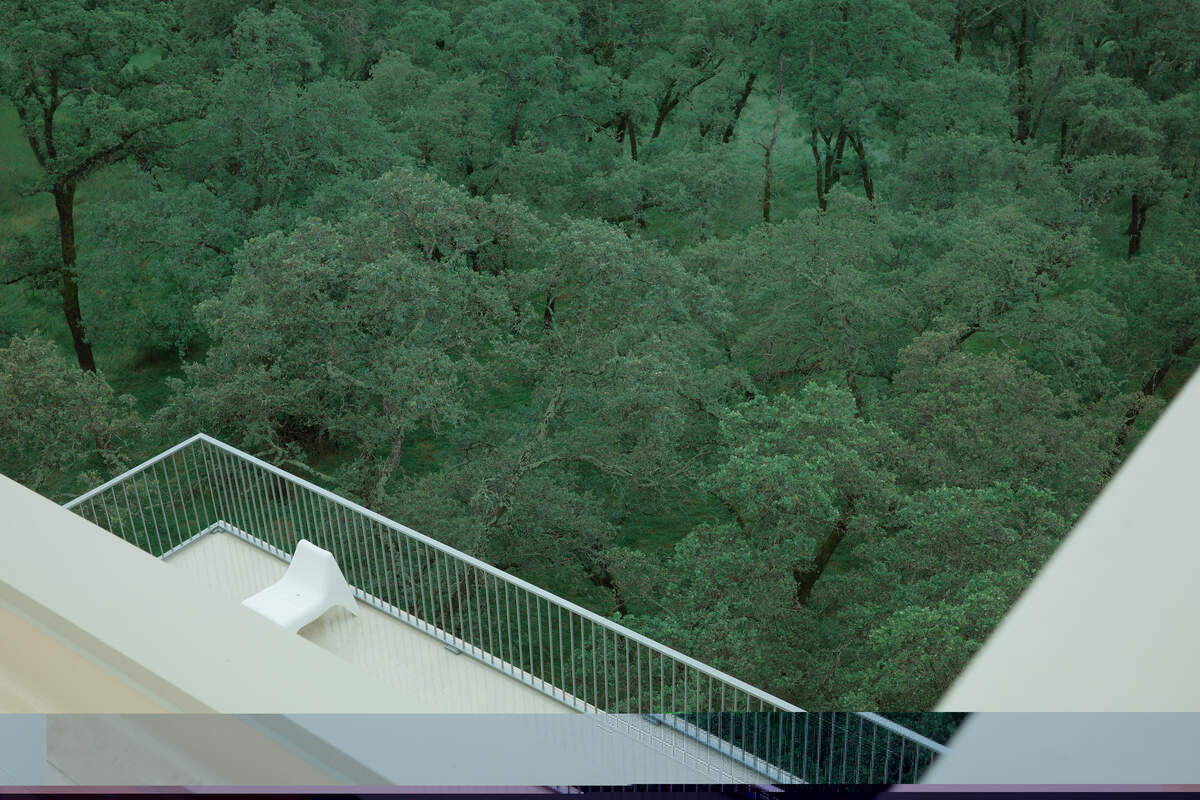
New, modern El Dorado Hills home designed around oaks, a ravine, arc of the sun
AI-generated summary reviewed by our newsroom.
- The 4,407-square-foot Scandinavian-style house in El Dorado Hills listed for $3.28M.
- The home sits on a steep, one-acre lot with a bridge driveway and 50-foot metal supports.
- Design priorities preserved mature oaks, staged views, and more than 2,200 sq ft outdoors.
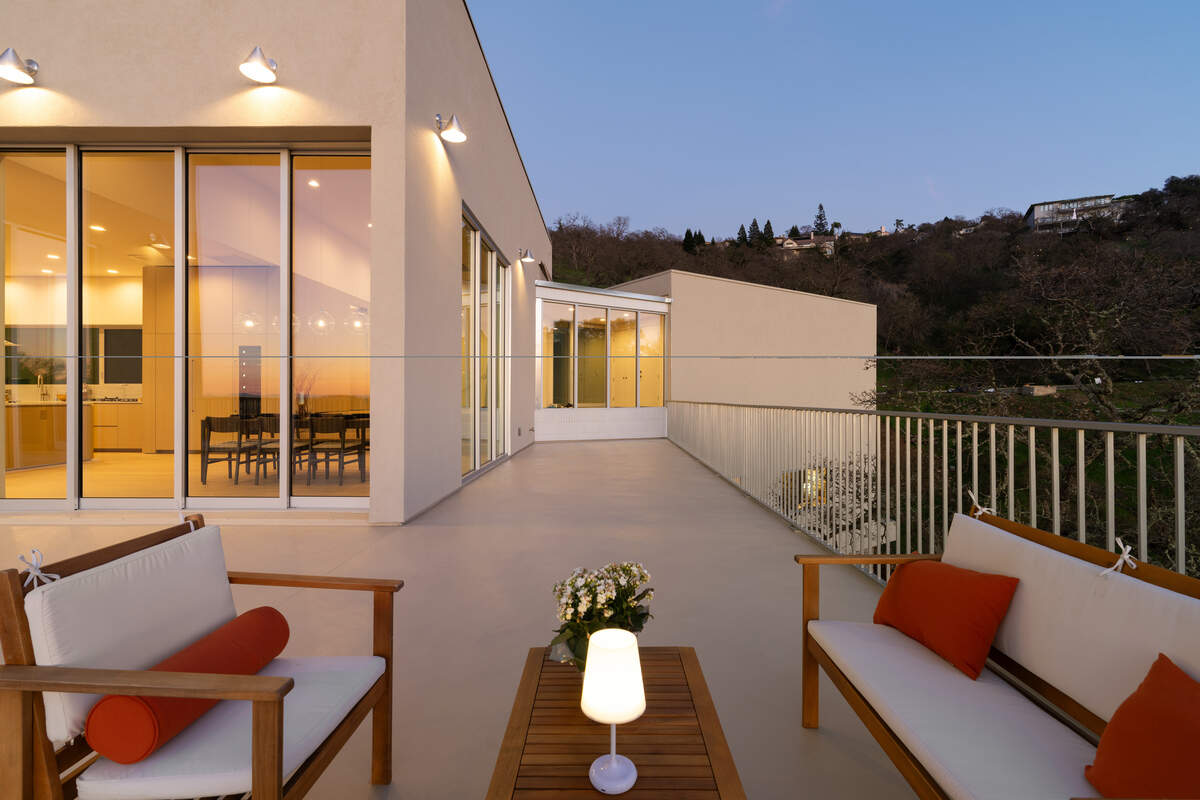
A newly built hilltop home in the Sacramento area is impressive before you ever reach the glass front door, before you begin to ponder its engineering, or take one step onto its 2,200 square feet of decks and terraces that look over a forest of mature oak trees and Folsom Lake in the distance.
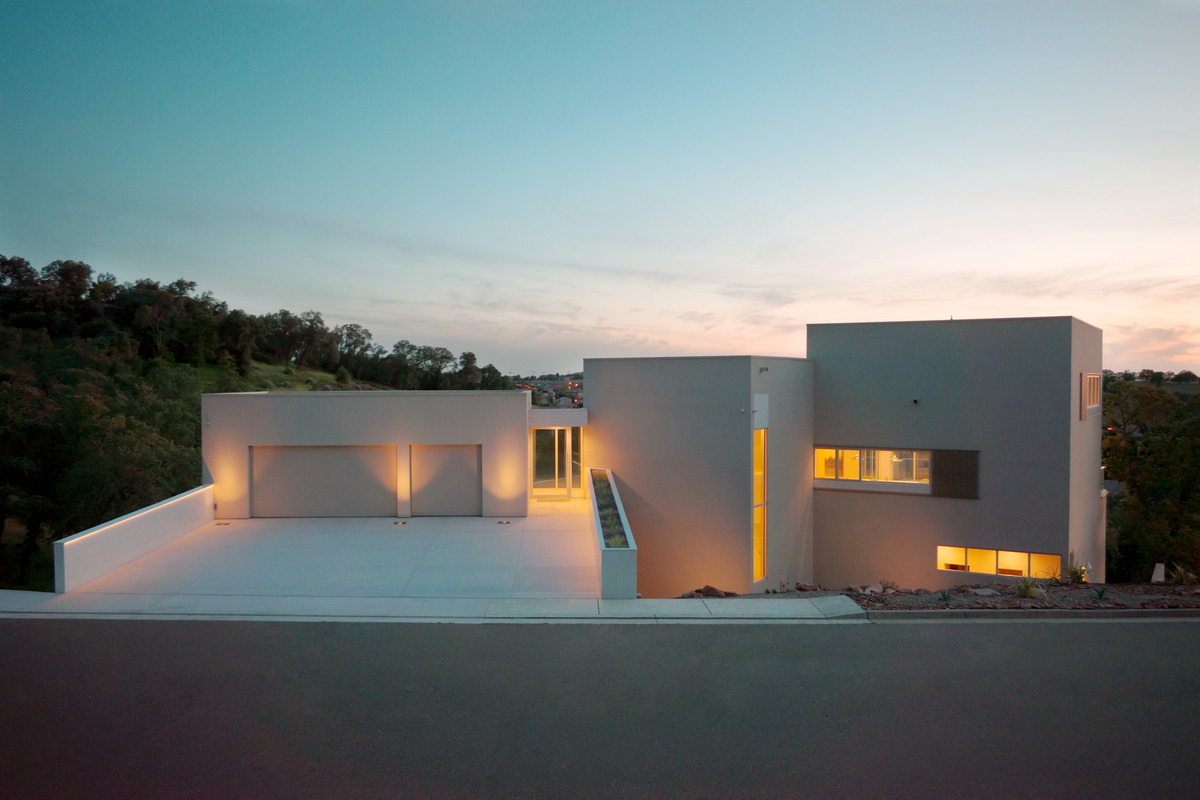
From the front, the residence offers a clean, contemporary façade, crisp horizontal lines and a single dominant color with subtle tile accents — modern without feeling busy. That’s a theme that carries throughout the sleek home’s 4,400-square-foot floor plan.
Right away, the engineering takes center stage, underscoring both form and function. You don’t simply pull into the driveway and step inside the El Dorado Hills house. You first cross a bridge over a ravine. The metal bridge is the driveway, flat and sturdy.
The house — listed for $3.28 million — is designed not to just conquer the hillside where it stands but to live into the natural environment, according to architect Kate Bilyk.
“We fell in love with this site from the moment that we saw it,” Bilyk said via email. “It is a small forest in the middle of the city, full of mature oaks, the landscape transforms during the year, going from deep greens in the winter to golden yellows in the summer. There is a creek on the site, the birds are always singing — the site feels very alive. It was important for us to honor that and preserve it, so we designed the house in a way that is connected to what is around and defined by its place.”
Glass walls, hidden doors
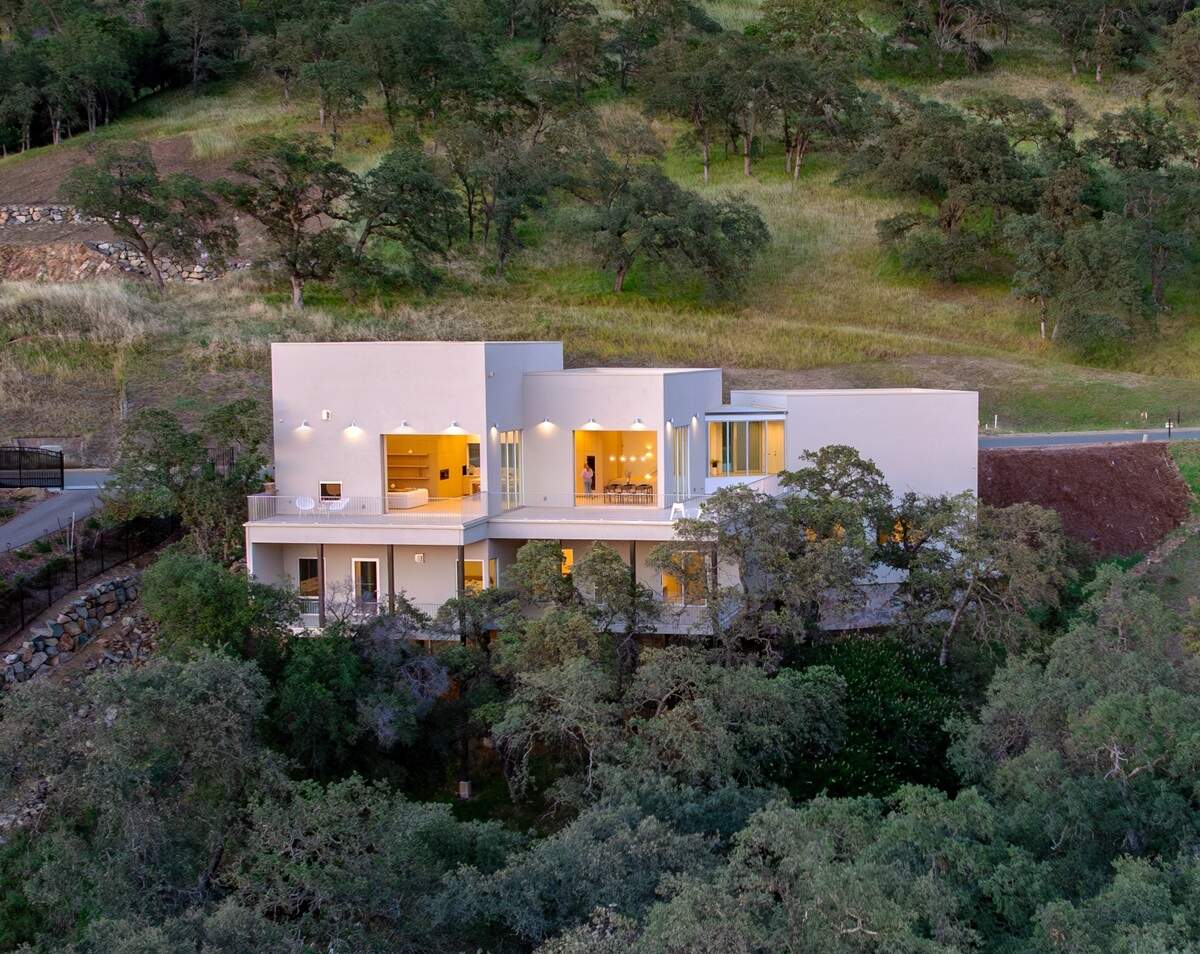
Listing agent Oleg Minzu of Keller Williams agrees.
“The essence of this project is the terrain,” Minzu said. “It’s a one-acre lot with lots of oak trees, positioned so that the morning sun comes through the kitchen and the sunset drops over the western hills. The house literally transforms throughout the day because of the light.”
The Scandinavian-style home — four bedrooms, five bathrooms — was completed in 2025 with an insistence on openness and precision. Glass walls slide fully into their pockets. Hidden interior doors are flush with the walls, reinforcing the home’s sleek, modern aesthetic.
It all started with a steep lot at 1022 Via Treviso. Given the terrain, the bridge-driveway was designed to reduce the grading level, Bilyk said. Minzu even has a nickname for it: “We call it the Bridge House.”
“We laid the house out in a way that minimized the number of trees to be cut and built a bridge as a driveway in order to eliminate the need to either fill the site with earth or to create complicated driveways down (into the garage),” Bilyk said.
Minzu said a traditional driveway dropping straight down the slope would have been “super inconvenient.”
The house rises three stories through the oaks with valley views staged from nearly every level and balconies and decks stacked like outlooks on a trail.
“I grew up in Folsom and have been part of how the area has been developing. It is often that a site is flattened and made bare prior to construction, leading to a house that could have been built anywhere,” Bilyk said. “I wanted to push against it and design a house that embraces the topography of the site, is formed around the sun path, and is organized in response to the trees.”
Working with the slope
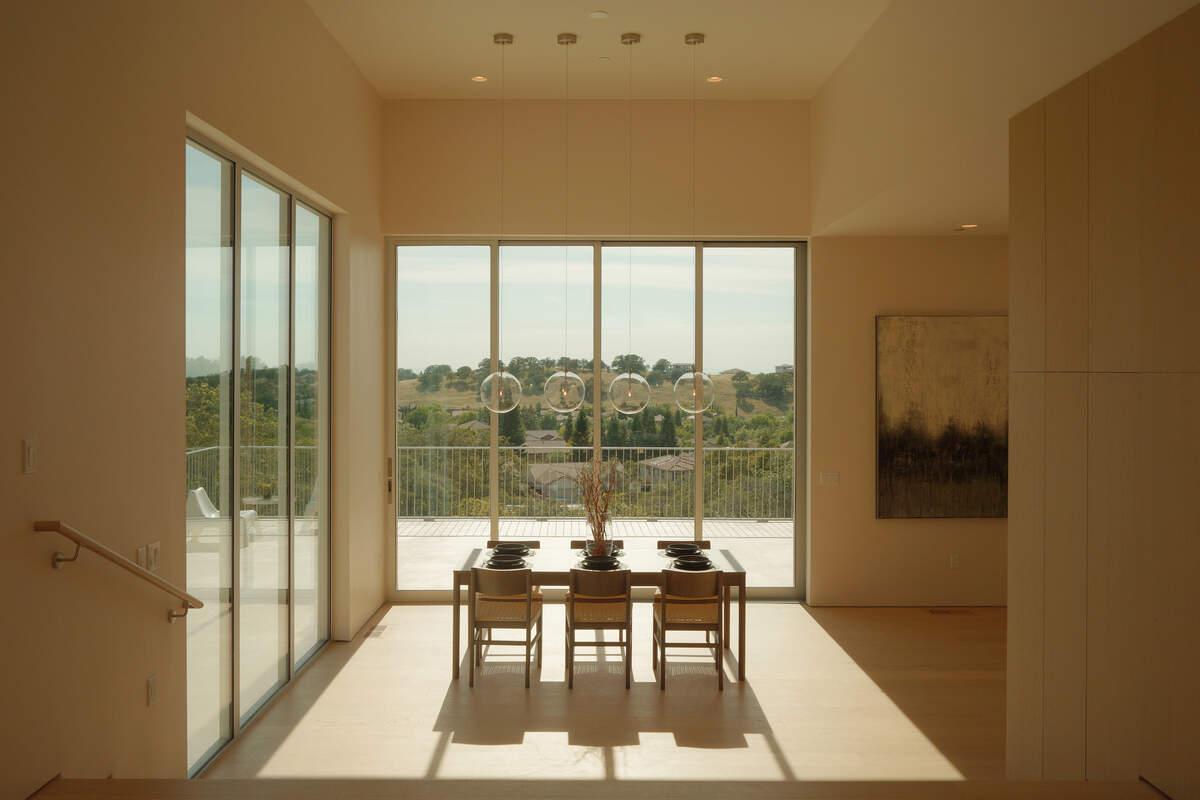
Bilyk said the outdoor areas were designed as usable rooms, not leftover edges.
“It is important to me that a building is giving its inhabitant as much as it can,” she said. “We utilized all parts of the house. Every roof is doing something — most of the roofs are terraces, while two are set aside for solar panels. The space under the house can be turned into a covered patio with a view onto the trees and the creek.”
Minzu said the home was designed to keep nature “incredibly close,” with its three levels offering distinct experiences of the landscape.
“On the rooftop, the sky opens up and you get a view toward Folsom Lake,” he said. “On the main level you float right above the trees — you can almost touch their tops. And downstairs, where the bedrooms are, you’re within the trees, like in a forest.”
Bilyk echoed that layered effect, adding that the design makes it feel “as if you are floating in a tree house,” with a progression from forest floor to canopy to open sky.
Underneath is where the engineering reveals itself. To keep the footprint lighter on the hillside — and to avoid what Minzu described as a “massive concrete foundation” — the house is elevated in places on 50-foot metal supports.
Bilyk said the house was set on the steel pillars to “touch down” lightly on the hillside.
“The house is set on steel posts to allow for a more delicate setting onto the site, which required perfectly engineered structure,” she said. “The steel posts were custom produced and brought from the East Coast, while the wooden structure is made of pre-manufactured trusses — all made precisely for the house. The construction relied on the magic of all pieces fitting together on a tough terrain, which was achieved through a great effort.”
Minimalist aesthetic
The effect, from certain angles, is of a building hovering, its decks and living areas suspended among branches. It’s also where the project’s minimalist aesthetic meets the hidden work required to make it happen.
“To achieve something that looks simple, there is a lot of complexity behind it,” Minzu said. “It’s super hard to make complex things look simple, and this house is one of those examples.”
Inside, the home’s progression starts at the front door with what architects often call “compression and release” — an entry that holds back before it opens wide.
“When you enter, the space is smaller and the ceiling is lower, but you already see the hills,” Minzu said. “As you move toward the kitchen and living room, the space expands, the ceiling rises, and you step down three steps while it keeps going up. By the time you reach the living room, the ceilings soar and you see a big slice of blue sky and the hills above the tree canopy.”
The main level is designed as one continuous living space: kitchen, dining and living areas flowing without the chopped-up boundaries of a more traditional floor plan. The geometry does much of the work — open sight lines, long views, doors that erase the line between interior and terrace.
“There is always natural light present in all the rooms, so a lot of the time there is no need to turn on the lights,” Bilyk said.
A large skylight spills daylight onto a beautiful floating staircase. The home’s tallest interior section is a dramatic 30 feet.
“The wall studs couldn’t be pieced together — they had to be one continuous piece from bottom to top,” he said. “They used custom trusses that fit together like a puzzle to create this volume.”
That level of precision also shows up in the finishes — or, more accurately, in what’s missing. In a house where trim is stripped away, like 1022 Via Treviso, there’s nowhere to hide a wavy wall or a slightly off corner.
“There are no baseboards, no crown moldings, no door trims,” Minzu said. “The framing and foundation had to be exact, because usually those details hide imperfections.”
Instead, the interior leans on restraint: European white oak, beige walls, and aluminum-gray countertops. There’s an absence of visual noise.
“Here you mainly see … three colors that make it very easy on your eyes and very peaceful to live in,” Minzu said. “Because there aren’t a lot of competing colors, you feel calm. It doesn’t drain your visual energy, so you can really rest and feel at ease at home.”
The yard is intentionally unfinished in the best sense: not an empty lot waiting for landscaping, but a slope left natural. There’s room to personalize. That might include adding a pool. Keller Williams has drawn up a rendering and cost estimate for a pool to sit in the natural landscape.
While Bilyk designed the home, her parents — the builders and owners — brought it to life.
“The home creates a world in which you feel protected, enveloped, and sun-lit. It provides a retreat from the daily hustle,” she said.