
Public-funded Oroville Dam advertising called ‘propaganda.’ Here’s how much it cost
The state agency that manages Oroville Dam is on the PR offensive nearly three years after its spillways collapsed, triggering the evacuation of nearly 200,000 Sacramento Valley residents.
The latest public relations effort cost California water ratepayers $29,000 to produce an eight-page color advertising insert that ran in recent days in six Sacramento Valley newspapers including The Sacramento Bee. The advertorial praises the dam and profiles the Department of Water Resources employees who manage it.
Critics argue it’s inappropriate for a state agency to be spending public money on an advertisement that they say serves little purpose other than to try to make the government look good.
“It’s propaganda,” said Butte County Supervisor Bill Connelly, a longtime critic of the DWR. “I didn’t know the government had money to do that, to prop themselves up. It would be illegal for me to use county money to prop myself up.”
“Oroville Dam: Part of Our Community,” the color newspaper insert, includes the Department of Water Resources’ logo on the front and details the dam’s record on flood protection, the spillway repair efforts, Lake Oroville’s role as a water-storage facility for millions of Californians, and features interviews with state officials.
Headlines declare: “Safety for the region,” “Stewards of California’s Water” and “Lake Oroville: Destination Beautiful.”
Taxpayer groups object
The advertorial “is part of DWR’s ongoing effort to educate and inform the public about the role Oroville Dam and the State Water Project play in managing and protecting our state’s water systems,” DWR spokeswoman Erin Mellon said in an email. “The insert provides information about the history of Oroville Dam, the benefits it provides for the Oroville community and surrounding region, how the facility is operated and maintained, and what went into the reconstruction efforts on the main and emergency spillways.”
Mellon said the $29,000 campaign was paid with funds from the State Water Project, which is financed by a consortium of public water agencies that bill ratepayers for maintaining Oroville Dam and other state-run water facilities that supply irrigation and drinking water. The largest water project contractor is the Metropolitan Water District of Southern California, a public water wholesaler based in Los Angeles that serves 19 million people.
The messaging campaign didn’t go over well with taxpayer advocates.
Jon Coupal, president of the Howard Jarvis Taxpayers Association, said there are times when it’s appropriate for the government to spend public funds on messaging campaigns such as when agencies have to explain to ratepayers the justification for why they need to increase their bills.
But this isn’t one of those times, he said, adding the expense was especially galling given DWR’s failures at Oroville Dam.
“If it’s nothing more than a puff piece, this is kind of thing that taxpayers would react negatively to,” Coupal said. “When they look at what happened with the Oroville Dam and the failure to maintain even basic safety protocols, the expenditure of any dollars, no matter how minor, in relative terms, they would look at that rather suspiciously and not favorably.”
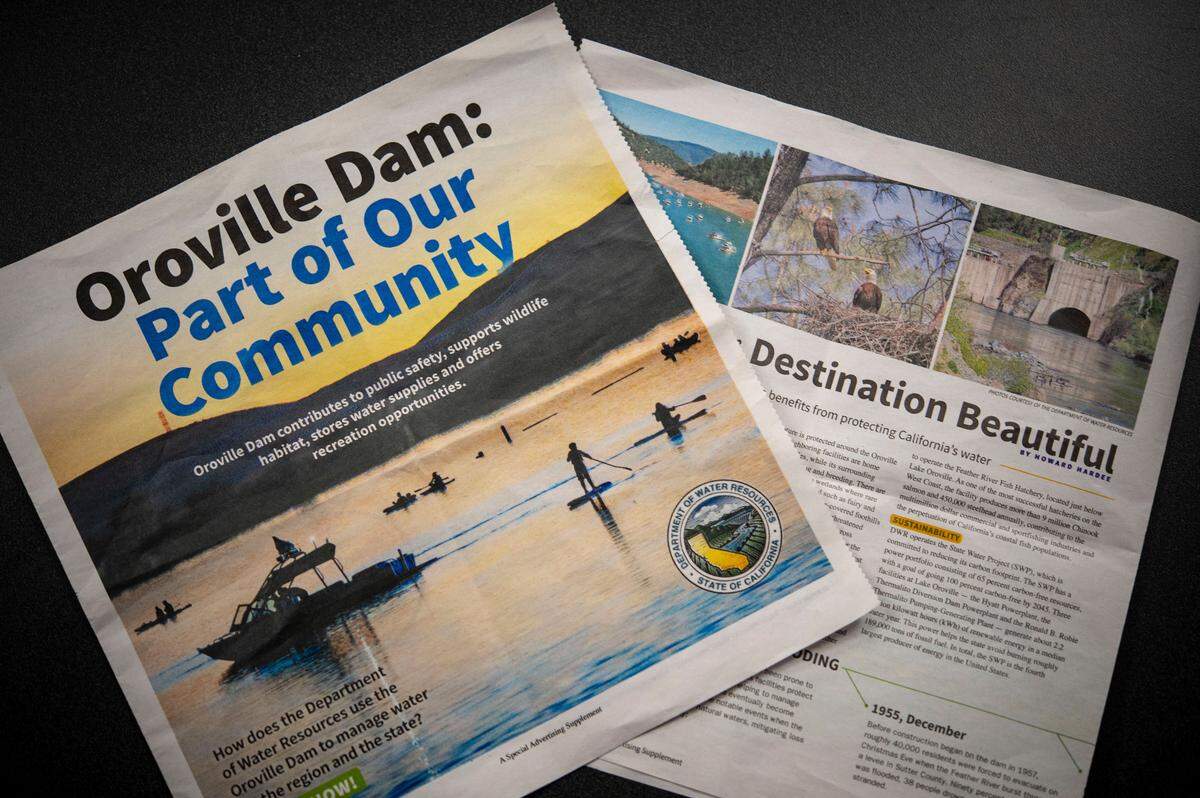
Along with The Bee, the advertisements appeared in The Chico News & Review, The Chico Enterprise-Record, The Gridley Herald, The Marysville Appeal-Democrat, and The Sacramento News & Review, Mellon said. The inserts were printed by News & Review Publications, a subsidiary of the newspaper chain, Mellon said. The writing was handled by freelancers, and state employees only worked on it for a couple of hours, she said.
2017 Oroville spillway crisis
“One of our many goals at DWR and (the State Water Project) is continued communication and public education,” Mellon said in an email. “As examples, SWP funds are used for public education at three visitors centers that educate Californians about the state’s water supply and the SWP, which is one of the state’s most important infrastructure projects.”
She said other examples of SWP funds being used for public outreach include educational tours of the Sacramento-San Joaquin Delta and DWR’s water safety campaign.
“We’re committed to sharing information and always looking for new ways to get that information into the hands of Californians, especially those who interact with or benefit from the SWP,” she said.
Oroville Dam’s 3,000-foot-long main spillway fractured in two during a heavy rainstorm in February 2017. Hoping to minimize the damage, dam engineers limited water releases on the spillway. Water levels in Lake Oroville rose to unprecedented heights, and water flowed over the adjacent emergency spillway, a concrete lip sitting atop an unlined hillside, the first time it had ever been used.
A day later, engineers spotted dangerous erosion on the hillside and feared that spillway would crumble and release a “wall of water” into the Feather River below. That triggered the evacuation of 188,000 people below the dam. The state eventually was able to get the water levels under control, and residents were able to return home after two days. No one was injured.
Fixing the two spillways has cost at least $1.1 billion.
Frustration over dam
The crisis caused decades-long frustration with DWR to bubble to the surface in Butte County, where residents like Connelly, the county supervisor, argue that California broke promises it made to residents in the 1950s and 1960s when the dam was being planned and built.
Before the nation’s tallest dam was completed, flooding California’s second-largest reservoir, state officials sold local residents on Oroville Dam by saying they would build the community a steam train and a monorail, a major resort featuring a 250-seat restaurant and a 1,000-seat amphitheater. As many as 5 million visitors a year would show up, creating a major economic driver for the community.
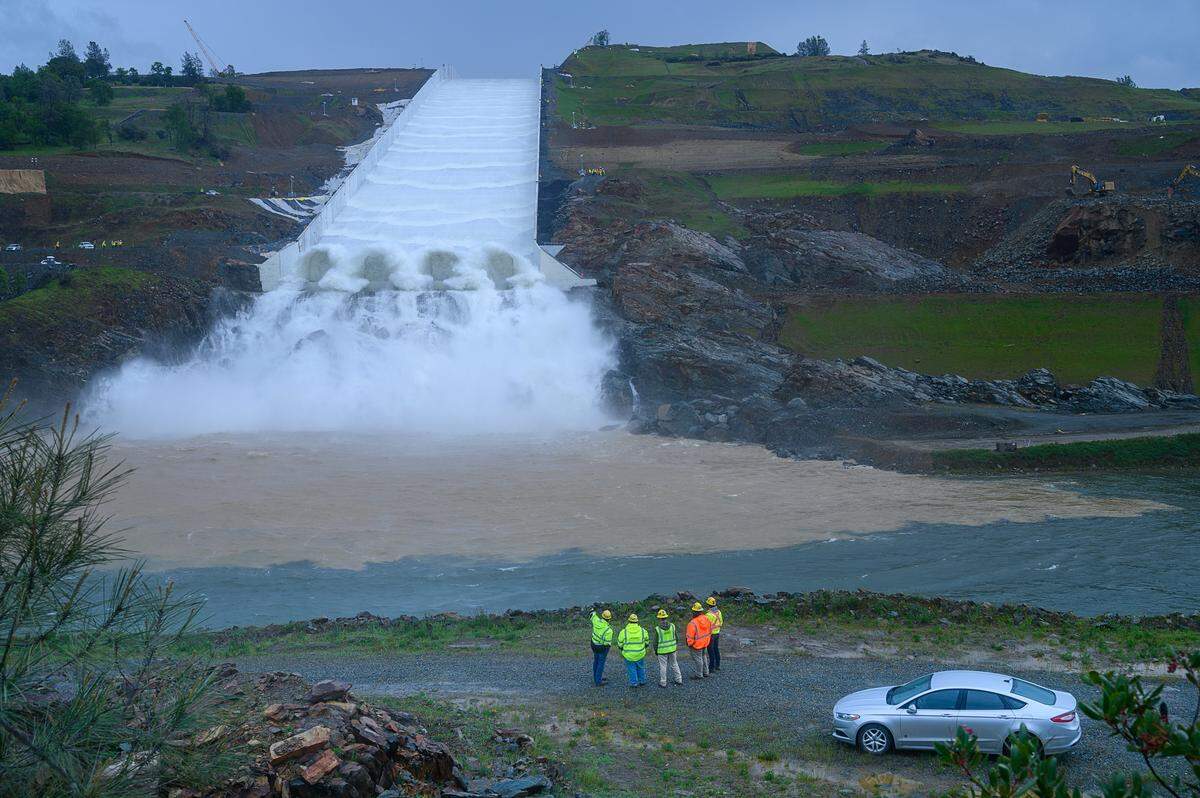
Once the dam was finished, none of those amenities were built, and the Oroville region has long struggled economically while its water has flown to more affluent regions like Los Angeles. Residents used the Oroville crisis to demand the state do more to keep its promises.
In the months after the crisis, DWR said it was going to spend $3 million for facilities improvements from its “supplemental benefits fund” to go to recreational amenities around the lake.
Critics said it was too little, too late and a public-relations move following the spillway fiasco.
Juan-Carlos Molleda, a public relations professor at the University of Oregon’s School of Journalism and Communication, said the newspaper insert might not have been necessary given the other, less costly channels the DWR could have used, such as news releases and social media accounts.
“Can we achieve the same public information goal ... by providing information without spending that amount of money?” he said. “The question is: could you have avoided this expense and have achieved the same thing?”