
California man had a destructive bear killed. Then his Tahoe neighbors went on the attack
Again and again, the bear climbed into the Tahoe Vista resident’s pickup and his neighbors’ cars. It broke through a dead-bolted door to get into a neighbor’s home. It acted aggressively when they tried to chase it away, he said.
In November, he’d had enough. He got a permit to have the bear killed.
Placer County’s trapper parked a cage trap on the man’s lot. In less than 24 hours, the trapper hauled the bear away for good. But that was plenty of time for Tahoe’s vocal and well-organized community of bear activists to spot the trap and share the homeowner’s personal information. Dozens of harassing emails, calls and texts came in.
“Don’t be surprised if a sudden fire takes hold of your place. Idiot,” read one.
For those who live and vacation in the Lake Tahoe region, living with wildlife out their backdoor is as much of a draw as the lake’s glassy blue waters and snow-capped mountains. And when it comes to bears, some, such as the members of Tahoe’s influential Bear League, passionately argue that close encounters with the black bears are just the price of living here.
To them, no bears should die because humans haven’t learned to coexist with their bruin neighbors. The most zealous bear defenders have over the years resorted to harassment and vandalism to keep their beloved bears out of government traps.
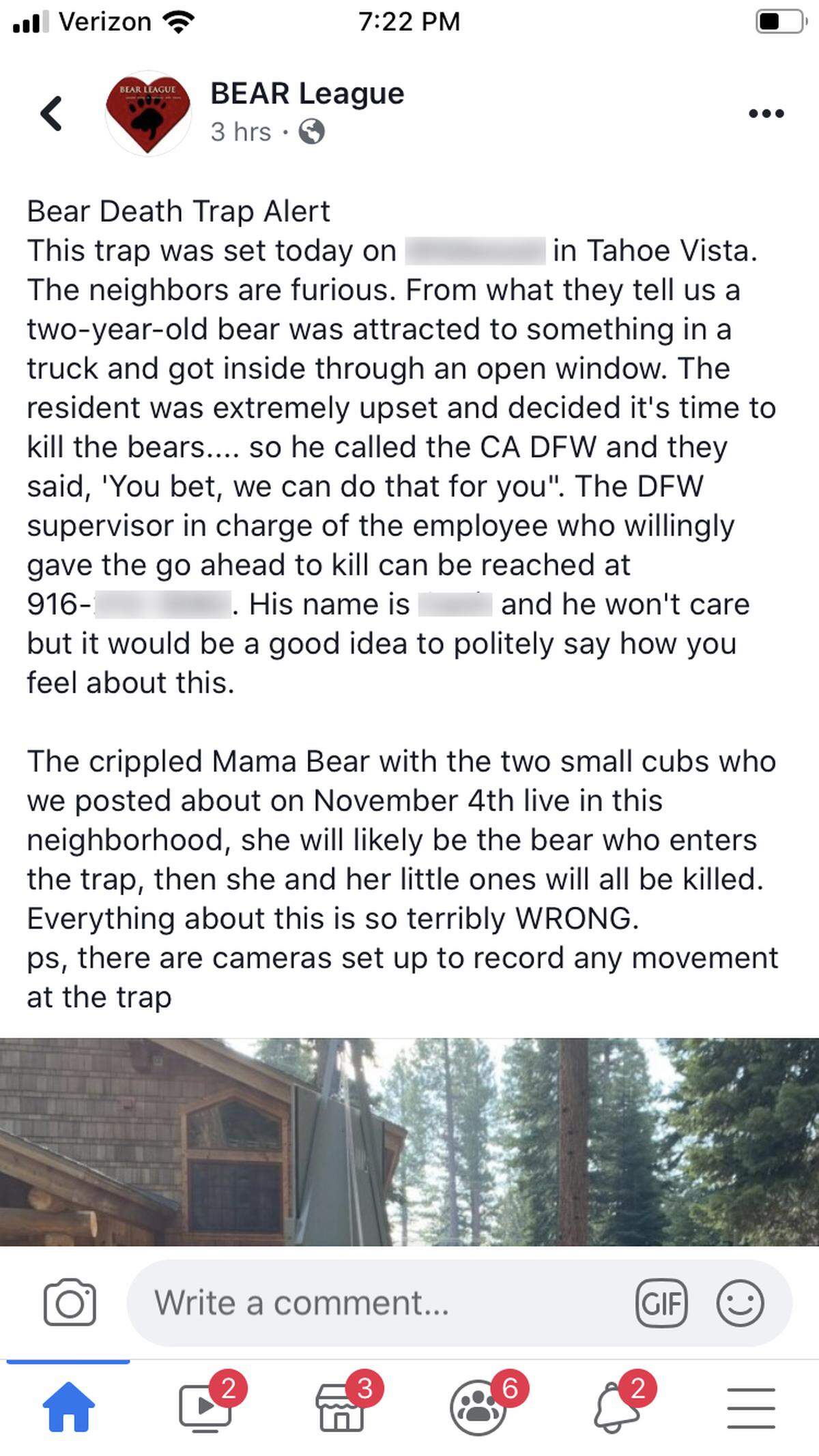
“Bear Death Trap Alert” read the Bear League’s Facebook post the afternoon the trap was set in Tahoe Vista, which included a picture of the cage-like device on the man’s property and a warning a camera had been pointed at it.
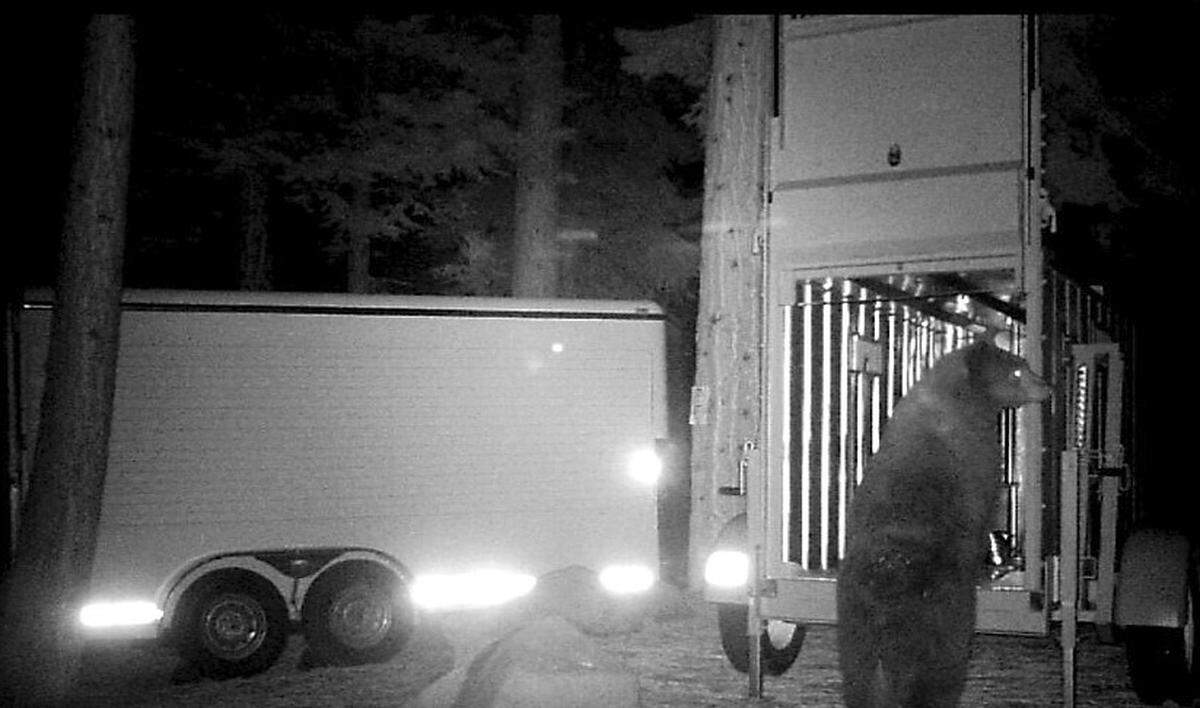
Government trappers have taken to hanging security cameras around their traps, designed to catch the bears alive to be killed later if necessary. Over the years, activists have moved, vandalized or slathered the traps with chemicals the bears don’t like.
“The crippled Mama Bear with the two small cubs who we posted about on November 4th live in this neighborhood,” the Bear League’s post read. “She will likely be the bear who enters the trap, then she and her little ones will all be killed. Everything about this is so terribly WRONG.”
One of the group’s 27,189 Facebook followers quickly posted the homeowner’s name, his address, his phone numbers and his business in the comments.
“Burn his phone lines up,” the comment read.
This is what’s known in popular culture as a “doxxing” — sharing someone’s personal information to pressure or harass them. And it worked.
The man said his phone buzzed with hostile calls and texts. Someone filed a bogus trash complaint at his address with local code enforcement officials. People drove by and cursed at his house from the road, he said. Two people were caught on the camera trespassing on the man’s lot as they snooped around the trap. The hateful emails rolled in for days.
“Thousands of people know where you live and your business name with your picture. I hope you get the karma you deserve you worthless piece of sh--!” read one.
“Hopefully you and your family get trapped in a burning house and died just like you want these bears to die,” read another.
The harassment got so bad the Placer County Sheriff’s Department opened a still-pending criminal investigation. The Sacramento Bee is not identifying the man out of concerns he’d be harassed even more.
Tahoe’s bears — originally drawn to populated areas by garbage and unattended ice chests — have grown bolder in their quest for human food. Entire blocks of homes and vehicles are getting ransacked each year. The bears are breaking windows, ripping doors off hinges and tearing through siding in the hopes of finding human food inside.
One local official estimated that bears recently damaged more than 75 homes in a single west shore Tahoe neighborhood. At least one of the homes suffered close to $100,000 in damage. Meanwhile, numerous homeowners have reported coming face to face with bears inside their homes. Newly released state records show some have even been mauled, though none fatally.
On California’s side of the lake, those who feel unsafe or who’ve repeatedly suffered property damage have few options to deal with habitually destructive bears that keep coming back despite a homeowners’ best efforts. They can either install expensive electrical fencing systems around homes and cars to keep the bears out, or they can seek a permit from the state to have a problem bear killed.
In effect, California residents have to make the fatal decision — and then live with the consequences of having their bear-loving neighbors turn on them.
Bears adapting to humans
The last of California’s grizzlies were killed off early last century, leaving only Ursus americanus, the black bear. Now, black bears have a devoted fan base in the Tahoe Basin, where they’re given names like Little Joe, T-Shirt, Brutus, Sunny, Butterscotch and Rascal. Here, bear lovers will hold memorial services when their favorite animals are killed in a government trap.
Black bears are omnivorous, opportunistic feeders whose lives are dominated by annual cycles of gorging and fasting as they pack on calories before and after their winter hibernation. They’re just as capable of eating wild elderberries and spotted fawns as they are ham sandwiches and strawberries left in ice chests.
Black bears, which can range in color from inky black to dirty blonde, are not endangered in California and Nevada, and their numbers are growing in both states. Biologists say Tahoe’s bears, estimated at between 300 and 500 animals, are some of the most densely populated in North America, drawn to the massive amounts of human food and garbage brought to the region by the more than 3 million tourists who visit each year.
In the eyes of Ann Bryant, executive director of the Bear League, the problem isn’t the bears. It’s the people who “don’t want to act responsibly” — leaving out trash, their doors unlocked, snacks in cars, crawl spaces improperly sealed and food in refrigerators and pantries when they’re not staying at their vacation homes.
“They don’t know what our rules are, they don’t know we’ve got a piece a paper called a deed to our property,” she said about the region’s black bear population. “This to them is their wilderness home.”
Others say that Tahoe’s bears, which often are seen sauntering down streets and snoozing in backyards, aren’t behaving like they would in a true wilderness setting. And they’re troubled by the trend noted by biologists of mother bears appearing to teach their cubs how to break into homes and cars, ensuring the break-ins will continue year after year.
The Bear League’s assertion that people shouldn’t keep food inside homes also is especially grating to some.
“I think it’s reasonable for humans to have food inside our houses,” said Placer County’s agricultural commissioner, Joshua Huntsinger, whose traps are sometimes used to capture problem bears like the one in Tahoe Vista.
Meanwhile, dangerous bear encounters in and outside homes are happening regularly, sometimes becoming national news.
That was the case this summer when a couple of teens came face to face a hungry, 250-pound bear that had wandered into their Truckee vacation home. They called a Placer County sheriff’s deputy who arrived and shot it with a non-lethal round from her shotgun to scare it away. The previous year, a bear was captured on camera wandering into a California Highway Patrol office near Truckee.
No one was hurt in those cases, but since 2014, at least nine people have been charged at, swiped or mauled by bears in and around homes and businesses on California’s side of Lake Tahoe, according to state records The Sacramento Bee obtained through the California Public Records Act.
The reports only offer short summaries of the incidents. In most cases, the person the bear charged wasn’t badly mauled. But a few weren’t so lucky.
“Victim received 23 stitches on two facial lacerations, and was also torn on the neck and shoulder,” reads a 2018 incident report after a 550-pound bear entered a South Lake Tahoe home.
“(Reporting party) was refilling bird feeders in evening and heard a noise, turned around and bear came at her,” reads a 2017 report from the Truckee area. “(The bear) knocked her down, swatted/scratched in back and on arm, bit several times in the neck. Treated at hospital, ok.”
“(Reporting party) heard a noise in his home after going to bed. He came downstairs and was confronted by a bear that had broken in,” reads a report from 2017 in Tahoe City. “Bear stood on hind legs and swiped the victim across the head. Victim retreated but re-entered to try and make the bear leave. Bear swiped his stomach and knocked him down before leaving the cabin. 32 staples.”
California’s wildlife agency captured and killed two of the bears, but officials weren’t able to find the bear that nearly disemboweled the man in Tahoe City, despite having traps out for several days.
In those cases, wildlife officials made the call to kill the animal, citing the public safety threat.
Bear League disputes claims
The harassment of the Tahoe Vista man triggered a rare public rebuke from Charlton Bonham, the head of California’s wildlife agency. In a column in the Sierra Sun newspaper, he blamed the Bear League for targeting Bonham’s employees with “violent posts on their social media accounts.”
Several people who had received permits to place a bear trap on their property handed them back in because they were worried they’d be similarly harassed, Bonham said.
He said the “fear-mongering tactics” had people “more afraid of backlash from the Bear League than they were troubled by damage to property, or themselves from a bear.”
Bryant says her group wasn’t responsible for any of the harassment of the Tahoe Vista man — an insistence Bryant has made for years whenever someone’s been targeted in Tahoe for having a bear trap on their property. The Bear League’s been accused in lawsuits at least twice for being part of harassment campaigns, but Bryant denies being part of them.
“We get blamed for it,” Bryant said during an interview last month inside her house in Homewood, which doubles as the Bear League’s headquarters. “The (wildlife) department constantly says, ‘You terrorize people. You make threats.’ We don’t do that. Why would we do that? Why would we risk our reputation?”
Bryant’s long been the Bear League’s public face, and it’s given her some measure of fame. She was the star of a 2011 Animal Planet network TV miniseries “Blonde vs. Bear,” which profiled her exploits as Tahoe’s unofficial bear-control officer.
Around the region, bear lovers often encourage those with problems to call Bryant’s organization rather than California’s or Nevada’s wildlife officers.
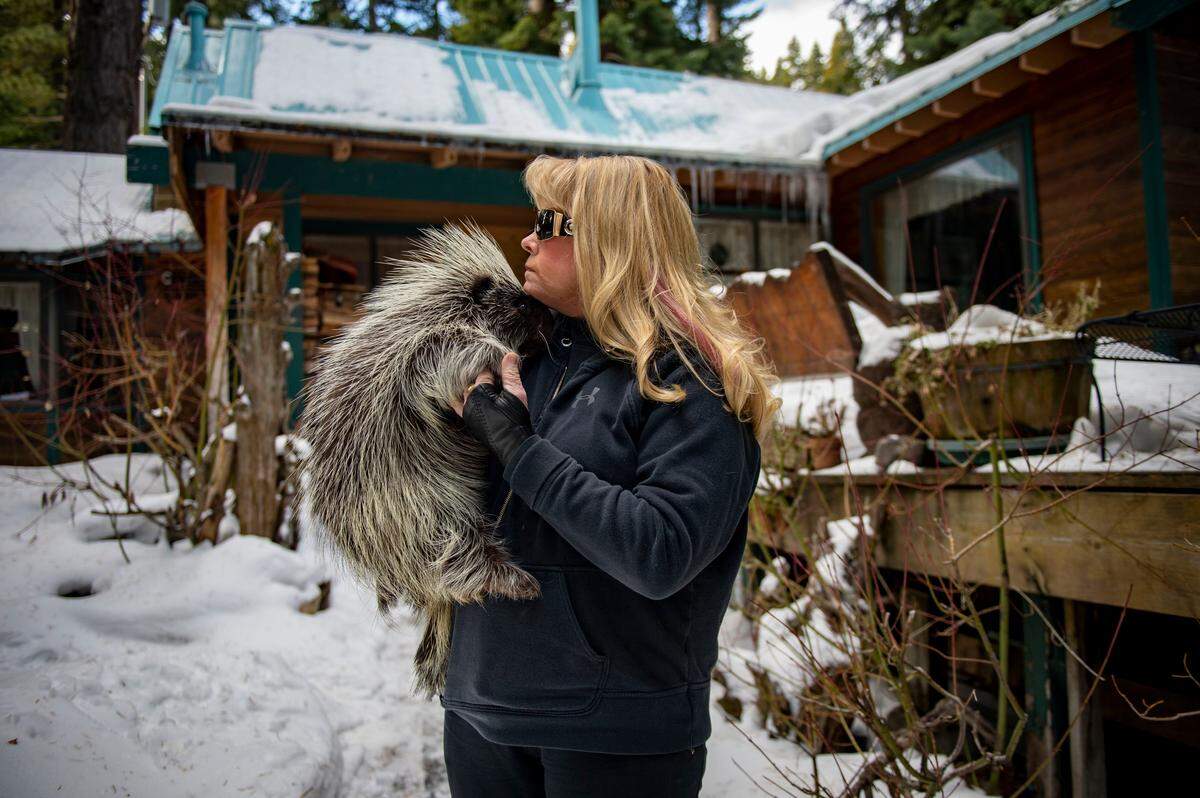
Known for her trademark dark glasses and fingerless gloves, both worn indoors and out, and her pet porcupine Maude, Bryant and her team of volunteers respond to calls to the Bear League’s hotline, sometimes armed with paintball guns. In at least one episode of “Blonde vs Bear,” Bryant fires a shotgun loaded with non-lethal rubber rounds at a bear that had been chased up a tree.

Bryant said she deleted the initial Facebook post about the Tahoe Vista incident when she saw that one of the group’s followers threatened to burn the man’s house down.
“I’ve never met that guy,” Bryant said. “I would’ve never given his name to anybody. I’ve never given his address to anybody. I’ve never talked to him, but we’re being blamed for being terrorists. .... I don’t want people to go after this man. That’s not going to do any good. He’s an idiot. I want people to question our Department of Wildlife. I want them to say, ‘This is not working.’”
Bryant said Bonham’s agency authorized killing the wrong animal, citing eye-witness accounts of neighbors she didn’t name.
“They made two huge mistakes — they gave a depredation permit without (a reason), and they trapped and killed the wrong bear,” Bryant said of Bonham’s employees. “And now they’re covering their tracks just like a bunch of cats in a litter box covering up the mess they just made. They’re lying, and they’re blaming us, and Chuck (Bonham) has fallen for it.”
The homeowner refutes that claim, saying the trapper had him confirm it was the same bear that had been causing his damage before the trapper hauled it away and killed it.
The county officials who put the trap out also say Bryant’s claims don’t add up.
“I don’t honestly believe the Bear League actually knows what bear was taken out,” said Huntsinger, Placer County’s agricultural commissioner. “The description of the bear given out (by the Bear League) doesn’t match the description of the bear that was actually taken. So I find that kind of interesting.”
The homeowner said the Bear League also falsely claimed he had repeatedly left food in his unlocked truck in an effort to lure the bear to its death.
He admits that he did forget to remove his lunch from his truck one day when he went inside his home for just a few minutes to change his clothes. A neighbor called him to tell him the bear was inside. He said he didn’t fault the bear for that, and he took steps to ensure the truck was food free. He said he also wiped the vehicle down with ammonia-soaked rags, which he left inside the cab.
Nonetheless, the bear got into his pickup at least twice more during the daylight hours when he was working around the property. It also got into his neighbors’ cars too, and he said it tore open a dead-bolted door to get into one of his neighbor’s homes, tipping over the refrigerator and pulling out all the items in the kitchen cabinets.
At one point, he said he shot the bear a half dozen times with a paintball gun to shoo it away for good, but he said the bear just ran a few yards and stopped.
“My concern was for the safety of the people living in the neighborhood,” he said in the email. “In this case, I put the people first.”
Why lethal traps?
The Tahoe Vista homeowner said he had originally asked to have the bear moved out of the area instead of killing it. But the answer he got from the state was the same as it almost always is these days. Biologists say trapping and moving habitual bear burglars isn’t usually an option.
Biologists in Nevada and California have tried relocating troublesome bears in the past, but the animals either eventually wander back or they just become some other community’s problem.
That leaves lethal removal as the governments’ primary method of dealing with bears that keep damaging property.
In California, most of the time it’s up to homeowners to make the decision to request what’s known as a lethal “depredation permit.” The state’s bear policy says a depredation permit will be issued “in cases where a bear has caused extensive and/or chronic damage to private property, such as injured or killed livestock, entered into an unoccupied home or cabin, or repeated damage where corrective or bear-proofing efforts have failed.”
Bears elude traps more often than not. In 2018, 75 permits were issued to kill black bears in Placer and El Dorado counties. Of those, 25 ended with a kill. In the Tahoe Basin, California’s wildlife agency issued around 13 permits this year — around half lead to a kill.
Typically, a county or federal trapper is called in for free to park a baited trap on the property of the person who requested it. Given the small lots in Tahoe, that almost always means the traps are visible from the street, making them easy for Tahoe’s bear activists to spot.
Some argue a property owner shouldn’t be the one making the decision to have a bear killed at all. They argue it’s the state wildlife agency’s responsibility.
State officials defend the current system, saying California’s legislature long ago put the onus on private citizens to defend their personal property.
“We manage fish and wildlife for the benefit of the species and for the use and enjoyment by the public. Our mandate is not to manage wildlife for property damage,” agency spokeswoman Jordan Traverso said in an email. “That’s why the depredation policies exist. So that private individuals who are experiencing property damage can get permission to protect their property.”
‘Recipe for disaster?’
Bears have recently broke in dozens of homes in the Chamberlands neighborhood, just south of the family-friendly ski slopes of Homewood on the west shore, neighbors said.
One Bay Area woman who has a vacation home told The Bee a family of bears did close to $100,000 in damage around Thanksgiving after they broke in and spent the better part of a week inside while she and her husband were away.
The woman, who asked not to be identified out of fear she’d get harassed by activists, said the bears went room to room tearing apart the home’s interior looking for any morsel. Paintings and shelves were ripped off the walls. The bears shredded her furniture. They chewed her leather Ugg Boots. The home was slathered with feces, saliva, urine and even blood. She said she found a severed bear ear that appeared to have been a causality of a bear-on-bear fracas.
The only food in the house was some assorted dry goods such as coffee and flour, condiments in the fridge and a frozen ham in the freezer, she said. The frustrating part for her was before she and her husband had just tried to have a local company install a bear wiring system around the house, but were told the wait list extended to the spring.
Shannon Hansen is one of the permanent residents who’s also had similar bear problems.
Bears broke out the window of her Chevy Suburban four times, leading her family to install an electric fence around the family car. But Hansen decided she had had enough after a bear left imprints on her home’s sliding glass door, scratches on the kitchen window, and did $20,000 worth of damage to her husband’s new pickup.
Last year, they secured a depredation permit from the state, but the bear was never trapped. This summer, Hansen’s family decided they needed to install an electrical wire around the whole house.
“Now he’s trying to come into our home, where our kids sleep,” Hansen said of her decision to wire the house. “They were trying to get into my house when my children are downstairs, our bedroom is upstairs. It’s scary. It’s super scary.”
For some such as John Boessenecker, whose Chamberlands vacation home also has been repeatedly ransacked, it’s only a matter of time before someone gets seriously hurt or killed.
“The Bear League is rightfully interested in protecting bears,” he said. “But the idea that they don’t break into occupied homes is totally false.”
“It’s just a recipe for disaster.”
This story was originally published January 6, 2020 at 5:10 AM.