
Maeley Tom had a historic career in California politics. Now she is sharing her story
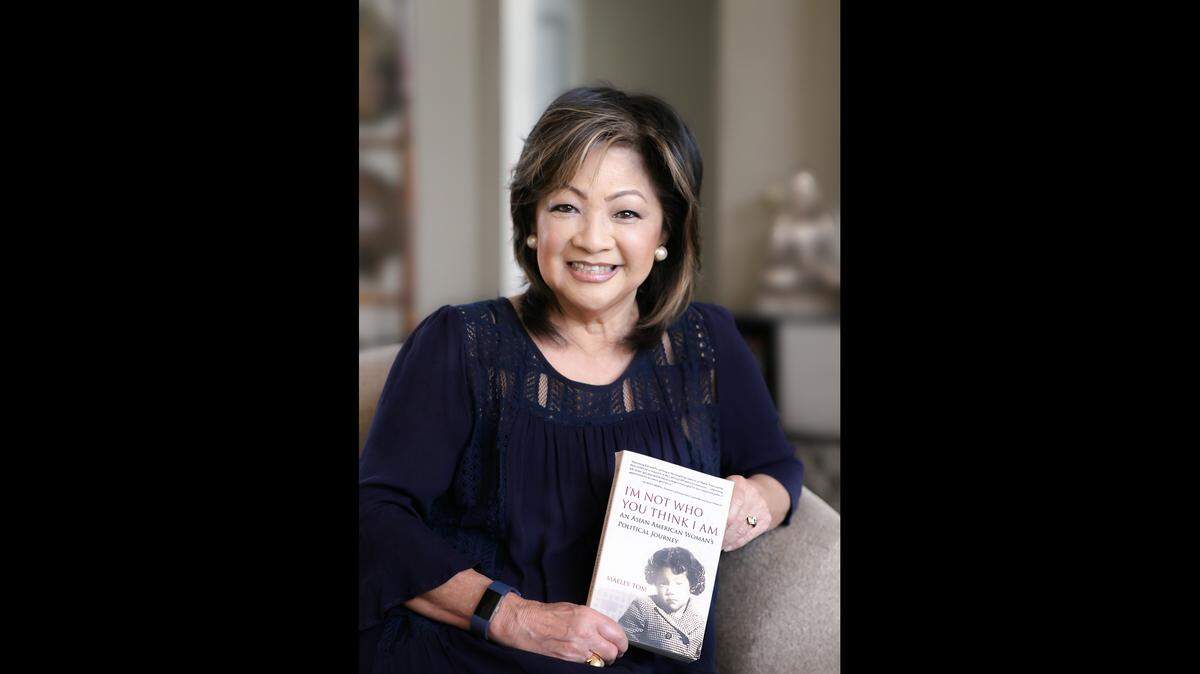
Maeley Tom is the first woman and first ethnic minority to serve at the highest level of California Legislature. Now she’s sharing her story. Her memoir – titled “I’m Not Who You Think I Am” – was published Sunday.
Throughout her career, from the 1970s to the early 2000s, Tom contributed to the state legislature and national politics. For 20 years she was the chief administrative officer of the California Assembly under Speaker Willie Brown Jr., then later appointed as the chief of staff to the California Senate President Pro Tem David Roberti.
Now retired, Tom wanted to speak publicly about the positive side of her struggles in climbing the political ladder, self-knowledge and sacrifices, as well as share heartfelt advice to the next generation of policymakers.
“I made mistakes, I wasn’t treated well, but I don’t want to be thought of as a victim,” Tom said. “I want people to know that you have to overcome hurdles, make mistakes and have the motivation to plug in and move on to accomplish what you want to accomplish. There is no perfect path.”
A child of Chinese opera celebrities, Tom grew up in Oakland’s Chinatown in the early 1940s, far removed from politics. After spending the first eight years of her life under foster care, Tom had to navigate her own path to adulthood. She began to support herself financially at age 16 and graduated from San Francisco State University four years later.
Getting into politics, which led to a lifetime career, was an accident, Tom recalled. In an nearly all-male and predominantly all-white working environment, she battled stereotypes every day to gain recognition. While she considered herself confident and outspoken, it was intimidating at first to work with few people who looked like her. But only the fittest could survive, she said. Throughout the years, Tom learned that merit alone does not grant one a leadership position, as exemplified by her own struggle, having to ask for the top position in the assembly, especially in a political environment.
“There’s no time to wait to speak,” she said.

Tom also chronicled her experience in giving a voice to the under-served communities in the state Capitol in the 1970s and ’80s, when Asians didn’t have a high level of representation in political offices and as voters. In the book, she unpacks the history of why some Asian immigrants don’t trust the government, as well as the barriers many faced to learn about the value of voting.
Tom said the biggest challenge is to be honest about lessons learned in her career, which could sometimes be a daunting task, yet is what makes the book meaningful. She dug deep into her conscientiousness to surface agonizing memories – the Clinton Asian fundraising scandal in the 1990s that forced her to face prejudice in the media – as well as moments of pride and triumph. She said it was anything but an easy path, which explains the book’s title.
“It was important to me that people tend to see all the successes (as well as) what the person had to go through to reach that pinnacle of achievement,” Tom said. “You have to be able to force yourself to deal with some of those barriers and some of those struggles.”
Although her journey wasn’t all rosy, Tom was not alone. She credited former state Sen. Art Torres, current U.S. Rep. Maxine Waters and the late John Vasconcellos as her cherished friends and mentors who supported her and taught her to speak up.
“I never hesitated to ask anyone I admire for help,” she said.
Now retired, Tom continues her work in advancing civil rights issues and helping Asian Americans in politics. She feels optimistic about more Asian representation in the state legislature. As the founding president of the California Asian Pacific Islander Legislative Caucus, Tom developed a program called the Capitol Academy, which trains local Asian American officials on how to run for state office. She said half of today’s Asian legislators in California are graduates of the program.
“I think all these organizations who work to expose Asian Americans to values of participating in political processes are all steps to empower our community to understand how important it is to be a part of this structure,” she said.
Tom’s biggest advice for policymakers of the next generation is to not be bound by the label “Asian Americans.”
“It is wonderful to be proud of your heritage,” Tom said. “We need to not confine ourselves to be just identities as Asians Americans, but to be seen as the best of Americans in the society.”
This story was originally published June 4, 2020 at 5:00 AM.