
California needs more medical workers, but are they being stalled at community colleges?
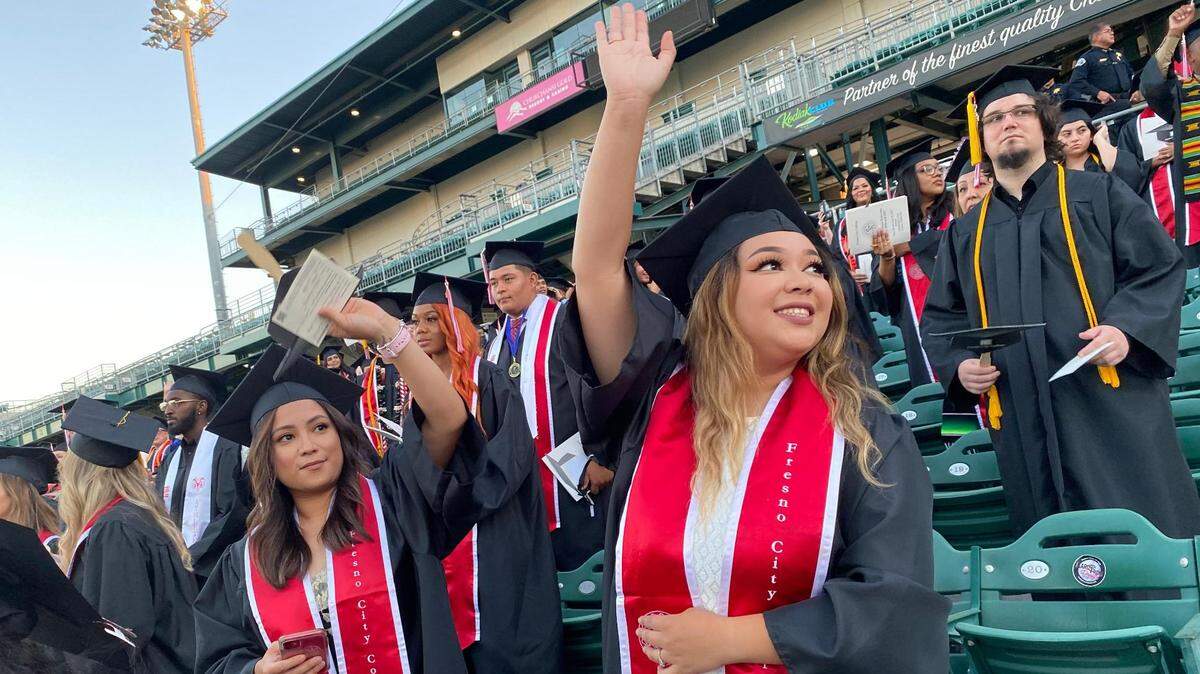
With a doctor and medical worker shortage likely exacerbated by the COVID-19 pandemic, California’s central San Joaquin Valley needs more health graduates – and from diverse backgrounds, experts say.
But a new report from the nonprofit Campaign for College Opportunity found that community college students, who are more likely to be Black and Latino, struggle to transfer to universities to finish their schooling.
Among 59,029 community college transfer students in the fall of 2020, 3,272 — only 5% — were students majoring in a health field, according to the report.
A major problem is confusion around associate degrees for transfer (ADTs) and how they don’t always clearly lead students on a pathway to graduation, according to the report titled “Critical Condition: Prescriptions for Improving Transfer Pathways in the Health Professions.”
The University of California and California State University systems have different requirements for admission, challenging students to choose a path early on in their schooling. AB 928, which passed in 2021, will streamline those requirements, creating major change.
The Campaign for College Opportunity noted other ways to improve transfer, including exempting health profession fields from the requirement that ADTs can only include 60 units taken at the community college level. Oftentimes healthcare majors have to take laboratory courses that would exceed that cap.
Expanding the number of ADTs available for health majors is another solution, the report says.
Currently, transfer degrees in health are limited to Kinesiology and Public Health Science. Degrees in General Nutrition and Dietetics, Human Services, Social Work, Psychology, and science-related degrees in Biology and Chemistry could be considered health-related, but nursing, dental, and medical degrees would help that expansion.
Even before the pandemic, California’s healthcare system was 240,000 nurses short, according to the College Futures Foundation. Physician-to-resident ratios have been well below what medical experts say is needed for adequate health care in the Central Valley.
Another 500,000 healthcare workers, including medical and dental assistants and other non-nursing specialists, will be needed in the coming years, researchers at California Competes estimate.
Even though most of California’s workforce is non-white, its healthcare workforce does not reflect that, according to the report.
Forty-six percent of undergraduates at community colleges are Latino, according to the National Center for Education Statistics.
The report cites research that shows “patients with doctors of a similar racial/ethnic background report higher levels of communication with their doctors, and Black and Latinx physicians are more likely to care for populations from minoritized communities.”
Medical students in one study who began their education at a community college were more likely to choose family medicine as their specialty, according to the report, “indicating the unique promise of community colleges in diversifying the composition of primary care medicine.”
Community colleges should also work with local universities to streamline pathways, according to the report. It noted Fresno City College especially has “cultivated strong connections” not only with Fresno State but with the Fresno County Public Health Department and community partners.
Campus leaders at community colleges acknowledged the transfer process for health majors “remains unnecessarily complex,” the report read.
“We learned about unique challenges present at smaller campuses, which often have different infrastructure and reduced capacity to develop new courses and pathways for transfer,” the report continued. “Despite a growing number of Health ADTs and a wide range of programs to support them, many barriers are delaying their development at the pace needed to help meet the demand for health professionals in California.
“Strong state and college leadership and systemic change across the community college and CSU systems are necessary to address the intractable problems that hinder Health ADT development.”
This story was originally published April 17, 2022 at 5:00 AM with the headline "California needs more medical workers, but are they being stalled at community colleges?."