Rare ‘planet parade’ appears in California sky, along with wolf moon. Here’s when to look up
From the wolf moon to a “planet parade,” California stargazers can expect several astronomical events in January.
On clear nights, you’ll be able to observe four planets aligned in the sky, according to NASA.
Amateur astronomers will also have a chance to see a Venus and Saturn conjunction and a mid-month full moon that will briefly cut off Mars from view.
Here’s what to know about the celestial sightings in store:
What’s the best time to see full moon in California?
The first full moon of the new year will reach peak illumination at 2:26 p.m. on Monday, Jan. 13, in California, according to Time and Date, an online calendar.
The wolf moon will appear on the eastern horizon around sunset.
The bright moon will be directly overhead around midnight and then sink into the western horizon by sunrise, the Old Farmer’s Almanac said on its website.
Sunrise occurs
Why is January’s full moon called the wolf moon?
The January full moon is called the wolf moon because wolves are often heard howling at this time of year, according to the Almanac.
“Wolf vocalizations are heard in the wintertime to locate pack members, reinforce social bonds, define territory and coordinate hunting,” the Almanac said on its website.
Other names for the full moon in January include the bear hunting moon, goose moon and moon of the strong cold, according to Farmers’ Almanac.
When will moon eclipse Mars?
On the evening of Monday, Jan. 13, the full moon “cozies up” to Mars, appearing extremely close to the Red Planet, NASA said on its website.
As the moon and Mars rise in the eastern sky, the moon will look like it’s passing in front of the planet for a couple of hours.
The sight will be visible to skywatchers in the United States and Eastern Canada, according to NASA.
What’s the best way to watch parade of planets?
In January, you’ll be able to witness four bright planets in a single glance up to the sky.
Each night, during the first couple hours of darkness, Venus and Saturn will appear in the southwest, Jupiter will be directly overhead and Mars will be visible in the east section of the sky, according to NASA spokesman Preston Dyches.
If you have a telescope, you can also view Uranus and Neptune in the sky at the same time.
NASA said planets always appear in a line in the night sky.
The astronomical alignment is technically called the ecliptic, which represents the plane of the solar system where planets orbit around the Sun, according to NASA.
“What’s less common is seeing four or five bright planets at once, which doesn’t happen every year,” Dyches said.
“Is it a planet parade?” he added. “This isn’t a technical term in astronomy, so call it what you wish!”
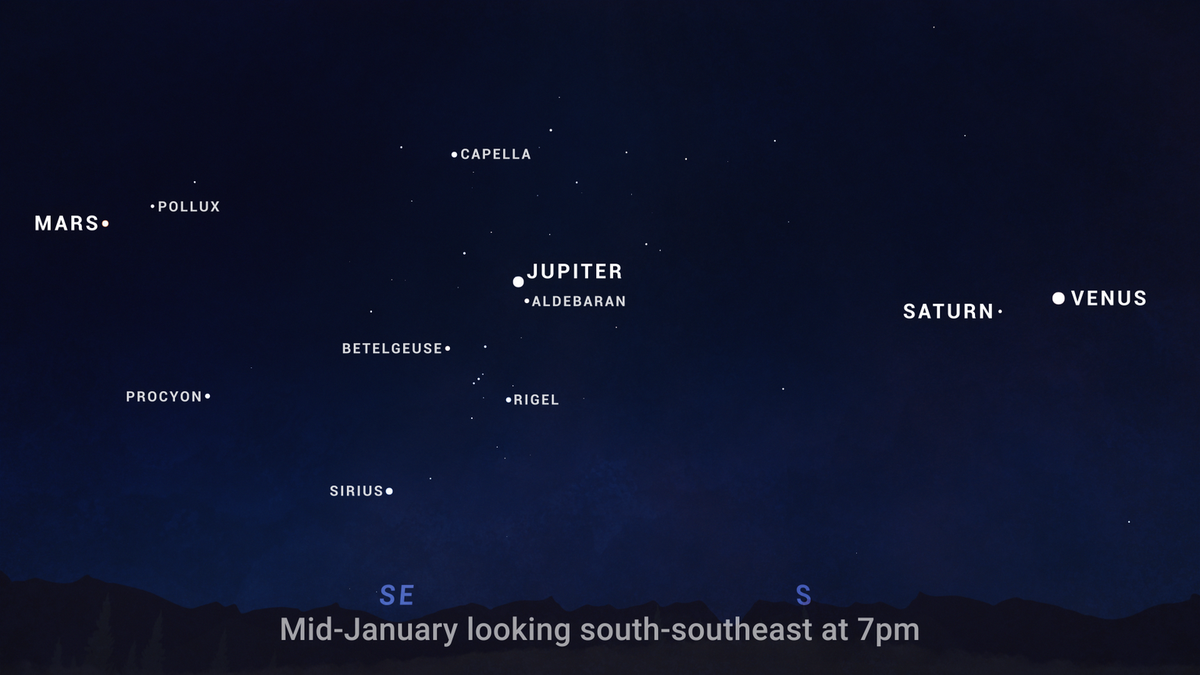
How can I see Venus and Saturn in the sky?
When does Mars become more visible?
During the month of January, Mars reaches opposition and will be much more visible to the human eye, NASA said.
At the point of opposition, which occurs roughly every two years, Mars will be on the opposite side of Earth from the Sun.
It marks when the planet is closest to Earth, so it will be “at its biggest and brightest” this January, according to NASA.
On winter mornings, Mars will be the only planet still visible in the sky.
Stargazers can find it hanging in the west in the hours before sunrise, the federal agency said.