
More than half of California is ‘abnormally dry’ after rains. Which areas are hit hardest?
Drought conditions in California improved after a series of atmospheric river-fueled rain storms swept through the state.
However, more than half of the state was “abnormally dry” as of Thursday, Feb. 20, according to the U.S. Drought Monitor.
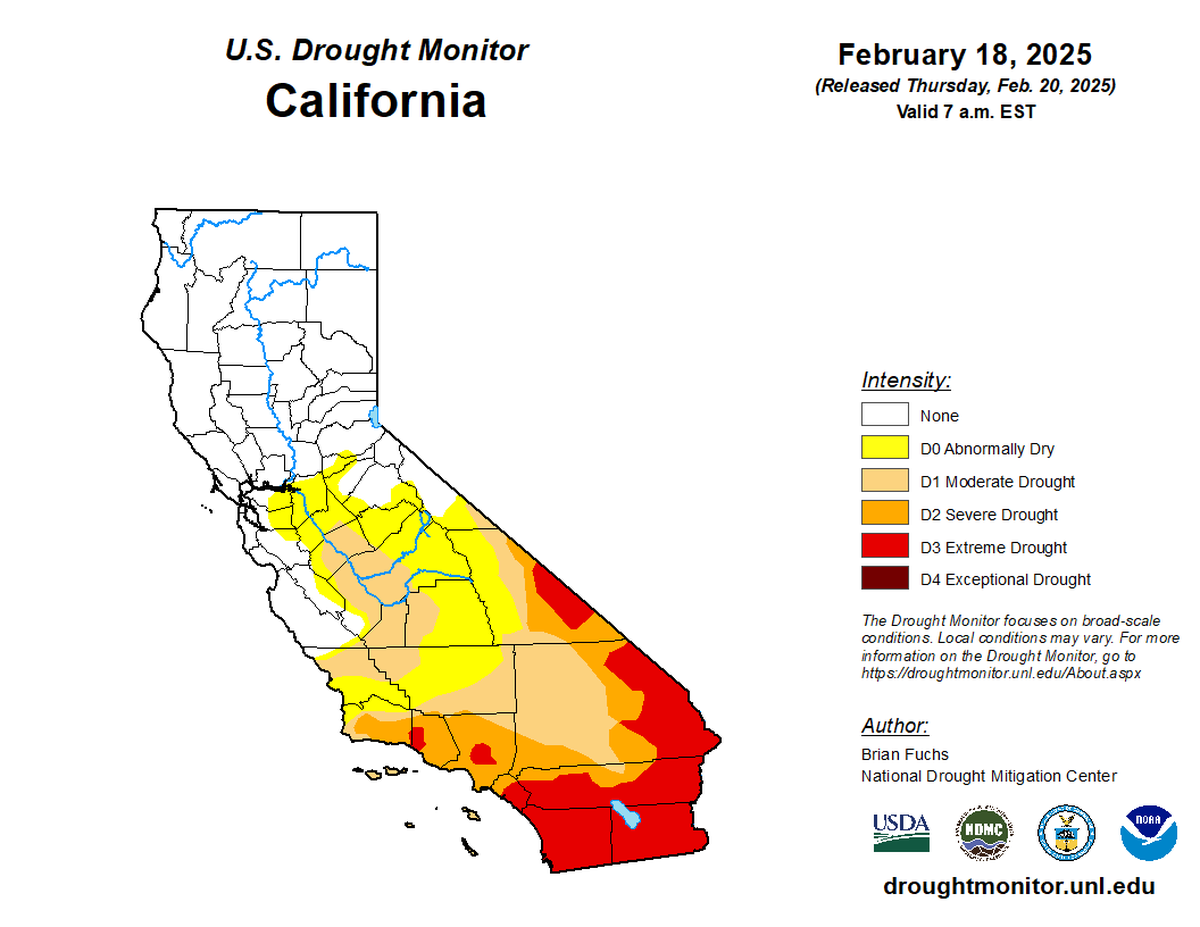
As of Thursday, areas of “moderate drought” could be found in Central California, including parts of Fresno, Kern, Madera and Merced counties, the Drought Monitor said, as well as San Bernardino County in Southern California.
On the Central Coast, parts of Santa Barbara and Ventura counties were experiencing severe drought conditions, the federal agency said.
So were areas of Inyo, Los Angeles and San Bernardino counties further south.
“Extreme drought” conditions could be found in Imperial, Riverside and San Diego counties, the federal agency said.
Here’s a look at drought conditions across California:
How much of California is in drought?
As of Thursday, nearly 58.2% of California was under abnormally dry drought conditions, according to the Drought Monitor’s weekly map showing drought intensities across the nation.
That’s a decrease of more than 7% compared to Feb. 11, when about 66.7% of the state was under drought conditions.
About 41.5% of California was under moderate drought conditions as of Thursday, while 24.8% of the state was under severe drought conditions.
The Drought Monitor map indicated that 14.7% of California was under extreme drought conditions.
Did rain help decrease drought conditions?
Recent rain storms helped dampen drought conditions across much of California, according to the Drought Monitor.
“Widespread precipitation” occurred over much of the West, the agency said in its weekly national drought summary, bringing rain to lower elevations of California and snow to upper elevations.
“The wetter conditions over California allowed for some improvements in areas where the current water year indicators improved and eased some of the drought conditions,” the Drought Monitor said.
January was one of the driest Januarys on record since 1895, according to the National Weather Service.
How many people are affected by drought?
As of Thursday afternoon, an estimated 23 million California residents were living in drought conditions according to the U.S. Drought Monitor.
What are California reservoir levels?
As of Thursday, California’s two largest reservoirs — Shasta Lake in Shasta County and Lake Oroville in Butte County — were at 77% and 84% capacity, respectively, according to the California Department of Water Resources.
Although Shasta Lake water levels saw no significant change since January, water levels at Lake Oroville increased by 15% compared to January, when the reservoir was at 69% capacity.
Folsom Lake east of Sacramento was at 70% capacity, state data indicated, up 33% from January.
According to the state water resource agency, San Luis Reservoir in Merced County was at 80% capacity and Pine Flat Lake in Fresno County was at 54% capacity.
This was a significant change from January, when San Luis Reservoir was at 69% capacity and the Pine Flat Lake was at 46% capacity.
Lake Nacimiento was at 66% capacity on Thursday, according to the the Monterey County Water Resources Agency.
The lake in northern San Luis Obispo County was at 53% capacity in January.
San Antonio Lake in southern Monterey County was at 72% capacity as of Thursday, according to the water resources agency, compared to 70% capacity in January.
This story was originally published February 20, 2025 at 3:58 PM.
%20Cropped.jpg)