CA drought conditions ease after storms. Which areas are still ‘abnormally dry’?
Major storms that drenched California in recent weeks have dramatically improved drought conditions statewide.
“In the West, heavy rain and snow was widespread, especially in parts of southern Nevada, southern and coastal California, the Sierra Nevada, the Pacific Northwest and northwest Montana,” the U.S. Drought Monitor said in its national drought summary release Tuesday, Nov. 18.
As of Tuesday, Nov. 25, more than two-thirds of the state was entirely drought-free.
California saw improvements “where recent precipitation has cut into or erased precipitation deficits and boosted soil moisture and streamflow,” the federal Drought Monitor said.
Only parts of Southern California were still experiencing “abnormally dry” to “severe drought” conditions, with the worst impacts concentrated in the far southeastern corner of the state.
With more rain in the forecast, here’s a look at drought conditions across California:
How much of California is experiencing drought?
Roughly 70% of California was no longer experiencing drought conditions as of Nov. 18, according to the latest data from the U.S. Drought Monitor.
According to the Drought Monitor’s weekly report, about 30% of the state was classified as “abnormally dry.”
Around 15% of California remained in “moderate drought,” the report indicated, while less than 1% faced “severe drought” conditions.
No areas of the state were experiencing “extreme” or “exceptional” drought conditions as of Nov. 18.
Which parts of California are ‘abnormally dry’?
According to the latest data from the U.S. Drought Monitor, much of Southern California was “abnormally dry” as of Tuesday, Nov. 25, including large areas of Los Angeles, Imperial, Mono, Inyo, San Bernardino and Kern counties.
Parts of San Diego, Orange and Riverside counties were experiencing “moderate drought” conditions, according to the drought monitor.
“Severe drought” was observed in areas of San Bernardino and Inyo counties.
How full are California lakes and reservoirs?
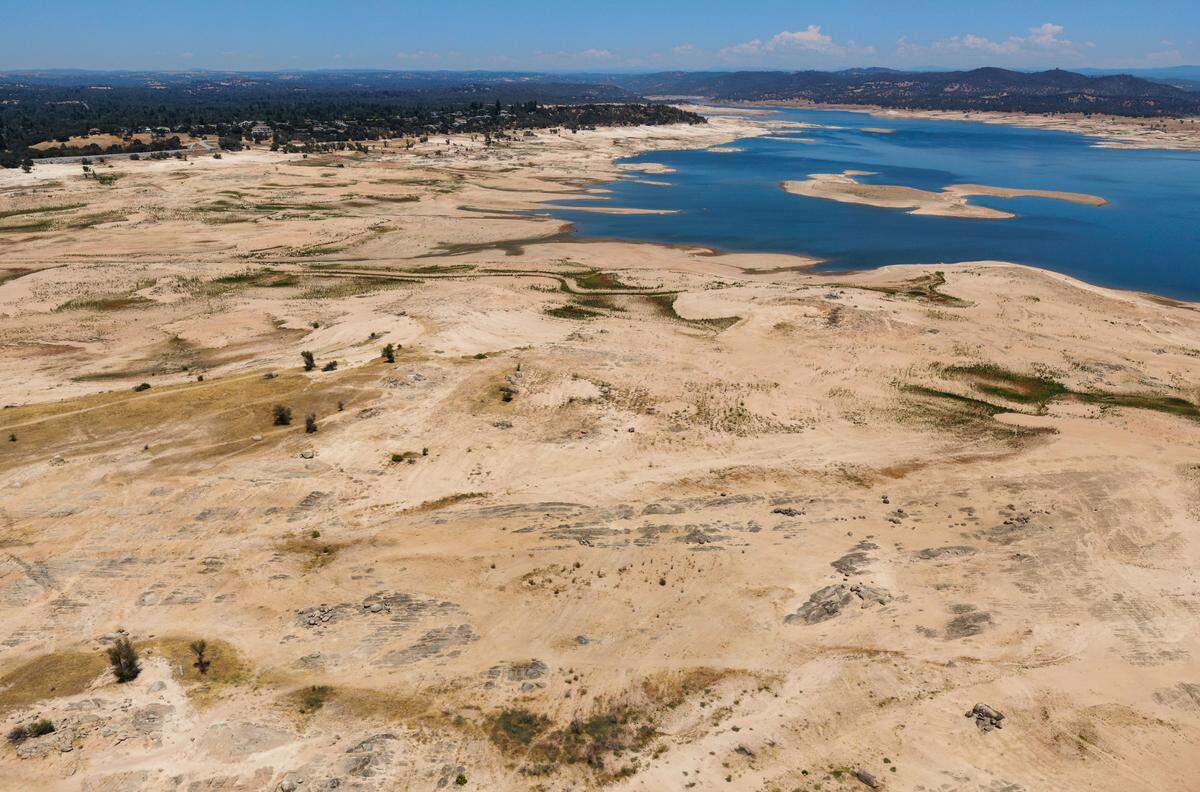
According to the California Department of Water Resources, California’s reservoirs were holding about 23 million acre-feet of water as of Tuesday, Nov. 25.
That’s roughly 115% of what they usually hold at this time of year, meaning that storage levels are above average.
These were current water levels in major California lakes and reservoirs as of Tuesday:
- Shasta Lake — 59% of capacity
- Lake Oroville — 52%
- New Bullards Bar Reservoir — 62%
- Folsom Lake — 46%
- Camanche Reservoir — 72%
- New Melones Lake — 68%
- Don Pedro Lake — 77%
- Lake McClure — 61%
- Pine Flat Lake — 30%
- Millerton Lake — 54%
- Castaic Lake — 77%
- Diamond Valley Lake — 94%
- Lake Casitas — 91%
- Lake Cachuma — 77%
- San Luis Reservoir— 60%
- Lake Sonoma — 59%
- Trinity Lake — 73%
Is more wet weather on its way to California?
More wet weather is expected to sweep through California next week.
As of Tuesday, Nov. 25, the National Weather Service’s Climate Prediction Center was predicting “above normal” rainfall across the Golden State in early December.
Recent forecasts indicate that there is a 33% to 50% chance of “above normal” precipitation across the Bay Area, Central Coast, the Central Valley and Southern California.
“Precipitation amounts of at least 0.75 inches are also forecast in parts of southern California, southern Arizona and southeast two-thirds of New Mexico,” the U.S. Drought Monitor said in its national drought summary on Tuesday, Nov. 18.
In Northern California, “near normal” precipitation is expected, according to the National Weather Service.
When will West Coast see most rain?
According to the Old Farmer’s Almanac, the West Coast — including California — will “experience the wettest conditions” on Thanksgiving Day, Thursday, Nov. 27.
“As the impact of this precipitation on the water cycle in California and Nevada is evaluated in the coming weeks, further improvements may occur,” the U.S. Drought Monitor said.