
Fields of betrayal? Chavez, UFW neglect farmworkers, critics say | From The Bee archive
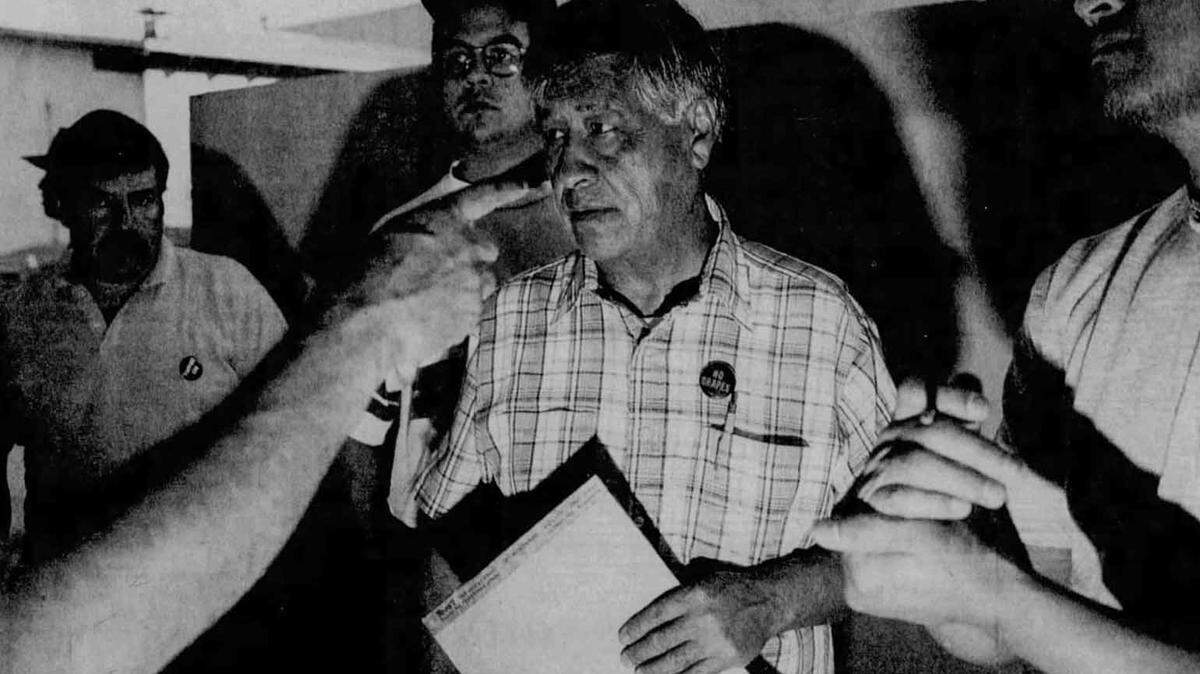
Editor’s Note: Last week, Bee opinion editor Marcos Breton wrote this column in which he recalled interviewing Cesar Chavez in 1991. Based on reader interest, we are republishing the Feb. 23, 1992, story Breton wrote after that interview.
There was once a time when even the whisper of Cesar Chavez and his United Farm Workers union caused growers across America to shudder.
But for the last decade, Chavez and the once powerful UFW have taken a beating - in the fields, at the bargaining tables and in the courts - and disil lusioned supporters say the union’s pledges since the 1980s have amounted to little more than empty promises.
“People see Chavez like he is a god and it’s not true,” said Paulino Gonzalez, a Tulare County farmworker. “The movement is good. Unity is good. But what doesn’t work is Chavez and his administration.
“When he had power it was because we were behind him. Without us he is nothing. And we need representation now more than ever. Things are worse now than they have ever been and the UFW isn’t doing anything and they don’t let anyone else do anything.”
At its peak in the 1970s, the UFW could boast that more than 100,000 workers in California’s fields worked under collective bargaining agreements. Today, the union represents 20,000 workers - about 2 percent of the state’s estimated 1 million farmworkers.
Critics say the numbers reflect that Chavez - the legendary leader of the most successful effort to improve the lot of the long-neglected California farmworker and a man revered in farmworker households in the United States and Mexico - has become virtually irrelevant.
His chorus of critics includes farmworkers, former UFW organizers and academics who have researched the labor organization. They say the vast majority of farmworkers and their advocates throughout harvest fields of the West retain few ties to Chavez’s union while others fear and mistrust it.
Chavez, 65, still fiercely proud of the UFW, said his union hasn’t backed off an inch from what it set out to accomplish in the 1960s: represent farmworkers and gain concessions by “negotiating, boycotting and bargaining.” The union, he said, has proven critics wrong many times before.
“We know more about organizing farmworkers than anyone else in the country today,” he said in an interview at his small office on the grounds of the UFW’s mountaintop La Paz compound, roughly 30 miles east of Bakersfield. “When we started I was by myself. Today we have developed a whole crew of leadership. We have more friends than we ever had. We’re self-funded and we’re staying on the fight for a long time.
“If we didn’t have any backing from the people we wouldn’t be here,” Chavez said. “We couldn’t. We take in a couple of million dollars from members, through dues and through contributions. And we get more volunteer time from our members than any union in the United States. That’s why we’re alive. If what these people were saying is true, we couldn’t do it. We couldn’t survive.”
Chavez and the UFW are not without supporters, such as Menecio Sanchez, a farmworker from Coachella in Riverside County. “This union is one of the most honest around,” he said. “Right now the laws don’t work for farmworkers and a lot of people have lost faith.
“But the only ones who keep fighting is this union. Right now I am getting a pension from them. If they weren’t around do you think that would be happening?”
And Dennis Lopez, a lawyer for the Mexican American Legal Defense and Education Fund, said Chavez’s national reputation shouldn’t be minimized.
“The UFW has provided a national focus on the plight of farmworkers in the United States,” he said. “Their organization has survived. . . . To organize this particular population of workers is a tremendous feat.”
But in dozens of interviews, farmworkers and others once close to what was known as “La Causa” said Chavez and the UFW broke promises after they organized at ranches, abandoning workers who lost their jobs. And when others tried to help farmworkers organize, Chavez or his aides undermined them, they said.
As a result, the critics said, Chavez and the UFW have become part of the reason so many farm workers remain unrepresented in California and elsewhere in the American West.
“The farmworker story disappeared because the UFW acted like it was over, like the battle had been won,” said David Runsten, a Berkeley-based economist and a national authority on farmworker issues.
“It’s a truly frustrating kind of thing. They don’t do anything and then somebody else comes in to organize and they show up. What it does is divide the vote and the situation ends up being pro-grower.”
Others said the UFW’s vindictiveness has hurt the organized farm labor movement in the long run. “I really in any way can’t understand their (the UFW’s) need to lash out, to treat people who have given their lives to the movement as being subhuman because they disagree with them on certain issues,” said Don Villarejo, director of the Davis-based California Institute for Rural Studies.
“In the 1970s, Cesar was a brilliant leader and should have led a national movement. That didn’t happen and that is unfortunate. Now, instead of having a strong national movement, you don’t even have a strong California movement,” he said.
If influence and power are based on perceptions, Chavez and his aides don’t deny that the assault on the union by former members fosters the perception the union’s influence is waning. Once their critics’ hidden agendas are exposed, they argue, the UFW will be vindicated.
“You’ve got to keep in mind what is happening,” Chavez said. “It’s contrived and it’s purely political. It’s very deliberate. Those are just people with axes to grind against us.
“I know farmworkers and they aren’t saying that,” Chavez said.
But how does Chavez explain the UFW’s dramatic decline in membership?
Chavez said the union has been ground up by the system - conservative politicians, hostile growers and an adversarial state Agricultural Labor Relations Board - created in 1975 in response to the growing influence of the farmworkers movement.
Chavez said the ALRB has been particularly damaging.
“It’s been disastrous what they’ve done to us,” he said. “Massive violations of our civil rights, a whole lot of horror stories including systematically cutting off our complaint process. They made it impossible to complain and if we did complain they set new rules so that the complaints were thrown out.”
Bruce Janigian, ALRB chairman, denied that the board has stacked the system against the union. “We’ve made a number of reforms to improve responsiveness,” he said. “There was a feeling, a perception that the ALRB was oriented more strongly toward growers. That has been engendered by the UFW and the press. That has been something I have worked to change by being scrupulously fair.”
Villarejo agreed with Chavez that “there was an assault on farmworker and other labor during the 1980s.”
“The ALRB became a tool to be used against the workers,” Villarejo said.
But the UFW needed to adapt to the new realities, to change tactics and strategy. “The UFW has had tremendous difficulty transforming itself from a social (consciousness-raising) movement to an administrative movement, to a labor union that could deliver,” Villarejo said.
Since the late 1970s, victories at the bargaining table have been less frequent, and UFW leaders admit ranchers thumbed their noses during contract negotiations, daring them to strike.
“I haven’t seen as much activity in recent years from them as we have in the past,” Roy Gabriel, labor lobbyist for the California Farm Bureau, said of the UFW. “You just reach a point where you make all the accusations you are going to make and it doesn’t accomplish anything.”
Chavez said the UFW did change course and take its fight out of the fields and back to where it had the most success - in the hearts and minds of consumers, students and like-minded political leaders. Now, for example, it’s in the midst of a boycott of table grapes to protest the use of pesticides.
Villarejo said the UFW made “very major contributions” in the late 1960s and 1970s in bargaining. “Some farm workers got workers’ compensation, minimum wages were addressed, some farm workers got unemployment, state disability and social security and, in the years that they did have contracts, the general wage level went up.”
Ezequiel Velez, a 17-year UFW member and Riverside County farm worker, is among those who remember the gains and has unwavering loyalty. “The conditions were terrible before the UFW came along,” he said. “Our salaries were terrible. There were no bathrooms in the fields. There was no water out in the fields. We were treated like animals.
“We used to have to use short-handled hoes that were crippling workers, but the UFW stopped that.”
In addition, Chavez said that over the years the UFW built up major benefits for its membership, with $54 million in a pension fund for retired workers and $12.5 million in a medical fund. The union has 4,000 members participating in the medical plan and 7,500 in the pension plan, said Douglas Blaylock, UFW administrator.
While critics acknowledge those programs, they say the number of workers covered by the UFW pension and medical plans are a drop in the bucket when considering the nearly 1 million farm workers in California left unprotected.
More puzzling, critics said, has been the union’s response to other farmworker advocates. “The fact that they were unable to work with other people is tragic,” Villarejo said. “People who have taken the initiative, often at great personal sacrifice, are seen as threats rather than allies.”
Chavez and his aides repeatedly claimed that their critics are Communist or grower sympathizers who infiltrated the UFW before turning on it.
“All this network of people who are disgruntled with us, they must have a reason for being disgruntled with us. They’re all part of these organizations,” said David Martinez, UFW secretary-treasurer.
In each instance, the former UFW members deny they are Communists, bitterly pointing out the irony of Chavez mimicking what growers once said about him decades ago.
“When you become king of the hill you don’t want to let anyone else on the hill,” said Antonio Orendain, a former UFW organizer who Chavez has discredited. “That is what has happened to Cesar. He has gone from being a revolutionary to a reactionary.”
Doroteo Lopez said he helped bring the UFW to Gerawan Ranches near Fresno and lost his job for it.
In early 1990, the UFW arrived with the promise that it could make things better at Gerawan, where California Rural Legal Assistance has filed a federal lawsuit on behalf of the workers. The suit, still pending, alleges the company forced 2,000 workers to labor under conditions reminiscent of the 1950s, including 13-hour workdays without a break, no toilets in the fields and no water.
Lopez said that once the UFW election was won in May 1990, union representatives stopped coming around. And when workers called the union office for help as alleged abuses continued, the UFW’s attitude grew steadily cooler.
“They would only come after we hounded them,” he said. “After we got involved with them our lives got worse. Chavez made lots of promises that he didn’t deliver. He promised there would be respect between the company and the workers and that there would be benefits for the workers and their families. But nothing happened. We didn’t get anything. The union just disappeared.”
Chavez and his aides said that Lopez and his new group — Gerawan Ranch Workers Committee — led other workers astray and only served “to promote anarchy.”
Another former ally who UFW leaders now discredit is Chon Garcia, a 20-year UFW organizer who split with the union in 1986.
Garcia is among those former Chavez loyalists who left the organization because they say it lost touch with the people it was representing, seeing enemies around every corner.
As the UFW’s power slipped away with the loss of contracts and unfavorable ALRB rulings, Garcia said, Chavez supporters went into labor camps and worked against organized labor rather than risk losing an election to a rival union.
“We would find a person who was a leader and tell him that if they didn’t vote in the UFW, that they should vote no union. . . . The important thing was that no one else got in. So what would happen is that no one would get representation,” he said.
The UFW said Garcia’s motives are suspect because he was thrown out of the union for being a poor organizer.
Farm workers point to similarities in disputes in Watsonville and Coalinga as well as in Texas and Arizona.
But in each instance, Chavez said the UFW was not to blame and was being discredited by people “with an ax to grind.”
“We know our business,” Chavez said. “We’re the experts. . . . You’re getting a slant there, which is their prerogative if they want to do it. But you know none of this counts if we don’t produce. If we don’t, we’re not around.”
One place where the UFW is no longer around is in Texas, although Chavez rallied a week ago in the state with 200 former members.
Carlos Marentes, a farmworker advocate in El Paso, blames Chavez and the UFW for helping destroy his dream of a national coalition of farmworker organizations in 1987.
Marentes said other farmworker advocates wanted a national strategy for dealing with the tens of thousands of immigrant farmworkers.
Most everyone thought the idea had merit. Everyone, that is, except the UFW, Marentes said.
“In the first meetings the UFW participated, but they let us know right away that they didn’t work with other groups,” Marentes said. “They said they had their own fights.
“We started meeting without them but we started finding out that they were discrediting us. They went to some of our funding sources and said we were a bunch of radicals.
“It hurt us. I don’t understand why it had to be that way. We should all be on the same side,” Marentes said.
In Pharr, Texas, Orendain also wonders what might have been.
In the late 1960s and early ‘70s, Orendain was a UFW organizer in Texas. Then he and Chavez had a bitter fight that spawned the ill-fated Texas Farm Workers Union.
By the late 1970s, the UFW and the Texas Farm Workers Union were in a full-scale war that Orendain said didn’t have to happen.
“We could have stayed in the UFW. People wanted the movement here to continue but Cesar said there couldn’t be two movements. He accused me of being a Communist.”
Orendain said the “worst enemy to us wasn’t the ranchers but Cesar Chavez.”
“The problem with Cesar is this: He thinks that if other groups start up he will lose face and money.”
In Arizona, former colleagues tell the same story. Lupe Sanchez, a farm worker advocate living in a suburb of Phoenix, said that in 1977 onion workers went on strike for higher wages but soon found themselves fighting Chavez.
“Cesar tried running the strike from California and he wanted us to stop. But the workers didn’t want to stop,” Sanchez said. “It became a big conflict.”
So the group splintered, forming the Arizona Farm Workers union. Sanchez said the AFW shut down in 1986 and the UFW left soon after. “They (UFW) didn’t have any interest in organizing here,” he said. “They just wanted to make sure that no one else did.
“Cesar made it a personal thing and it wasn’t personal. It’s like he didn’t want to let anyone else do anything. The worst thing for people like us is that there are lots of Chicanos and others in other states that won’t get involved. People would say, “I can’t get involved with you because you are in a fight with Cesar.’ That would give an excuse to Chicano politicians and others not to get involved.”
In denying blame for what occurred in Texas, Chavez and his aides produced a petition signed by 56 people in Texas saying that Orendain “never organized farm workers.”
“From time to time he (Orendain) would protest in the fields. However, by 1978, Orendain was no longer active in the fields and almost no one who worked as farm workers thought of him as someone who spoke for them,” the petition states.
And Sanchez, the UFW said, was never truly a representative of farm workers in Arizona and only used his influence to fight against the UFW. “He went in company with a grower during a contract to Mexico and went into business in Mexico” with the grower, Chavez said of Sanchez, who denies the allegation.
Moreover, Chavez alleges that the rival unions, now defunct, in Texas and Arizona were founded by radicals whose goals were to disrupt, not represent, farmworkers, and that they manipulated the media to weaken the UFW.
To that end, the UFW released a list containing the names of 51 groups across the country that it claims work against it. “There have been stories planted in newspapers across the country trying to discredit us,” Martinez said.
To Alfredo De Avila, of the Oakland Center for Third World Organizing, the UFW’s claims that Communist insurgents are plotting against Chavez and his union highlight how far the UFW has fallen.
De Avila’s group is on Chavez’s list. “The only people who are being hurt by all this are farmworkers,” the former UFW organizer said.
“Cesar and the union planted the flag and say this is their turf. But the truth is no one is organizing.”
Curiously, there is less bitterness among farmworkers and advocates than there is sadness.
“People don’t believe anymore. They have seen what has happened to the UFW and they don’t want to hear anyone talking about organizing,” said Ismael Arreguin, a farmworker from Coalinga who also felt abandoned by the union in a failed job action.
“It’s been the biggest disillusionment of my life,” Arreguin said. “It has really affected me. I feel drained and completely ruined.
“What I learned from the UFW is that there is no place to turn. Nothing to believe in anymore.”
DOWN, DOWN, DOWN
The number of United Farm Workers members working under contract has declined sharply in recent years.
| Mid-1970s | 100,000+ |
| 1984 | 80,000 |
| 1988 | 40,000 |
| 1992 | 20,000 |
Source: United Farm Workers
UNITED FARM WORKERS ACCOMPLISHMENTS
- 1962: UFW established.
- 1966: First collective-bargaining agreement for workers.
- 1966: First union contract requiring rest periods, clean drinking water, hand-washing facilities, protective clothing against pesticide exposure, and banning pesticide spraying while workers are in the fields.
- 1966: First union contract regulating safety and sanitary conditions in farm labor camps.
- 1967: First union contract restricting the use of dangerous pesticides.
- 1969: First union health benefits paid for farm workers and their families under the UFW’s self-insured Robert F. Kennedy Medical Plan; more than $200 million in benefits have been paid to date.
- 1970: First union contract requiring testing of farm workers on a regular basis to monitor exposure to pesticides.
- 1970: First union contracts prohibiting job discrimination in employment against women workers.
- 1975: Years of protests and lobbying by the UFW and California Rural Legal Assistance lead to Gov. Jerry Brown’s abolition of the short-handled hoe and extension of unemployment insurance benefits to farm workers.
- 1981: First cost-of-living guarantee in union contract.
- 1983: Benefits paid under the nation’s first and only pension program for retired farm workers; more than 1,000 farm workers are receiving pension checks.
- 1987: First profit-sharing program under a union contract dividing a percentage of company profits among workers at the end of the year.
- 1991: First union contract providing farm workers with parental leave to care for a sick child, parent or newborn baby.
Source: United Farm Workers