How bad are California drought conditions after storms? See lake, snow levels
Recent thunderstorms swept through California, bringing heavy rain and mountain snow.
In January, the U.S. Drought Monitor showed 0% of California was experiencing “abnormally dry” conditions — or worse — for the first time in 25 years.
However, a stretch of record heat in March quickly changed that, melting much of the state’s snowpack.
“Changes this week included improvements in moderate drought in northeastern California,” the U.S. Drought Monitor said in its national drought summary on Thursday, April 16.
How are snowpack and water levels across California? Which areas are experiencing the worst drought conditions?
Here’s what to know:
How much of California is experiencing drought?
As of Thursday, about 44% of California showed no drought conditions, according to the federal Drought Monitor.
The remaining 56% of the state was “abnormally dry,” with about 5% experiencing “moderate drought” conditions.
Despite recent storms, that is only a 3% improvement for areas with “moderate drought” conditions from the previous week on April 7.
No areas of the Golden State were experiencing “severe,” “extreme” or “exceptional” drought conditions as of Thursday.
Which parts of California are ‘abnormally dry’?
According to the latest data from the U.S. Drought Monitor, much of Northern California was “abnormally dry” as of Thursday, including large areas of Sacramento, Yuba, Tuolumne, Placer and Yolo counties.
Counties across the Central Valley, including Fresno, Tulare and Madera, were also experiencing “abnormally dry” conditions.
Parts of Del Norte, Siskiyou, Modoc, Lassen, Plumas, Sierra and Nevada counties were experiencing “moderate drought” conditions, according to the federal drought monitor.
How did recent storms affect California’s snowpack?
As of Thursday, the Sierra Nevada had received an average of 294 inches of snow so far this season, with approximately 43 inches falling at Donner Pass in the past seven days, according to the latest data from the UC Berkeley Central Sierra Snow Laboratory.
Despite recent storms, the California Department of Water Resources said, statewide snowpack totals remain below average.
As of Thursday, the snow water equivalent — which reflects how much water the snow contains — was 5.4 inches, or just 20% of average statewide, according to the state department.
Snow water equivalent is a key measurement because it helps determine how much water will be available when the snow melts in spring and summer, according to the California Department of Water Resources.
How full are California lakes and reservoirs?
According to the state Water Resources Department, reservoirs across California were holding approximately 33 million acre-feet of water as of Thursday, April 16.
That’s roughly 121% of what they usually hold at this time of year, meaning that storage levels are above average.
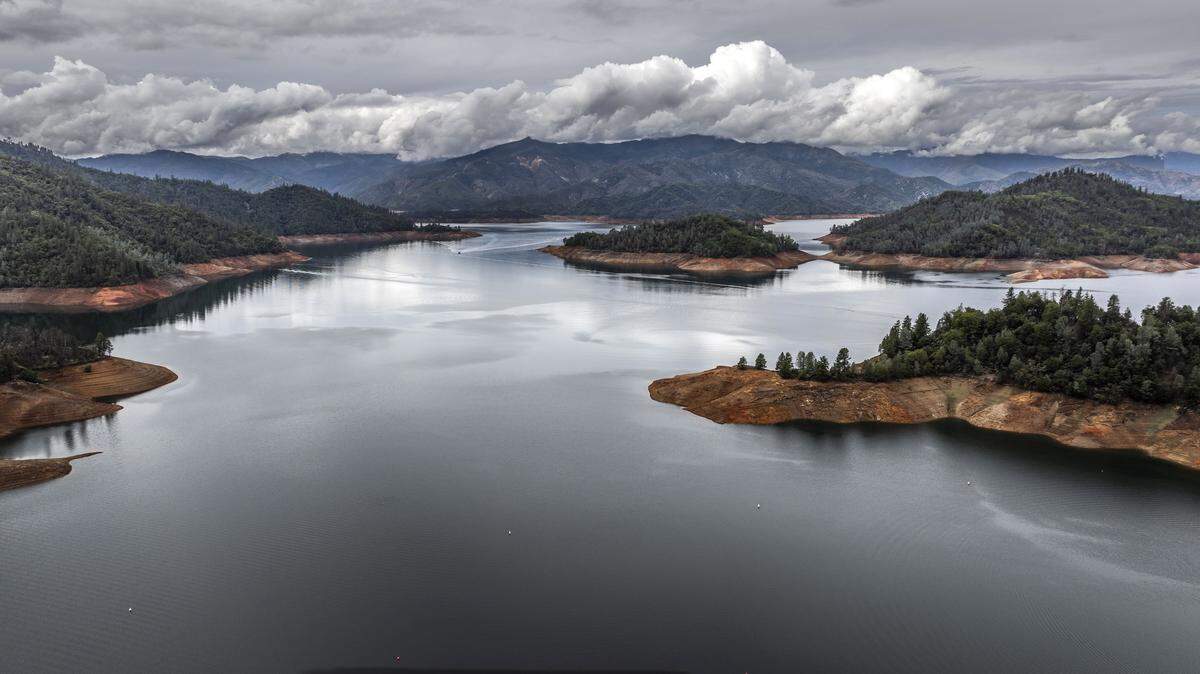
As of Thursday, these were current water levels in major California lakes and reservoirs:
- Shasta Lake — 90% of capacity
- Lake Oroville — 95%
- New Bullards Bar Reservoir — 94%
- Folsom Lake — 92%
- Camanche Reservoir — 84%
- New Melones Lake — 78%
- Don Pedro Lake — 88%
- Lake McClure — 81%
- Pine Flat Lake — 82%
- Millerton Lake — 84%
- Castaic Lake — 84%
- Diamond Valley Lake — 97%
- Lake Casitas — 100%
- Lake Cachuma — 99%
- San Luis Reservoir— 88%
- Lake Sonoma — 69%
- Trinity Lake — 92%