Here’s when Sacramento air quality is best, and which activities to avoid at its worst
Wildfire smoke continues to make skies hazy and air quality poor across Northern California, but you may have noticed the air in Sacramento hasn’t been quite as bad the past few mornings as it was earlier in the week.
It’s not your imagination. Smoke has indeed been on the lighter side Wednesday and Thursday mornings in the southern half of the Sacramento Valley, according to the National Weather Service.
“One of the reasons that we’ve been fortunate enough to clear out (smoke) here in Sacramento is the Delta breeze the past day-and-a-half,” said Karleisa Rogacheski, a meteorologist with the NWS Sacramento office.
The Delta breeze has kept most of the near-surface smoke, being produced by multiple raging wildfire incidents in the greater Bay Area and across Northern California, away from the immediate capital region overnight and into the morning.
A NWS radar forecast for Thursday shows light levels of smoke could roll through Sacramento County around midday and persist through late afternoon or early evening.
The local air districts’ forecasts mirror that trend: air monitors on SpareTheAir.com showed air quality index readings in the “good” to “moderate” levels below an AQI of 100 as of 9:30 a.m., but they still predict max AQI readings near or above 150, which are considered unhealthy for the general population, later in the day Thursday as well as Friday through next Monday.
Most of the smoke that has impacted the Sacramento area for more than a week is coming from the massive LNU Lightning Complex that continues to burn in the North Bay, in parts of Napa, Lake, Sonoma, Solano and Yolo counties, Rogacheski said. A small amount of smoke has also poured in from the SCU Complex burning in the South Bay, which is almost equal to the LNU fire in size but is farther from Sacramento.
Smoke and air conditions that materialize over the course of the day could vary from weather and air districts’ forecasts depending on the actual activity within those wildfires, such as a flare-up, as well as how winds shift after the morning, she said.
The Delta breeze helps Sacramento, but the foothills and the northern reaches of the valley aren’t so lucky, including the Redding area.
“It definitely looks pretty awful up there” Thursday morning, Rogacheski said.
What should you do when air quality is poor?
Air quality and weather officials have a number of tips and recommendations for what to do when AQI levels reach unhealthy levels. Chief among them: Avoid spending significant periods of time outside when air quality is poor, especially anything that involves physical exertion.
What constitutes a “significant” amount of time depends on exactly how bad the air pollution is, but physical activity means anything that will increase your rate of breathing.
The greater Sacramento area’s worst impacts from the LNU Lightning Complex have come in Solano and Yolo counties. The Yolo-Solano Air Quality Management District has created a chart breaking down its recommendations for physical activity in various conditions.
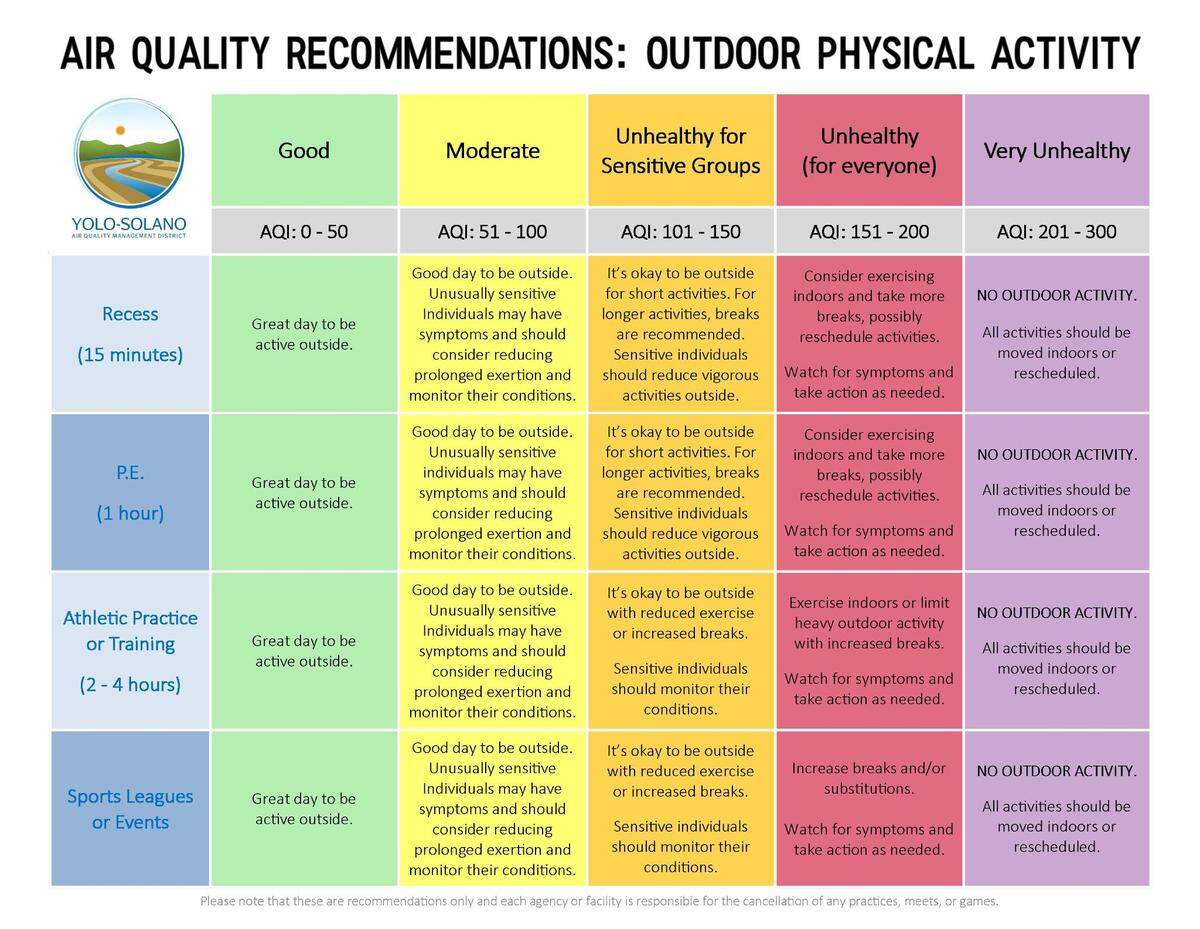
When AQI is in the “good” range, from 0 to 50, it’s an optimal time to do any amount of physical activity outside, the air district says.
In the “moderate” level, AQI 51 to 100, it’s still fine for most of the general population to engage in any amount of work or exercise outdoors, though those who are “unusually sensitive” or have significant medical conditions affecting breathing should take caution.
From 101 to 150, AQI levels are deemed “unhealthy for sensitive groups.” At this level of wildfire pollution, the Yolo-Solano district says sensitive individuals — such as children, those with asthma or those who are pregnant — should reduce outdoor activities.
“It’s okay to be outside for short activities” lasting about 15 minutes in these conditions, but for activities closer to an hour or longer, the air district recommends taking indoor breaks. Breaks will not only get you out of the polluted conditions, but will give you a chance to catch your breath so that you can breathe slower — and therefore breathe in fewer particulate matter particles — once you go back outside.
From 151 to 200, AQI is considered unhealthy for the general population. At this level, even those without any sensitivities should hold off on any outdoor activities that aren’t immediately necessary and wait until conditions improve. If you go outside, doing so in 15-minute stretches with indoor breaks between is advised. You should also be monitoring for symptoms like chest tightness, coughing, wheezing or trouble breathing. And, as always, you should stay hydrated.
Above an AQI of 200 is “very unhealthy,” and anything over 300 is denoted “hazardous.” At these levels, you shouldn’t even consider outdoor exercise or activities. Stay indoors, air experts say.
The general rule of thumb is that if you can smell wildfire smoke, you’re breathing it; and if you can see it in the skies, it’s probably also prevalent enough to impact air quality.
If you can smell smoke or experience related symptoms while inside your home or your vehicle, there are numerous measures you can take, including using the “recirculate” feature on your air conditioning system or sealing up any openings that may be letting polluted air in.