Did an illegal pot grow spark Sierra’s Creek Fire? Residents went looking for clues
Was California’s largest single-incident wildfire caused by an illegal marijuana garden?
That question has hovered over the Creek Fire since Big Creek residents were told as much by a local fire captain on the evening of Sept. 4, 2020 — hours before they were evacuated and half the town’s privately owned homes burned down.
The last six months have not produced any clear answers. The U.S. Forest Service remains silent about its internal investigation into the Creek Fire’s cause, which only serves to inflame rumors and online speculation.
Unsatisfied with the answers they’re getting, or not getting in most cases, a few locals are doing their own sleuthing.
“There’s a lot of rumors and not a lot of hard information,” said Ty Gillette, a Pine Ridge resident who lost his business (the historic Cressman’s Store) and home to the Creek Fire. “People who know won’t talk, so you’ve got to try to figure it out for yourself.”
For Gillette and others, that means hiking into Big Creek Canyon below Camp Sierra toward the fire’s origin zone to see what’s down there.
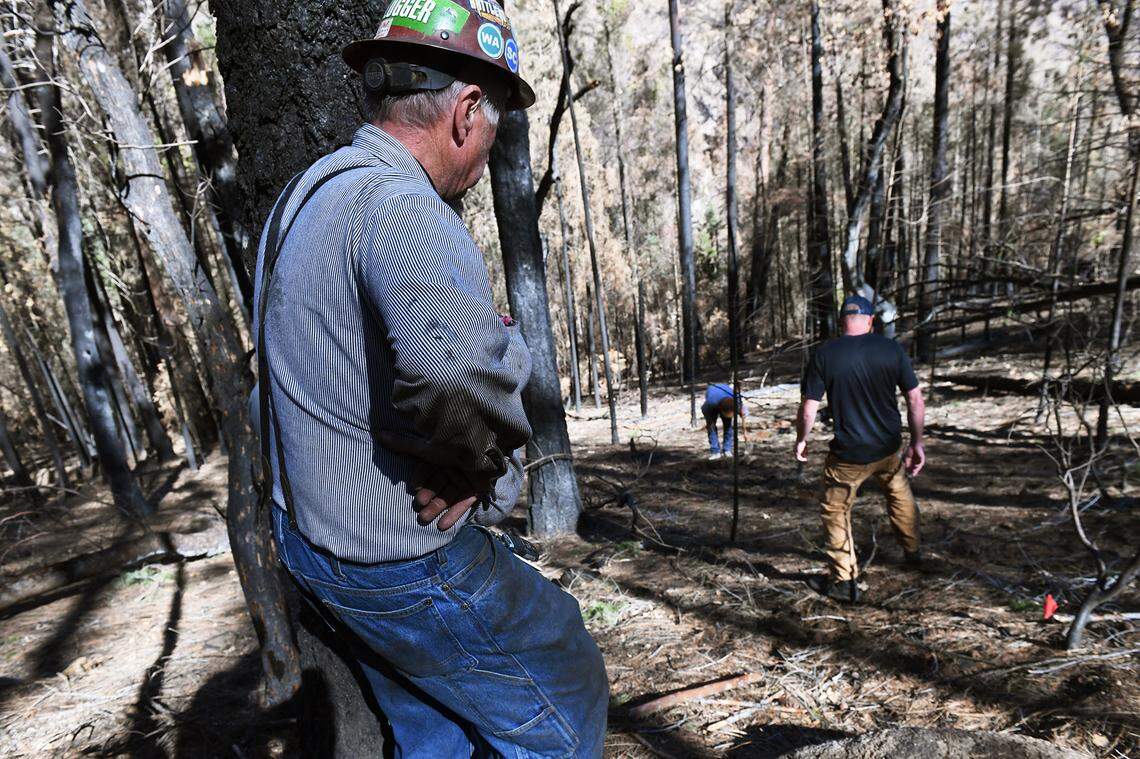
The word “others” in the preceding paragraph includes me. On Wednesday, I made my second February visit to Big Creek Canyon below Camp Sierra, this time accompanied by veteran Auberry logger Tim Messer and Bee visual journalist Eric Paul Zamora.
We weren’t the only ones tramping through the burned-out woods that morning. Shortly after we arrived at the origin zone, Gillette and two friends (Ted Kearns of Shaver Springs and Evan Cornelsen of Pine Ridge) whose homes were also among the 853 structures consumed by the blaze turned up.
What did we discover? First, let me give you the lay of the land. The area where the Creek Fire first ignited is best reached by an old dirt road near Camp Sierra that isn’t on any maps and barely perceptible on satellite imagery when zoomed in.
The old road (a stone’s throw from Canyon Road in places) heads west and downhill before reversing course with a sweeping right-hand turn. In the middle of the turn, an obvious path cleared by a bulldozer heads straight downhill toward the bottom of the canyon.
Bulldozers help firefighters battle aggressive, fast-moving fires by creating containment lines. This particular path goes down a steep slope before ending abruptly at a more level area where a marijuana garden may have once existed.
Possible grow site ‘erased’ by bulldozer
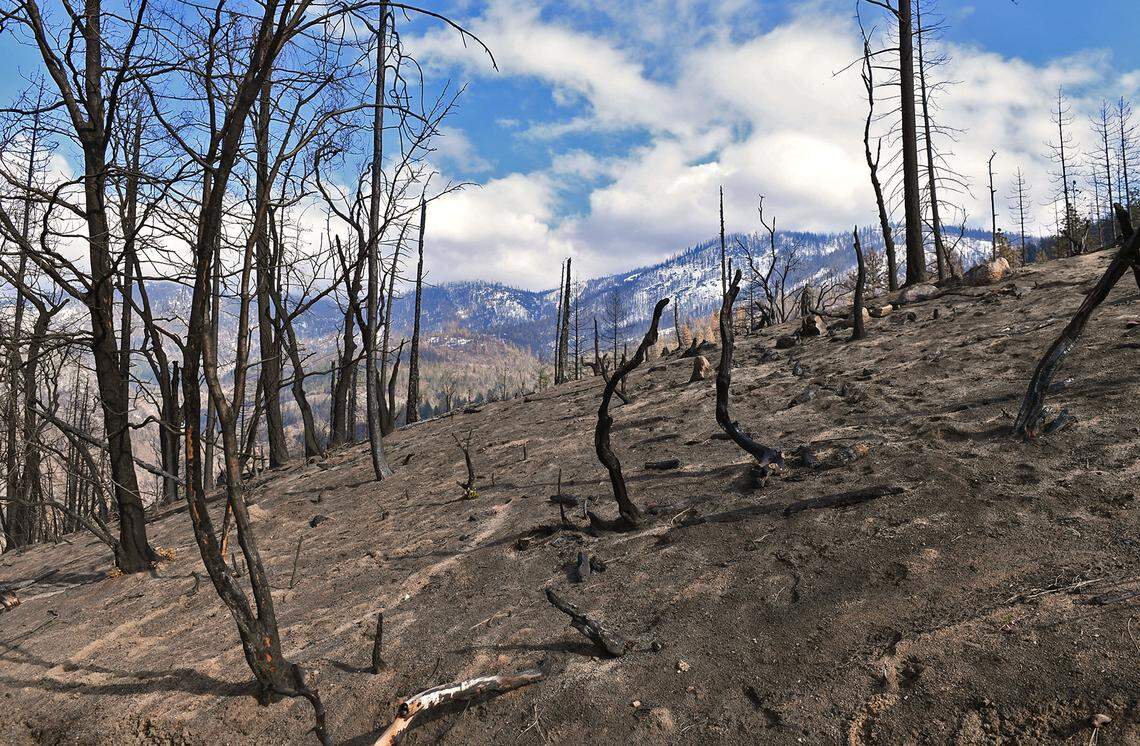
I can’t be more definitive than that. Why? Because any and all traces of a grow site have been obliterated. The same bulldozer path can be seen along a 500-foot-long by 20-foot-wide arc that contours around the nose of a hill.
Could this arc have been a containment line? Messer, based on decades of experience logging forest fires, doesn’t believe so. If it were, he said, the bulldozer operator would have used the machine’s blade to clear the ground of flammable brush, grass and trees.
Instead, this operator used the bulldozer more like a tractor. All the dirt along the arc has been carved up and turned over. Besides, the line doesn’t encircle or contain anything.
“There was no reason for the ‘dozer to do what it did there except to erase something,” said Shaver Lake native Jeff Young, another logger who visited the origin zone on two occasions in January.
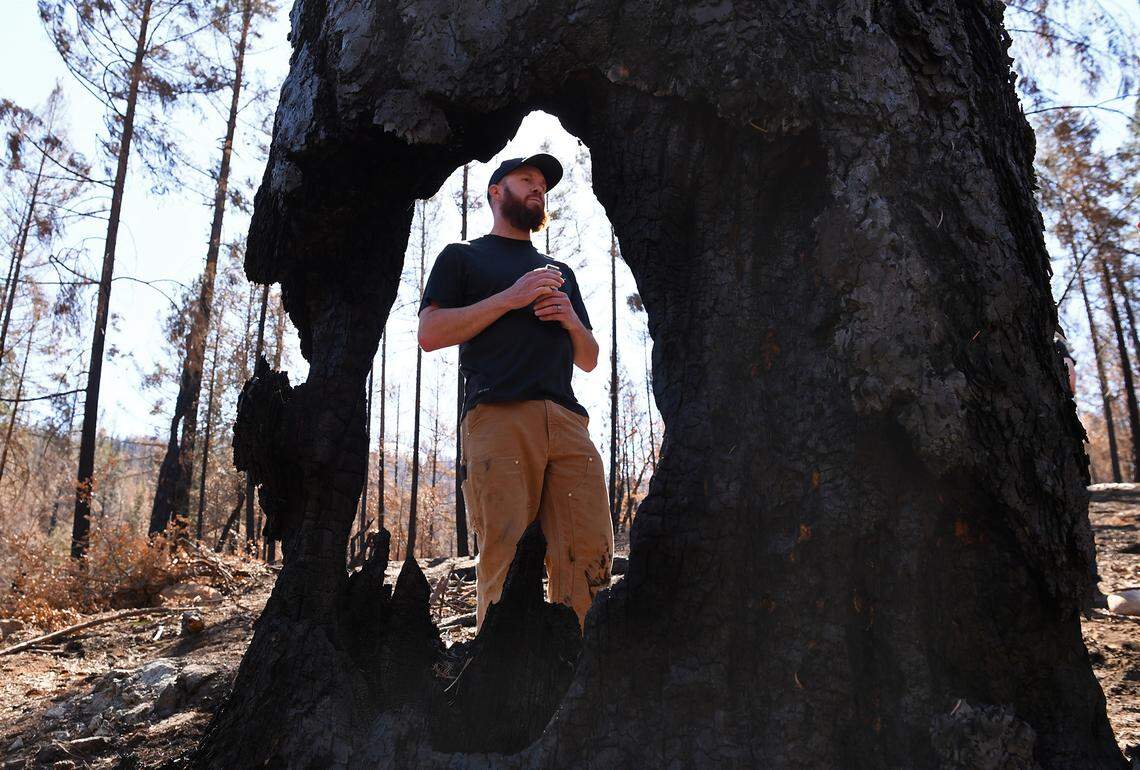
During their visit, Gillette, Kearns and Cornelsen carried shovels and rakes. They dug into the suspected pot garden and removed some roots they intend to send to a lab for testing.
“That’s what this is about,” Gillette said. “Trying to collect enough evidence to get somebody to talk.”
Every garden needs a water source. About 50 yards down a steep hillside from the mysterious overturned area is a small, unnamed stream (it may be a thread of nearby Balsam Creek) that locals say flows year round.
The hillside between the suspected garden and creek — so steep and loose you can barely walk — is marked with strands of fluorescent yellow-green surveyor’s tape tied to tree branches. The tape seems to mark a trail that someone deliberately cut. Multiple branches blocking the route have been sawed off and dragged out of sight.
Could the path have been created by a pot grower and later marked as evidence by the person or persons who discovered it? Seems like a plausible scenario.
Was the yellow-green tape hung before or after the fire? My guess is before. (There are field markings of several different colors around the origin zone. I’ll save that topic for a subsequent column.)
There are no visible signs of an irrigation system. However, it isn’t hard to imagine a generator-powered pump sitting beside the stream, drawing water from a pool and piping it up the hill to where it could be gravity fed to the garden.
Did pot growers return to canyon?
Hang on a second. Didn’t the Fresno County Sheriff’s Office recently shoot down the pot garden rumor? Not exactly.
Sheriff’s spokesman Tony Botti said the county’s narcotics unit has not been involved in any recent enforcement in the Big Creek area. Meanwhile, Frances Devins, Public Records Act Unit commander, said there have not been “any specific arrests related to the Creek Fire.”
Furthermore, none of the 10 illegal operations busted in Fresno County last year by the state’s multi-agency Campaign Against Marijuana Planting program were located nearby, according to a Bee public records request. (Blue Canyon was the closest.)
All of that might be true — I have no reason to suspect otherwise. Still, that doesn’t rule out the existence of a pot garden that law enforcement didn’t know about. Or an old one busted years ago that sprang back to life.
A Camp Sierra cabin owner told me a story about hiking into Big Creek Canyon “about 8-10 years ago” and coming across PVC pipe drawing water from the creek plus several milk jugs with hoses attached.
“We got out of there really fast,” she said. “Just because it was obvious something wasn’t right.”
Around the same time, the woman’s adult son “ran into” a suspicious-looking person in the canyon while playing paintball with friends.
About five years ago, Messer said a forester acquaintance discovered a pot garden while fishing in Big Creek and reported it to the authorities.
Those timelines correspond to what we found a couple hundred yards downhill from the potential grow site: old pots, pans, cups and used food cans stashed beneath boulders near flat spots suitable for camping. None of it looked recent.
Voices in the middle of the night
The question remains: Was there an active pot garden during the months prior to the fire? While I can’t say for certain, the Camp Sierra cabin owner has an interesting story to tell. (I agreed not to disclose her identity.)
At 2 a.m. last July, the woman awoke to the sound of male voices. Alone in the cabin besides her two German shepherds, which started barking, she grabbed a flashlight and shined it through large windows in the room that looked out onto Big Creek Canyon.
“I can’t see them, but I can clearly hear two or three men having a discussion,” she said. “The sound coming up from the canyon is like an echo chamber.”
The woman calmed her dogs and sat listening in the dark. (“It went on for an hour, an hour and a half.”) While she couldn’t make out any words, the voices were definitely coming from a direction where no one should’ve been out hiking in the middle of the night.
The following evening, she heard the voices a second time.
Last October, I surmised a pot garden being the cause of the Creek Fire was “unlikely” due to the fact that all roads in the vicinity are gated or well traveled by Southern California Edison personnel.
But now, with a better understanding, I believe otherwise. The Camp Sierra cabin owner who heard the voices was interviewed multiple times by Forest Service investigators. Pot growers have used the area previously, she told them, and could have returned last summer and gone about their business undetected since the small, rustic development 5 miles from Shaver Lake was practically empty due to the COVID-19 pandemic.
“If they knew there was nobody in Camp Sierra and water was plentiful, why not go back to what they know?” she asked. “It makes perfect sense.”
Even if definitive proof is produced showing an illegal marijuana garden at or near the Creek Fire origin zone, that still leaves room for questions.
Was the fire started by one of the people assigned to tend to the garden? If so, they must have fled the area without being detected or detained.
Or was it started, presumably by accident, by Forest Service personnel who discovered the grow site while marking the area for a timber stewardship associated with the Musick Fuels Reduction and Forest Restoration Program? (Again, a topic for a subsequent column.)
‘They know what started’ Creek Fire
The hundreds of Fresno County residents who lost their homes and possessions to the 380,000-acre blaze deserve more than the blank stare Forest Service officials are currently giving them.
“They know what started it,” said Messer, whose 1,000-acre property in Jose Basin was consumed by the fire. “Why don’t they come out with it?”
“If the pot garden rumors aren’t true, they should be able to explain what happened,” Gillette added.
The fire’s cause isn’t the only mystery. For example, the Creek Fire InciWeb page lists “coordinates” (37.201 latitude, -119.272 longitude) that correspond to a location on the north side of Big Creek Canyon — even though photos and video taken from the Big Creek Fire Station in the blaze’s initial hours show it ignited on the south side.
(These photos were used to further corroborate the origin point by Young, who carried a laser pointer into the canyon, stood near the suspected pot garden and pointed the beam at a friend standing at the fire station helipad.)
Why would the Forest Service want the general public to think the Creek Fire started in a different location from where it actually did? To keep people from poking around?
Just two more questions for the pile.
“They’re concealing something,” Messer said. “I just don’t know what it is.”
This story was originally published February 28, 2021 at 5:00 AM with the headline "Did an illegal pot grow spark Sierra’s Creek Fire? Residents went looking for clues."