
Stay or go? Some ignore evacuation orders — and die in California’s worsening wildfires
James “Mac” Benton frantically tried to start his Chevy Tahoe as embers from the McKinney Fire burned his skin.
Choking on the smoke in Siskiyou County’s rural community of Klamath River, Benton ended up running to a motor home and driving away from the fire with a woman named Sherri Marchetti-Perreault and another man who lived on the property with them.
But Marchetti’s uncle, John Cogan, wasn’t going anywhere that deadly evening of July 29.
“He had been through this before, and he was gonna stay and fight the fire or whatever,” Benton recalled. “He was very stubborn.”
Afterward, Benton feared that Cogan was among the four people who perished in the McKinney Fire. Each of the victims’ bodies was discovered in the rugged Klamath River canyon west of Interstate 5, in an area that was ordered evacuated.
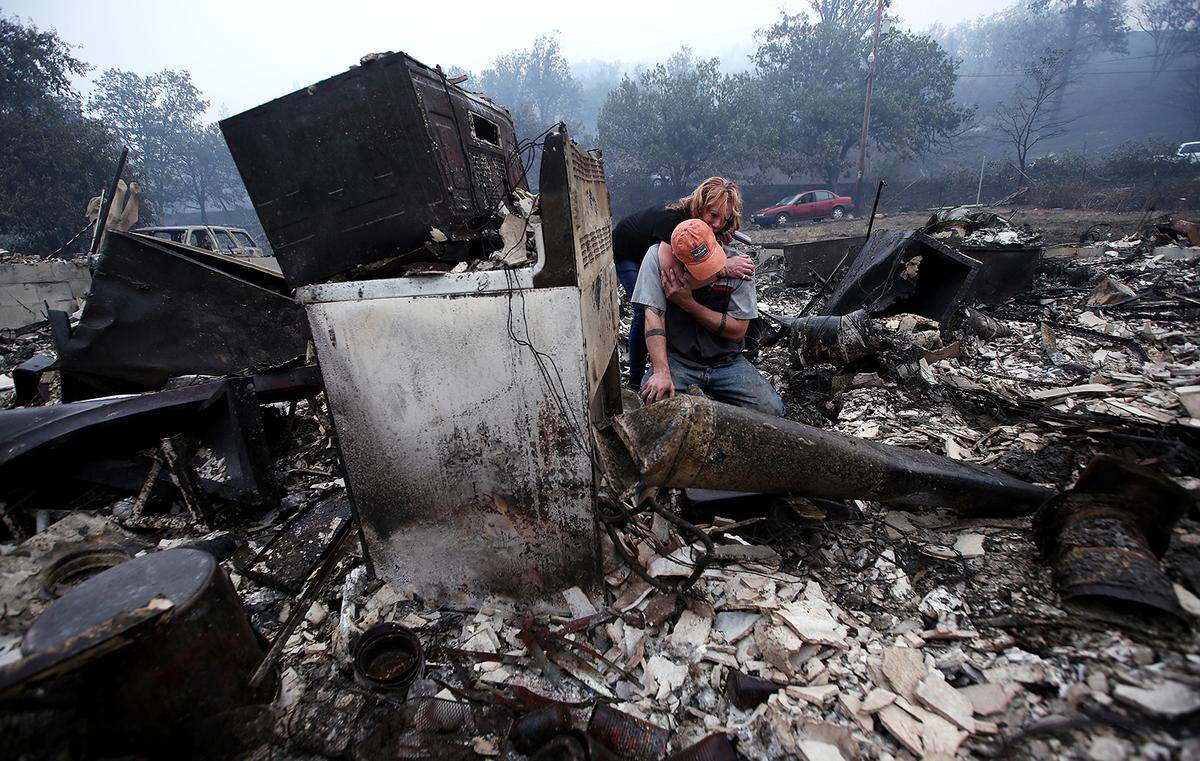
Wildfire season has arrived and by the time it’s over, thousands of Californians in wildfire-prone areas will have faced a difficult choice: Stay or go? Leave when the evacuation order is sounded? Or do what Cogan apparently did and stick it out?
The vast majority will heed the evacuation orders, even if it means a lengthy stay at a motel or Red Cross shelter, or on a relative’s couch.
But every fire season, a hardy few will disregard the orders, perhaps figuring they’ve lived through false alarms and close calls in California’s fire country before. Others will believe they can make a stand and save their home.
Those who make that decision are a monumental source of frustration to fire officials. Inevitably, they say, some holdouts will die.
“We’ve had people who’ve chosen to stay, and as a result they’ve lost their lives,” said Tom Bosenko, the retired sheriff of Shasta County, home to several lethal wildfires over the past few years.
Those who stay behind don’t just endanger themselves, said Darryl Laws, operations chief at Cal Fire’s Siskiyou unit.
“When people don’t evacuate … and they call 911, that takes a firefighter or takes an engine out of service to go make that rescue to try to get those folks out of the way,” he said last week at a town hall briefing for McKinney Fire evacuees. “And they can’t fight fire.”
Experts say the decision to stay is becoming riskier as California gets hotter and drier. Climate change and the consequences of decades of forest mismanagement are creating a new era of disastrous mega-fires. Long-time residents who don’t evacuate are likely to be facing a wildfire that’s far more ferocious and unpredictable than anything anyone’s seen before.
Yet for those who choose to stay on their own land, there’s no one who can make them leave.
While it’s a misdemeanor to willfully disobey an evacuation order, California law doesn’t authorize law enforcement officers, firefighters or others to force people to leave their homes or properties. However, if they do leave the evacuation zone, they can be prevented from returning.
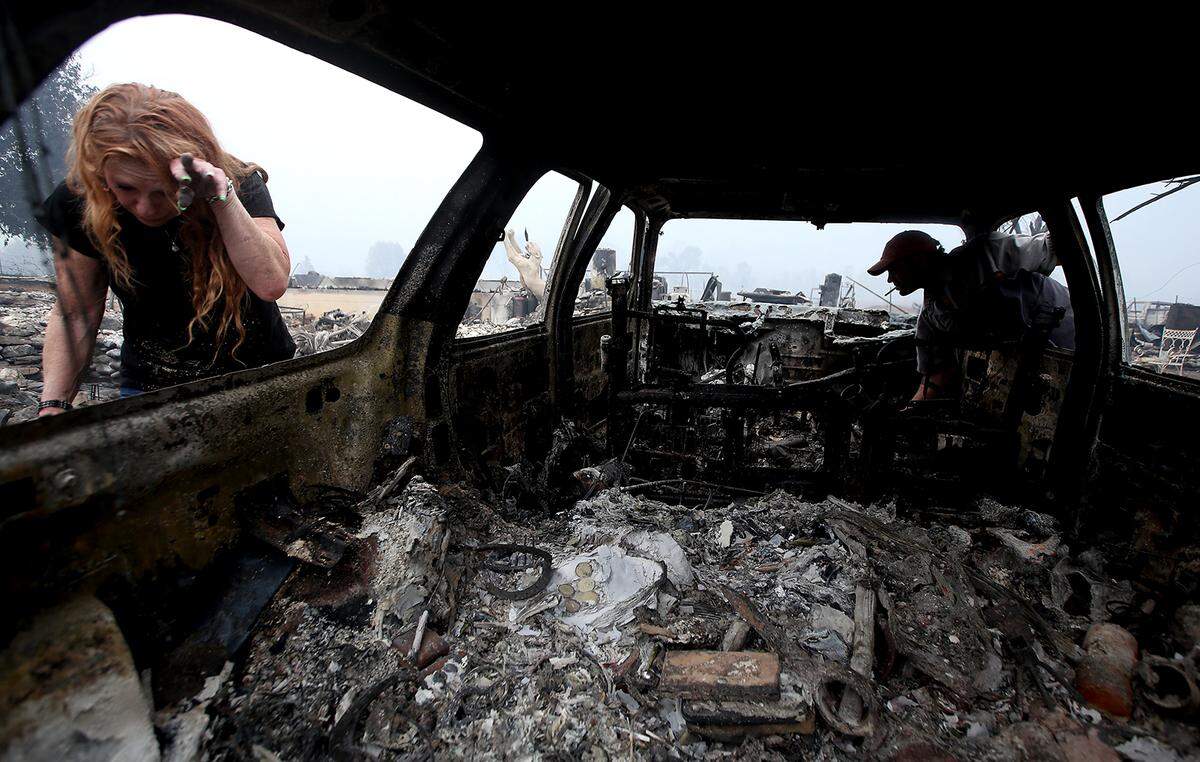
“You cannot charge people for staying in their homes … or physically remove them,” said Brian Ferguson, a spokesman for the California Office of Emergency Services.
Ferguson said officers typically only arrest someone if they stray from their properties and they “get in the way, or do things they ought not to be doing,” such as looting, Ferguson said.
“They have the authority to take someone into custody,’ he said, “if they present a risk.” As a practical matter, arrests are rare unless someone is caught looting or if someone who isn’t on their property becomes belligerent and refuses to leave.
As the evacuation order is disseminated — by social media, CodeRed alerts or automated phone calls and text messages — officers will usually tour the evacuation zone, knock on residents’ doors and use the power of persuasion to try to empty the area.
“We don’t forcibly remove anybody,” said Cal Fire Capt. Chris Bruno, a spokesman for the agency. “We’re not authorized to remove folks from their home.”
Why ‘rugged individuals’ ignore evacuation orders
Rachel Bagwell and her husband, Dom Glass, stayed in their home in the Horse Creek area of Siskiyou County through two previous fires. Both burned within 200 yards of their home.
So while their pickup was packed just in case, they decided to stick around during the McKinney Fire — which was about a mile northeast of their property Wednesday afternoon.
Bagwell said she and her husband believe it’s their responsibility to protect their homestead.
“It’s up to me if my house is going to be standing,” she said.
They diligently trim their yard’s vegetation to reduce fire danger, and have hoses and a swimming pool. They also have friends nearby who can help.
“We have plenty of shovels,” she said. “And determination.”
The experience from the earlier fires has fortified their belief that sticking it out is the right call.
“I am familiar with fire behavior at this point,” Bagwell said. “I have a better idea of what I’m dealing with.”
That’s exactly what fire experts don’t want to hear.
“There are some people — we call them rugged individuals — who have lived in wildland areas,” said Bob Roper of the Western Fire Chiefs Association. “But in today’s conditions, we’re seeing fire tornadoes, erratic fire behavior.”
In other words, Roper believes rural Californians are endangering themselves if they think their earlier experience with wildfire prepares them for what lies ahead in this era of climate change. At the same time, a century of logging and fire suppression has created unnaturally dense stands of small trees and brush in many of California’s forests that butt up against rural towns — perfect conditions for mega-infernos that dwarf the fires of previous generations.
“You get a false sense of security sometimes,” said Janet Jones, the chief of the Klamath River Volunteer Fire Co. “We’re a rural community, and people are used to sheltering in place.”
.JPG "WesternWildfires (10).JPG")
The stay-or-go question was put to the test again Thursday: The Siskiyou sheriff ordered evacuations for an area threatened by two small fires, the Alex and Yeti, that were burning near the community of Happy Camp. How many residents were told to leave was unclear.
In the hours after the McKinney Fire erupted, roughly 5,000 people were ordered to evacuate, about half of them from Yreka, the county seat that straddles I-5.
The western edge of the city, about five miles from the fire’s perimeter, was eerily quiet last week during the evacuation. Law enforcement and firefighter’s vehicles patrolled neighborhoods looking for looters. Deer grazed on front lawns.
Some of the evacuees didn’t leave or decided to return to their neighborhoods, even though the orders hadn’t been lifted.
Donna Meyer, 55, was one. She and her husband, Eric, 73, had originally gone to a family member’s house in Yreka that wasn’t in the evacuated area, but it was too crowded. All the hotels were full, so they chose to return home to sleep in their own bed.
Eric Meyer spent a sleepless night Monday, listening for sirens and watching for flames along the ridgetop on the city’s western edge, his wife said. They had their car and pick-up in their driveway loaded up and facing toward the street, ready to flee the second they saw orange flames on the ridge.
“We’re just keeping a good eye on it, because we’re not going to be stupid and think we’re going to ride it out,” she said. “I’m not going to sit out there with a hose and try to, you know, keep (the fire) off the house.”
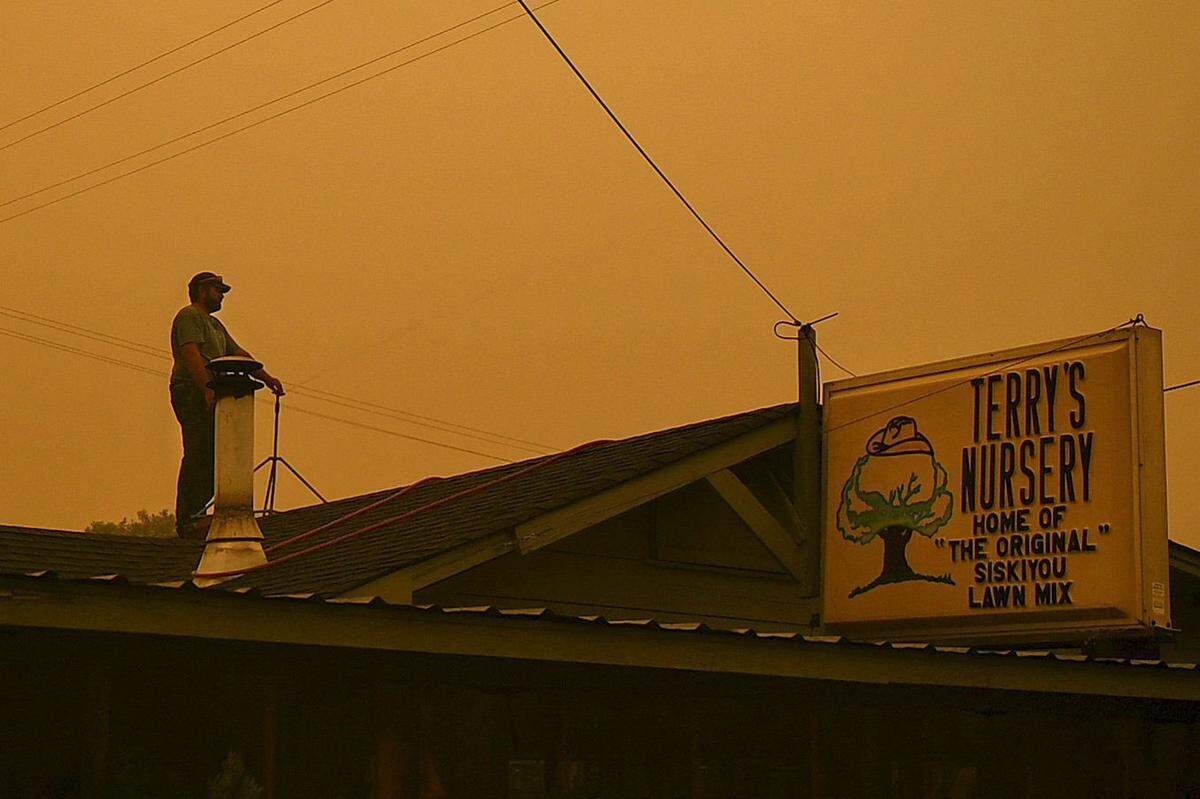
Deadly consequences when fire orders ignored
The Dixie Fire had just blown through Greenville, destroying hundreds of homes and much of the Plumas County community’s Gold Rush-era downtown, and firefighters were more than a little frustrated with the residents.
In a video briefing posted on Facebook the morning after the Aug. 4, 2021 disaster, Jake Cagle, operations section chief for the interagency incident management team, said Greenville residents had been slow to evacuate. That forced firefighters to spend precious time helping people flee instead of protecting their homes from the inferno.
“I’m not trying to blame the people,” he said. “I understand the people want to stay there, and we can’t force people to get out of their property, but … when our resources come in and they have to load people into their fire vehicles and put them into a safe spot, that takes us away from fighting the fire.”
Luckily, no one was killed in Greenville, but 11 months earlier, fierce winds turned a fire that had been burning quietly for weeks into a deadly monster.
Fueled by 40 mph winds, the West Zone of the North Complex fire killed 15 people in just a few hours in the Butte County community of Berry Creek.
It was clear, from sheriff’s dispatch logs and Sacramento Bee interviews, that some residents didn’t leave for a good nine or 10 hours after the evacuation was ordered — even though deputies went through the area, sounding sirens, shouting warnings through bullhorns and knocking on doors.
Still, Butte County Sheriff Kory Honea said afterward that some residents might not have gotten the evacuation order. Berry Creek is a remote community, north of Lake Oroville, with spotty cell service, long driveways and homes that are often tucked behind locked gates.
“There is no way to guarantee 100% saturation of your message,” he said.
Emergency alert failures have been a substantial problem in other California mega-fires.
During the Camp Fire in 2018, dozens of people complained they never got automated phone calls, texts or other alerts as Paradise began burning and communications networks became overloaded. The Camp Fire, the deadliest wildfire on record in California, killed 85 people and burned more than 12,000 homes.
Brandon Hill grew up in Concow, northeast of Paradise, and wasn’t particularly rattled at first when he heard another fire had ignited that morning of Nov. 8, 2018.
Before long, he realized the Camp Fire was different.
After sending his wife and children away, he spent a half hour trying to save his house before giving up. By that point, the roads were beginning to clog — with traffic and downed trees — and he drove about a mile to his mother’s house because “it was the only safe place I really had to go.” Along the way, he picked up two neighbors and an elderly woman who’d crashed her car.
He spent hours at his mother’s home that day, working with neighbors to hose down the property and his grandmother’s nearby home as well. They borrowed a tractor to carve out a buffer to keep the properties safe from fire. The effort paid off, and his mom and grandmothers’ homes were spared.
The next morning, he grabbed a chainsaw and started clearing roads of debris. He rescued a woman sitting in a parked car, surrounded by fallen debris, her hands frozen with fear to the steering wheel. Soon after, he was confronted by a sheriff’s deputy who threatened to arrest him, but then let him go.
Would Hill do it again? Maybe. Maybe not.
“If you know you’re going to be safe, I say take a shot if you think you can save your house,” he said last week.
Then he paused and added: “Honestly, in hindsight, get out. You can’t fight these fires anymore … Just get out of the way. These fires aren’t the same anymore.”
Shortly after the fire, with their house gone, Hill and his family moved to the wetter climate of the southern Oregon coast.
Wildfires kick up unexpectedly, McKinney Fire shows
The community of Klamath River is a strip of homes and trailer parks straddling the river of the same name, about 20 miles northwest of Yreka. About 190 people live there, at the base of a rugged canyon. The main thoroughfare is Highway 96, a meandering roadway that follows the river.
And now it’s mostly gone. Practically every building burned. Cars and pickups have been turned into scorched skeletons of metal. The reflective lettering on some of the street signs blistered in the heat. The Klamath River community center was completely gone. On Tuesday, an American flag hung from a pole out front. It wasn’t clear whether it survived the fire or had been erected as a symbol of resiliency.
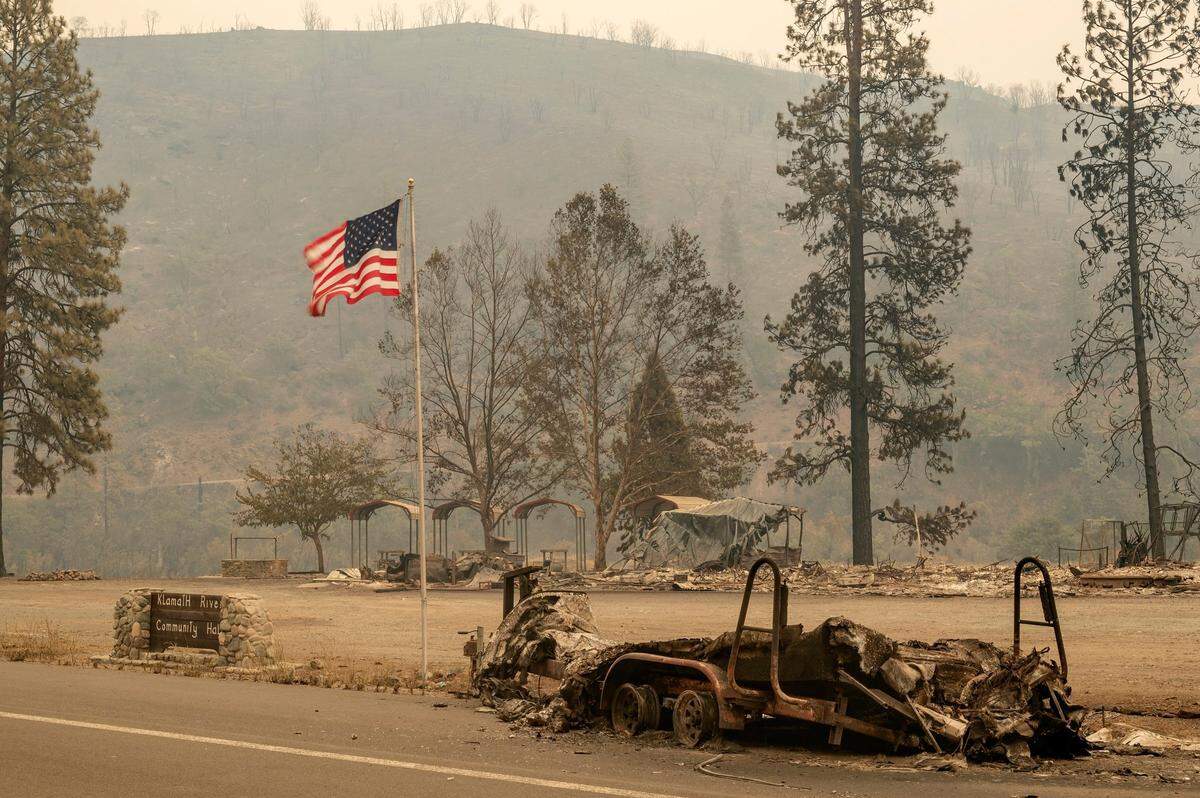
The general store, Quigley’s, was still standing. So was a roadside U.S. Forest Service sign featuring Smokey the Bear, his cartoon feet standing on a charred hillside.
Officials said the McKinney Fire didn’t appear overly threatening — at first.
Laws, the operations chief at Cal Fire’s Siskiyou unit, said the fire looked as if it could be held to a few hundred acres.
“We felt we had enough resources; we emptied all the stations. Forest Service, Cal Fire sent everything we had,” he said.
Then the weather changed. “A thunder cell came over the top of it and our dreams were shattered. It went to 18,000 acres immediately.” Strong winds from the thunderstorm blew the fire directly into the community of Klamath River, he said.
About two hours after the fire was reported, the Siskiyou Sheriff’s Office issued its first evacuation order at 4:35 p.m., according to a Facebook post, covering an area south of the river. Further evacuation warnings came about three hours later. A little after 10 p.m., after reporting the fire had jumped the highway, the sheriff dramatically expanded the evacuation zone, covering a broad area west of Yreka.
Courtney Kreider, a spokeswoman for the sheriff, said “there are several people who chose to stay” in spite of the evacuation order. She said investigators hadn’t yet determined whether the four people who died had ignored the evacuation orders.
She said deputies and other officers knocked on the doors of about 500 homes July 29 and 30, trying to get people to leave.
But there was little they could do to those who chose to stick it out.
“We cannot physically remove anyone from an evacuation zone,” she said. “Our policy is to strongly advise them (to flee).”
Local officers did arrest two people on looting-related charges Monday.
Rammed gate, stuck SUV reveal final moments
Sheriff’s officials announced the discovery of the first two victims Monday morning.
An SUV with two bodies inside was found at the end of a driveway off Doggett Creek Road in Klamath River, the vehicle tilted almost on its side after it careened off the driveway. It was surrounded by charred trees.
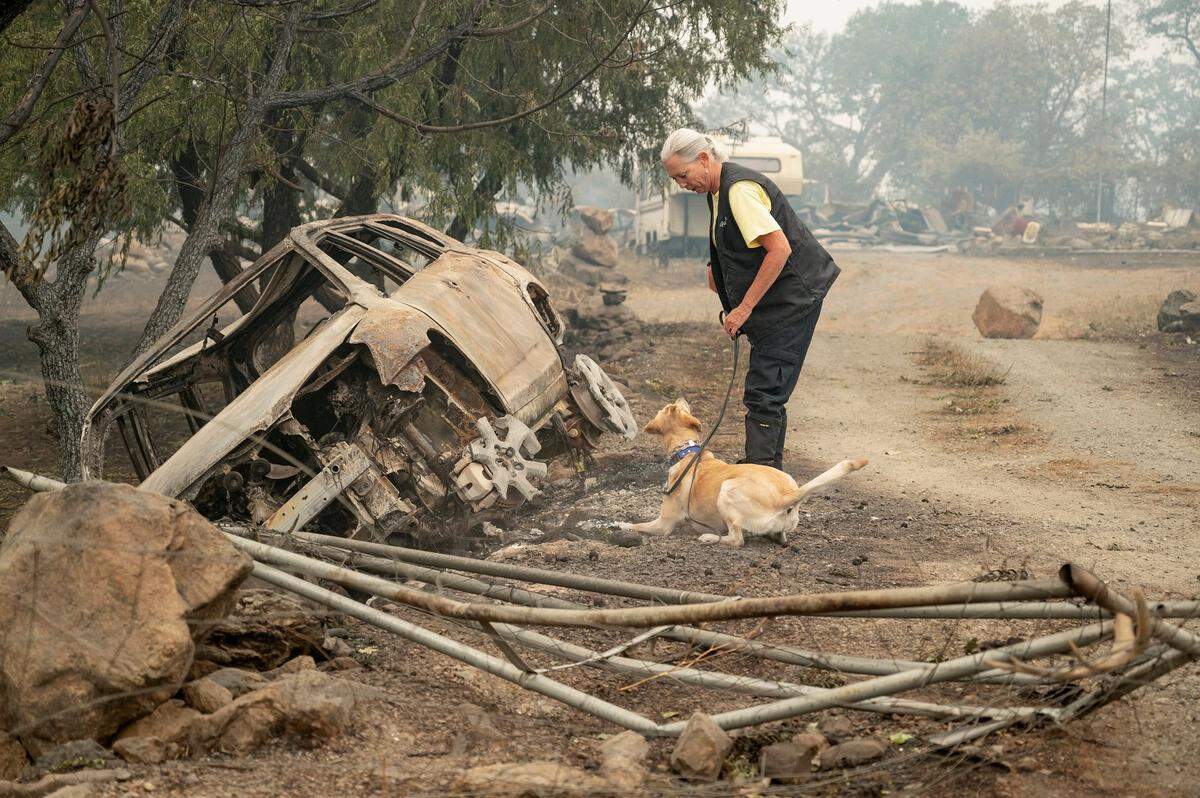
Everything but the metal had melted off the SUV in the searing heat. A few feet away was a badly dented gate at the end of the driveway, torn off its hinges
Investigators believe the people inside the SUV had tried to drive through the gate with the fire bearing down on them on all sides.
“They didn’t have time to get out and unlock the gate, and tried to ram the gate,” sheriff’s Sgt. Jeff Moser told The Bee on Monday. “The gate did not open. They backed up and drove off the driveway, getting stuck.”
Less than a mile away was the property where Cogan told Benton he was going to stay as Benton and others on the property were frantically gathering up pets and belongings.
Later, Benton would make headlines after he was reunited on Sunday with Patches, one of his missing dogs. He and Marchetti-Perreault also became the part of a public scolding from the Sheriff’s Office after they accompanied a TV news crew into the closed zone and made it to Cogan’s house. State law gives reporters authorization to enter closed disaster areas. The sheriff chided the journalists for bringing the pair into the closed area.
Benton told The Bee it was still daylight when sheriff’s deputies arrived at the property July 29, the day the fire started, and warned everyone to be ready to evacuate. He and the three others who live on Cogan’s property spent the next few hours stuffing their belongings into vehicles and trying to round up all their dogs and cats.
As everyone else was getting ready, Cogan, 77, made his intentions perfectly clear.
“Right before everything just got out of control,” Benton said, “I was talking to him on the back deck, and he said, ‘I saw the same thing 20 years ago.’ He said, ‘I’m not going anywhere.’ ”
Before deputies ordered Benton to leave Cogan’s property on Monday, Benton believes he saw Cogan’s skeleton, curled in the fetal position, near where his fireplace would have been inside the charred rubble of the home.
Officials haven’t identified any of the four victims in the McKinney Fire, but they confirmed a body was found at the site. Definitive identification of wildfire victims can sometimes take weeks or months because the corpses are so badly burned.
.JPG "APTOPIXWesternWildfires (4).JPG")
Benton apologized Wednesday for going back inside the evacuated area with the TV news crew. He said he was just desperate and trying to find out what happened to his missing friend and to his animals. Benton said he found the remains of another one of his dogs, but two others remain missing.
Benton said he takes comfort in the fact that Cogan, who’d lived in Klamath River for decades, died in the place he cherished.
“John’s wish was to remain in that home until he passed away,” Benton said. “That’s all he wanted. That’s his home, and he was with his community and the people that he loved and in the place that he loved most in the world. And I don’t think he would have had it any other way.”
This story was originally published August 7, 2022 at 5:00 AM.