
Red alert sounding on California drought, as Valley gets grim news about water supply
A government agency that controls much of California’s water supply released its initial allocation for 2021, and the numbers reinforced fears that the state is falling into another drought.
The U.S. Bureau of Reclamation said Tuesday that most of the water agencies that rely on the Central Valley Project will get just 5% of their contract supply, a dismally low number. Although the figure could grow if California gets more rain and snow, the allocation comes amid fresh weather forecasts suggesting the dry winter is continuing.
The National Weather Service says the Sacramento Valley will be warm and windy the next few days, with no rain in the forecast.
“We’re pretty well dry for at least another week,” said Jan Null of the private forecasting firm Golden Gate Weather Services. “There’s nothing in the short term.”
The federal Central Valley Project, a network of dams and canals dating to the New Deal, largely serves farm-irrigation districts in the Sacramento and San Joaquin valleys. But its customers also include much of Silicon Valley, and the CVP’s allocations serve as an unofficial sign of how much precipitation California is receiving during the crucial winter months.
The State Water Project, which runs parallel to the federal system and serves a mix of urban and agricultural agencies, announced an initial allocation of 10% in December. Taken together, the initial allocations show the depths of California’s water deficit as the clock ticks; typically the rainy season ends around April 1.
“Although we had a couple of precipitation-packed storms in January and early February, we are still well below normal for precipitation and snowfall this year,” said Ernest Conant, the regional director at the Bureau of Reclamation, in a prepared statement.
Farm groups that purchase water from the Central Valley Project complained mightily about the announcement, arguing that the miserly allocation isn’t simply about unfortunate weather patterns. Rather, they said the CVP is also being hemmed in by stringent environmental regulations governing the Sacramento-San Joaquin Delta, the estuary that serves as the hub of the state’s elaborate delivery network. A small allocation could prove especially difficult for the San Joaquin Valley, where agriculture dominates an economy that’s already struggling.
“Today’s announcement is no surprise given current hydrologic conditions and regulations that restrict operations of the Central Valley Project, but it is devastating nonetheless for farmers and communities across the region that rely on water from the CVP and jobs created by irrigated agriculture,” said Tom Birmingham, general manager of Westlands Water District, which delivers water to farmers on the west side of the San Joaquin Valley.
In a prepared statement, Birmingham said Westlands has received its full allocation just once in the past decade. Twice, during the last officially declared drought, Westlands got no CVP water at all. That drought was declared over in spring 2017 by then-Gov. Jerry Brown.
Snowpack and reservoir levels are low
While farmers bemoan environmental regulations, hydrological data also show the water shortages are genuine. The Sierra Nevada snowpack is 35% below normal for this time of year. Water levels at Lake Oroville are just 55% of average; Folsom Lake is just 63% of average.
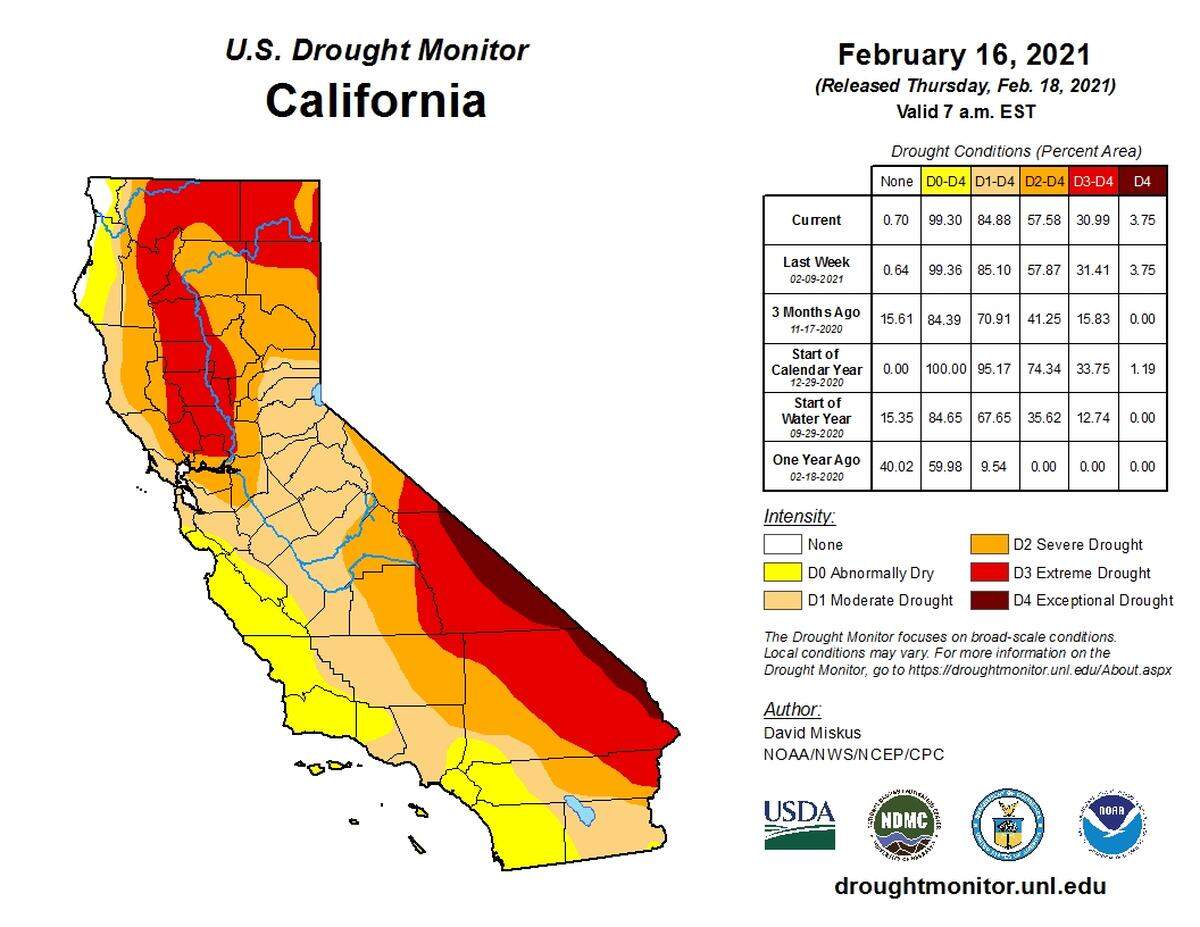
The U.S. Drought Monitor, a blend of metrics compiled weekly by the federal government, says 99 percent of California is at least “abnormally dry” and 30 percent is in “extreme” or “exceptional” drought conditions.
The worst areas are in the state’s northeastern corner, the western Sacramento Valley and its foothills and in the southern half of the Sierra.
The northern part of the state is at its 10th driest level since record-keeping began in the 1920s, state officials say.
Sacramento has received barely an inch of rain this month; a normal February is nearly 3.7 inches. Null said San Francisco is having the seventh-driest year since the Gold Rush.
The forecaster said a high-pressure ridge is blocking winter storms from reaching California.
“Sometimes these things got locked into a more stationary pattern, and that’s what we’ve been seeing this winter,” the forecaster said. “That’s why it’s staying dry here.” The same stationary pattern is keeping temperatures cold in most of the central part of the country, he said.
State officials say California’s water supply hasn’t yet reached the remarkably dry levels of 2014 and 2015, which prompted Brown to declare a drought emergency that had Californians putting buckets in their shower and letting their lawns turn brown. Brown declared an end to the drought in spring 2017.
Four years later, tough times have returned. Two dry winters in a row means some water users are starting to ration their supplies, said Michael Anderson, state climatologist at the Department of Water Resources.
“From a climate perspective, it’s year No. 2 of a dry year,” Anderson said. “And, historically, that’s when we start to see some impacts come into play.“
This story was originally published February 23, 2021 at 2:20 PM.