
California’s lucrative almond orchards face a reckoning with drought, climate change
First came the asparagus field. Then came the melons. And now Joe Del Bosque is considering the unthinkable: tearing out a sprawling almond orchard bursting with healthy, nut-producing trees.
“It’s a tough decision to pull out these orchards,” said Del Bosque, who farms on the west side of the San Joaquin Valley. “But what do you do? We’re thinking of ways to survive.”
Two decades of almost unrelenting growth vaulted almonds into the upper ranks of California agriculture. Now, though, the state’s $6 billion-a-year industry is being humbled by a devastating drought. Farmers have slowed the pace of new orchard plantings and, in a few cases, have plowed up trees still capable of bearing almonds.
“That boom may be over for now,” said Del Bosque, who’s thinking of destroying 150 acres of almond trees this fall. “The price of almonds is low; the price of water is high.”
To some critics in the environmental community, the end of the almond boom would represent a long-overdue reckoning for years of relentless planting.
Almonds are among the thirstiest of the 400-plus commodities grown in California. They’re expensive investments: Planting an acre of almond trees can cost $8,500, compared to $4,500 for an acre of tomatoes. And unlike that tomato field, almond trees must be watered and can’t be left fallow for a year because of water problems.
That means farmers are extremely reluctant to let trees go without water — and it makes California’s adjustment to the drought harder. The problem is likely to worsen as climate change intensifies and the state’s groundwater law, designed to gradually curtail the amount of pumping from aquifers, takes hold.
“The investment in permanent crops has hardened the demand for water and made it more difficult to cut back in dry years,” said Peter Gleick, president emeritus of the Pacific Institute, a water policy think tank based in Oakland. “Any farmer ripping out permanent crops now made a risky investment.”
Some farmers, though, say they’re being made the scapegoat for a drought that’s the result of poor policy decisions by the state — including environmental policies that let much of California’s water flow to the ocean instead of capturing it for agriculture. The state hasn’t built a major reservoir in more than 40 years, and its water management system must balance water use with protecting Chinook salmon and other endangered fish species.
“It’s not that we have a lack of rainfall; we have a mismanagement of our resources,” said Garrett Fowler of Fowler Brothers Farming, a management and consulting company based in eastern Stanislaus County.
Farmers up and down the state are considering abandoning water-heavy crops in favor of ones such as agave for tequila or solar panels. Fowler said one of his clients plans to rip out an almond orchard in Fresno County later this year, in large part because of water shortages.
“We’re feeding a lot of the world,” he said. “If we don’t have water, we can’t grow. If we take away that water, our economies will also be evaporated.”
Most receiving no water
Del Bosque has already seen what water shortages mean for his corner of the San Joaquin Valley. He’s trimmed his workforce by around 100 employees after cutting back his production of asparagus and melons. Leveling one of his almond orchards will worsen the situation.
“You know their faces, you know they have families,” he said of his employees. “That’s what hurts.”
Del Bosque, 72, runs a relatively modest farm operation of about 2,000 acres but is one of the most well-known growers in the Valley. His prominence hasn’t brought him a single extra drop of water, though.
He belongs to the San Luis Water District, which gets its water from the federal government’s Central Valley Project. Normally, he uses upwards of 2,000 acre-feet of water annually.
In this drought year, the federal project’s allocation to most farmers is zero. There’s no groundwater where Del Bosque farms, so he has arranged to buy water from irrigation districts north of the Sacramento-San Joaquin Delta, the estuary that serves as the hub of California’s water-delivery system. The price: $750 per acre-foot. Compare that with the $250 he paid last year for Central Valley Project water.
The trouble is that a few hundred acre-feet of that water is being held up, he’s told, in Lake Shasta, at the northern terminus of the federal system. The federal Bureau of Reclamation is holding as much water as it can in Shasta this summer in a desperate effort to preserve a decent-sized pool of cold water in the giant reservoir. The aim is to prevent much of this year’s juvenile winter-run Chinook salmon from cooking to death in the warm waters of the Sacramento River.
Which leaves a 150-acre orchard at Del Bosque’s farm in limbo. It’s 21 years old and probably has two or three years’ worth of productive life left. The trees have already taken a beating this year — he cut their water supply by about a quarter — and the nuts are smaller than they should be. This fall will be crunch time: If he wants the trees to produce a crop in 2022, they need to be watered this fall, after this year’s harvest.
If the water arrives from Shasta, he’s likely to keep the orchard alive. But Del Bosque is already speaking of the orchard in the past tense, as if it’s highly doubtful the water will get delivered and the trees will survive.
“These things were still producing, could have gone another two or three years,” he said, examining some nuts that had fallen to the ground. “We’ve already taken out our asparagus fields; we’ve cut back on our melons. What’s next? This is probably next.”
How almonds took over the Valley
It’s hard to overstate how much the almond business has grown in California. Plantings have exploded in this century, driven by a strong marketing push, favorable news on health and nutrition, and the growing appetite for specialty products such as almond milk. The seeming insatiable international demand didn’t hurt, either: Almonds, not cheese or California’s fabled wines, are the state’s leading agricultural export, with most of the product going to the European Union, India and China.
Fifteen years ago, almonds took up about 600,000 acres of California farmland. During much of the 2010s, bolstered by an expanding export market and prices that for a while surpassed $4 a pound, new orchards sprouted all over the Central Valley. Less valuable commodities, such as cotton, have faded in recent years from the Valley landscape.
This year, the U.S. Department of Agriculture estimates that almonds occupy 1.3 million acres of California land. That’s more than 14% of all the irrigated farmland in the state. More than 7,600 farmers in California grow almonds.
“When you have high prices, everybody wants to be an almond farmer,” Fowler said. Almonds are the second-largest farm commodity in California, trailing only the dairy industry.
But when the rains halted in 2014, almond farmers became the poster boys of the last drought.
A 2015 story in Mother Jones magazine generated enormous amounts of negative attention. Among the story’s revelations: It took a gallon of water to produce one almond — more than three times what was needed for a grape, for instance.
Gleick said it’s true almonds require lots of water. Analysis by the Pacific Institute in 2015 showed that almonds required 4 to 5 acre-feet of water for every acre grown, making them among the most water-intensive of crops. Tomatoes and rice needed about half as much. An acre-foot is 326,000 gallons.
But almonds also generate, per gallon, lots of revenue.
“By some measures, almonds are very thirsty,” the Pacific Institute expert said. “Water required per acre, they’re right up there. But water required per dollar of revenue produced, they actually look a lot better. And that’s what farmers are looking at, return on the investment of a gallon of water. And by that measure, almonds are better than a lot of crops.”
Almond economics took a hit four years ago, partly because of the drought-busting rains of 2017. Farmers who were receiving nearly $5 a pound saw prices fall to the $3 range in a few months.
Last year, average prices paid to growers fell below $2, said Michael Easterbrook of Stratamarkets, a Texas-based commodity market research firm. Prices were still weak until a few months ago, when they started creeping up as drought fears sparked speculation about a smaller crop. Then, in mid-July, the USDA predicted that this year’s crop would come in at just 2.8 billion pounds, a fairly steep drop from the 3.2 billion pounds forecast three months earlier.
While still the second-largest crop ever, the new forecast reinforced the idea that almonds won’t be as plentiful. Easterbrook said growers can now expect to be paid more than $2.50 a pound, on average.
That’s if they’re willing to sell. Many are holding back supply on the expectation of a bigger payday down the road, he said.
“Sellers recently anticipate that drought conditions are going to continue to drive prices higher.”
A difficult decision
Stuart Woolf isn’t interested in hearing environmentalists complain about almonds. A farmer in Huron, western Fresno County, he believes he’s made responsible, rational decisions about planting crops that “enjoy the highest rate of return per acre-foot of water.” That includes almonds, which take up about 15% of his land.
But he understands the almond business of 2021 isn’t what it was a decade ago.
Woolf, president of Woolf Farming and Processing, spent the early spring wrestling with a difficult decision. About 400 acres of almond trees at the western edge of his ranch were short of water. They were only 15 years old and could normally expect to have several good growing years left. But they had contracted a disease that would hinder production.
“They were already beyond their peak,” he said.
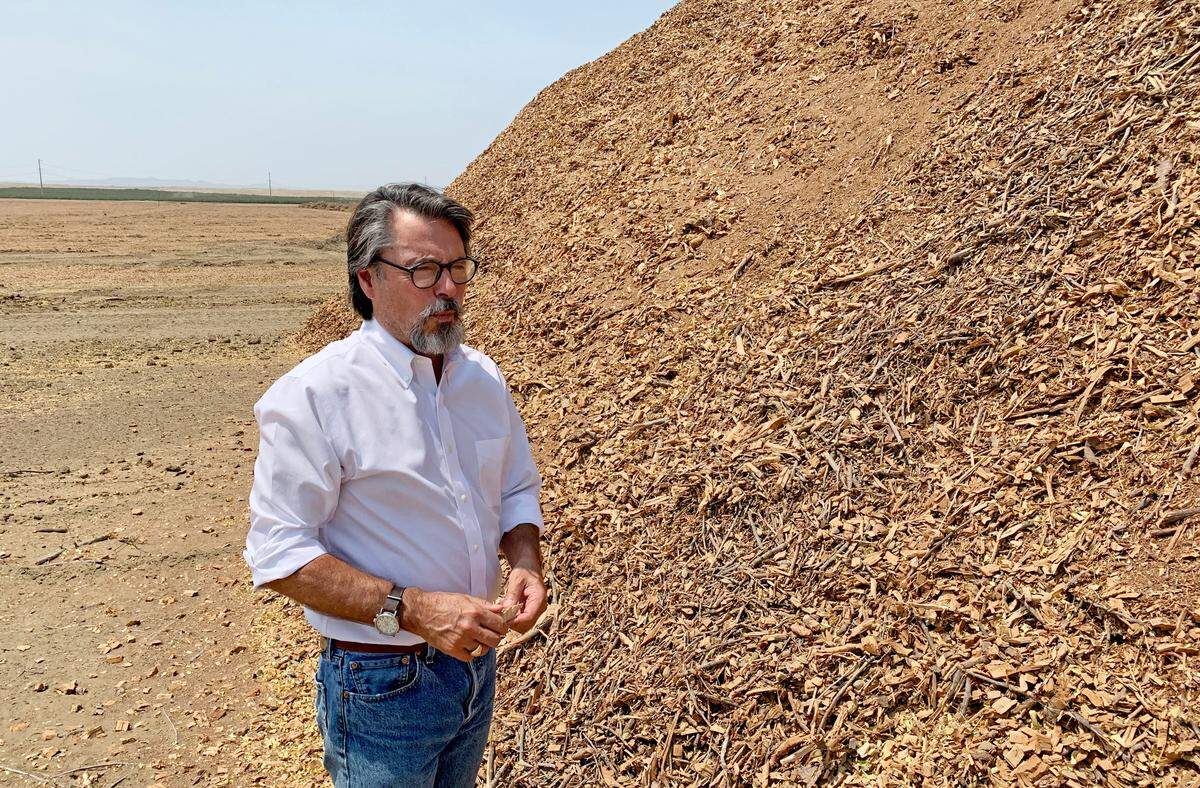
With prices still below $2 a pound, did it make sense to spend as much as $1 million scouring up the water needed to squeeze out another year’s crop?
After considerable debate with his staff, the decision was made to sacrifice the trees. The orchard was destroyed, and the water was used instead on tomatoes, which were fetching a better price at the time.
Since then, almond prices have improved, but Woolf said, “Here’s the deal with farming: You never look back.”
Almond farming is expensive. A new orchard can cost upwards of $11,000 per acre in its first two years — before a single marketable almond can be harvested — according to UC Davis estimates. By the time the orchard reaches full production, usually in the sixth year, the farmer has poured almost $19,000 into each acre, said Daniel Sumner, a UC Davis economist.
Woolf Farming is family-owned but is hardly a mom-and-pop operation. Stuart Woolf does business dressed in jeans and a crisp, white buttoned-down shirt. His operation is large, diversified and vertically integrated, with 20,000 acres of almonds, pistachios, grapes and other commodities at the “home ranch” straddling Interstate 5 in Huron and another 10,000 acres scattered all around the Central Valley. It still has hundreds of acres of almonds.
The company owns two processing plants, one for almonds and one for tomatoes, and has the wherewithal to dabble in experimental crops. It recently planted a two acres of agave, with the idea of selling it to a tequila distiller. There are plans to lease a portion of its land to an investor who will build solar panels.
For all that, though, tearing out the almond trees took an emotional toll.
“You develop a real bond for the land and the crop on it, and then to pull something out prematurely, it’s kind of brutal,” said Woolf, 62. “It’s like losing the family dog.”
Will more orchards go?
Land IQ, a Sacramento farming consultant, has estimated that 47,803 acres of almond trees have been pulled out of the ground so far this year. While that’s just a sliver of the 1.3 million acres of almonds, the tearing up of almond trees isn’t done. By year’s end, “there will be more than that,” said Joel Kimmelshue, the firm’s owner and principal scientist.
What isn’t clear is how many of those trees are being removed because of water shortages or simply due to old age. Fowler, the farm manager from Stanislaus County, said some trees are being replaced with new almond orchards. Some are giving way to pistachios — also a permanent crop that, like almonds, can’t be allowed to remain fallow but is better able to tolerate the salty irrigation water that’s common in some parts of the Valley.
But many of the forsaken almond orchards will be replaced with annual row crops or left to lie fallow for the foreseeable future. Industry leaders acknowledge that California’s difficult water conditions could lead to the shrinkage of almonds’ footprint.
“Farmers are incredibly resilient and have to adapt,” said Richard Waycott, president of the Almond Board of California, the industry’s trade association. For some growers, “the drought could well be the trigger that causes them ... to repurpose land.”
The long-term outlook isn’t great, either. The Sustainable Groundwater Management Act will force growers of all crops to curtail their groundwater pumping over the next 20 years, Waycott said.
But he said the almond industry won’t shrivel up and die. Water shortages notwithstanding, California’s climate is ideal for growing almonds; the state accounts for three-quarters of all the world’s almonds.
“There are very few places where almonds can grow well, and California is one of them,” Waycott said.
Will the California industry grow? UC Davis economist Sumner said it’s unlikely in an era of water scarcity.
“There’s no huge incentive to be expanding almond orchards,” Sumner said.
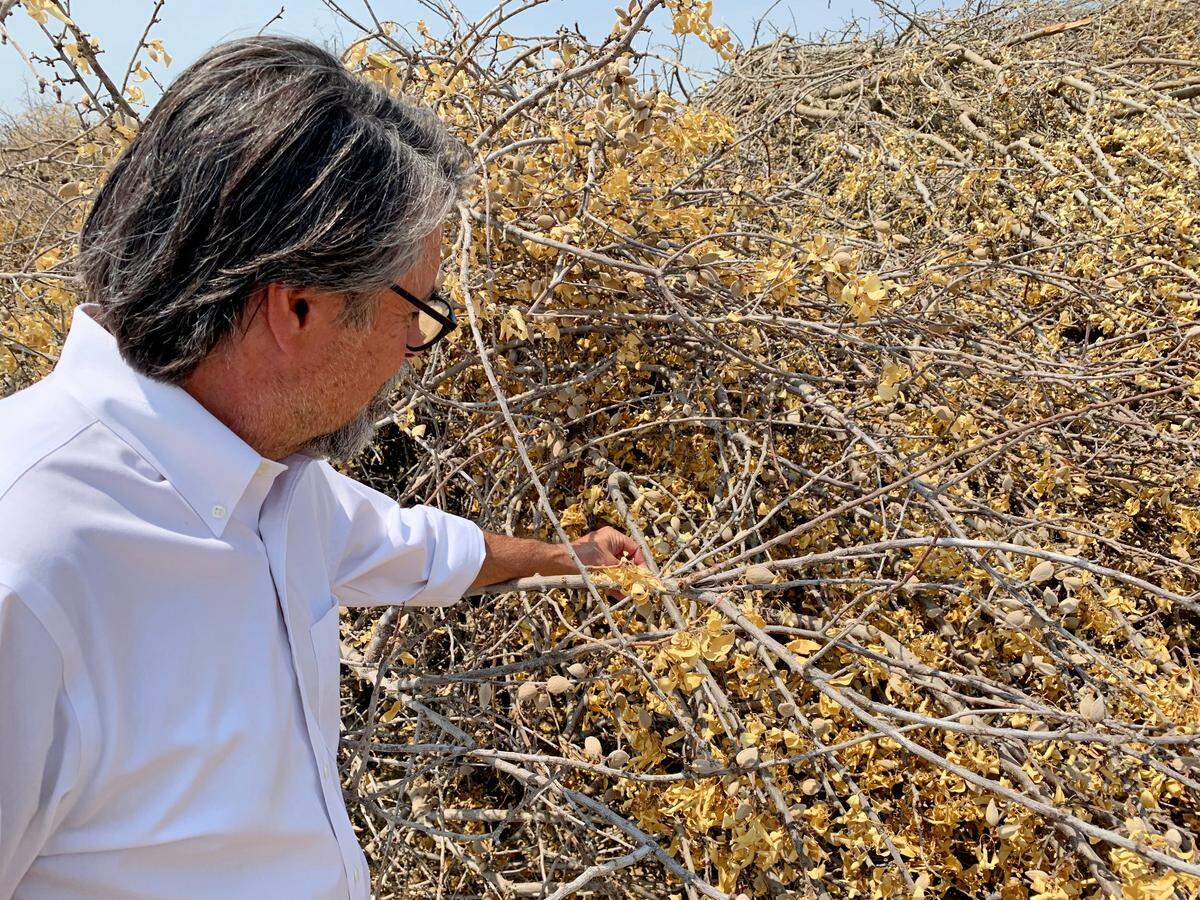
Back in Huron, Woolf’s former almond orchard is a sad sight. Most of the trees have been ground up, leaving enormous piles of wood chips and nuts. A few clumps of trees lie on the ground, uprooted but not yet fed into the wood chipper. At some point, maybe in a year or two, Woolf will likely plant a row crop — not permanent trees — on the land.
Woolf agrees that the California almond industry has probably peaked in terms of the number of acres planted. Ever the entrepreneur, he’s considering launching a tree-removal business.
“There’s going to be a lot of right-sizing,” he said of the almond industry’s future. “There’s going to be trees coming out of production.”
This story was updated Sept. 5 to correct the acreage of Woolf Farming’s agave fields.
This story was originally published September 5, 2021 at 5:00 AM.